
87 – Walking on Water; Matthew 14:24-33, Mark 6:47-52, John 6:16-21
Matthew 14:24 and the boat was already a considerable distance from land, buffeted by the waves because the wind was against it. 25 Shortly before dawn Jesus went out to them, walking on the lake. 26 When the disciples saw him walking on the lake, they were terrified. “It’s a ghost,” they said, and cried out in fear. 27 But Jesus immediately said to them: “Take courage! It is I. Don’t be afraid.” 28 “Lord, if it’s you,” Peter replied, “tell me to come to you on the water.” 29 “Come,” he said. Then Peter got down out of the boat, walked on the water and came toward Jesus. 30 But when he saw the wind, he was afraid and, beginning to sink, cried out, “Lord, save me!” 31 Immediately Jesus reached out his hand and caught him. “You of little faith,” he said, “why did you doubt?” 32 And when they climbed into the boat, the wind died down. 33 Then those who were in the boat worshiped him, saying, “Truly you are the Son of God.”
Mark 6:47 Later that night, the boat was in the middle of the lake, and he was alone on land. 48 He saw the disciples straining at the oars, because the wind was against them. Shortly before dawn he went out to them, walking on the lake. He was about to pass by them, 49 but when they saw him walking on the lake, they thought he was a ghost. They cried out, 50 because they all saw him and were terrified. Immediately he spoke to them and said, “Take courage! It is I. Don’t be afraid.” 51 Then he climbed into the boat with them, and the wind died down. They were completely amazed, 52 for they had not understood about the loaves; their hearts were hardened.
John 6:16 When evening came, his disciples went down to the lake, 17 where they got into a boat and set off across the lake for Capernaum. By now it was dark, and Jesus had not yet joined them. 18 A strong wind was blowing and the waters grew rough. 19 When they had rowed about three or four miles,[a] they saw Jesus approaching the boat, walking on the water; and they were frightened. 20 But he said to them, “It is I; don’t be afraid.” 21 Then they were willing to take him into the boat, and immediately the boat reached the shore where they were heading.
Footnotes
a. John 6:19 Or about 5 or 6 kilometers
Commentary
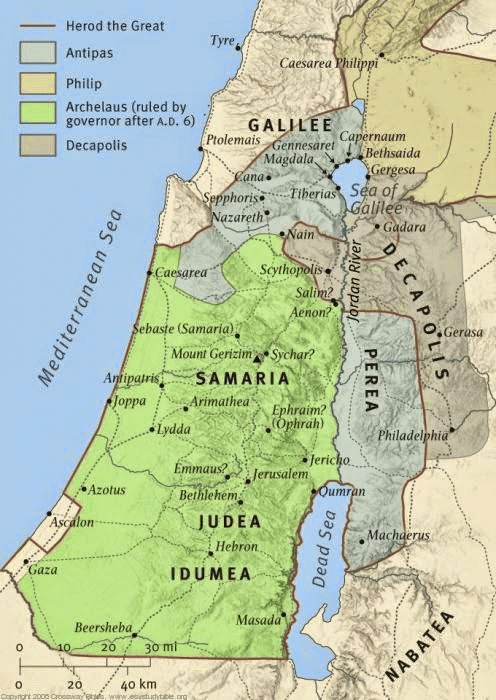
The Sea of Galilee goes by multiple names in the Bible. In the Old Testament, it is known as the Sea of Chinnereth, but it isn’t mentioned very much in the Old Testament, except for being part of the border of the promised land. However, it is heavily featured in the New Testament because it is the epicenter of Jesus’s ministry. It sits about 60 miles north of Jerusalem, and it is 13 miles long and 7.5 miles wide, at its widest point (https://www.gotquestions.org/Sea-of-Galilee.html). It is prone to tempests, such as the one we hear about in this story, and fishermen regularly would have struggled in terror with the wind and waves. It would have been treacherous travel, and falling out of the boat posed enormous risk for all sailors. It is important to understand how alarming and awe-inspiring Jesus’s presence on the top of the water would have seemed to these men.
Not only was it stormy, but when Jesus walked on the Sea of Galilee, it was dark outside. The time recorded in the Bible was the fourth watch (translated as “just before dawn”), which scholars estimate to be 3 am to 6 am, so the event could have occurred at any time within that window. The significance of the time of day is that the disciples had been struggling against the waves almost the entire night in an attempt to travel a relatively short distance up the coast, but the wind had driven them three or four miles off shore into the middle of the lake (apparently, Jesus was still able to see them at this distance). So they hadn’t gotten very far (toward their destination) and must have been exhausted by the effort.
Matthew and Mark both admit to thinking Jesus was a ghost (Mark was of course not there and is probably speaking from Peter’s point of view), and John’s description of their fear corroborates this assumption. “Apparently, the attitude of the disciples when they saw Jesus walking on the water mirrors the beliefs of the Jews in the time of Christ – that ghosts, or spirits, not only surround them in the invisible world, but could on occasion reveal themselves to human eyes” (Pictorial Encyclopedia of the Bible, Vol 2, pg. 711). Since it was dark outside, it is understandable that they couldn’t make out Jesus’s features very well, and since the figure was walking on top of water, which defied the laws of gravity, their minds did not immediately consider their Lord but the folklore they had grown up with.
Next, I want to ponder that this miracle was performed solely for the benefit of the disciples. No one else witnessed it, but it was another manifestation of Jesus’s messiahship that was meant to prove (again) He was God. Mark even takes the time to mention that the disciples hadn’t understood the miracle of the loaves and fishes, which gives the implication that Jesus needed to perform another miracle in order to open their eyes. When he says their hearts were hardened, remember that he is writing down the story as Peter remembered it because Mark was Peter’s scribe. Peter did not imply that the disciples were hardened against God, but simply that their minds were too dull to comprehend the miracle for what it was. Peter’s version of the story also leaves out the failure of his faith (sinking in the water), which Matthew included as part of the amazing miracle that caused them to open their eyes to the glory of God in their midst. It is good Matthew gave us that additional insight because I think Peter’s participation in the miracle may have gone a long way in persuading the disciples they were dealing with no mere rabbi, but God incarnate, who chose to share His power with whom He pleased.
Remember that Jesus had already calmed the waves before this, but the act of walking on water was the tipping point when the disciples realized they were dealing with the Son of God. One other aspect of this miracle that we often do not consider is the fact that the boat was in the “middle” of the lake, according to Mark, but that, according to John, once Jesus got in, they immediately reached shore. “Christ demonstrated His power over gravity (walking on the water), over the storm (stilling the winds), and over space (bringing the ship to land)” (Nelson KJV Bible Commentary pg. 1308). Add to that list the incorporation of Peter’s brief miraculous steps on the water, and this event finally caused the disciples to experience and understand Jesus’s identity. “The disciples worshiped him and recognized Him as the Son of God. Their spoken Aramaic of this phrase was a clear recognition of the deity of Jesus. No mere man deserved their worship, and no mere man could do what He had done” (Nelson KJV Bible Commentary pg. 1203).
I believe the author of the following quoted web article offers significant insight into the purpose of Jesus’s miracle on the lake. “Though they had a long way to go in their spiritual understanding, the disciples were growing in their faith in the Lord. Also, this was the first time the disciples are said to have worshiped Jesus. In Matthew 2:11, the magi from the East worshiped Jesus. Later, a leper is said to have worshiped Jesus (Matthew 8:2). A synagogue ruler does the same thing in Matthew 9:18. But this is the first time the disciples worshiped Him. It is also important to note that their worship is joined to their confession (Matthew 14:33). And this is what worship is, acknowledging who God is and praising Him both for who He is and for what He has done. It was in this story that the disciples took the first step and worshiped Jesus as the Son of God” (https://www.gotquestions.org/walking-on-water.html).
See the next post here https://onthepath.online/2024/09/17/healings-at-gennesaret/
References
Matthew 14:24
Acts 11:24 Barnabas was a good man, full of the Holy Spirit and faith, and a great number of people were brought to the Lord.
Acts 27:4 After putting out from there, we sailed to the lee of Cyprus because the winds were against us.
Matthew 14:25
Matthew 24:43 But understand this: If the homeowner had known in which watch of the night the thief was coming, he would have kept watch and would not have let his house be broken into.
Mark 13:35 Therefore keep watch, because you do not know when the master of the house will return–whether in the evening, at midnight, when the rooster crows, or in the morning.
Matthew 14:26
Luke 24:23 but they did not find His body. They came and told us they had seen a vision of angels, who said that Jesus was alive.
Luke 24:37 But they were startled and frightened, thinking they had seen a spirit.
Matthew 14:27
Matthew 9:2 Just then some men brought to Him a paralytic lying on a mat. When Jesus saw their faith, He said to the paralytic, “Take courage, son; your sins are forgiven.”
Matthew 17:7 Then Jesus came over and touched them. “Get up,” He said. “Do not be afraid.”
Matthew 28:5 But the angel said to the women, “Do not be afraid, for I know that you are looking for Jesus, who was crucified.
Matthew 28:10 “Do not be afraid,” said Jesus. “Go and tell My brothers to go to Galilee. There they will see Me.”
Mark 6:50 for they all saw Him and were terrified. But Jesus spoke up at once: “Take courage! It is I. Do not be afraid.”
Luke 1:13 But the angel said to him, “Do not be afraid, Zechariah, because your prayer has been heard. Your wife Elizabeth will bear you a son, and you are to give him the name John.
Matthew 14:28
James 1:6 But he must ask in faith, without doubting, because he who doubts is like a wave of the sea, blown and tossed by the wind.
Matthew 14:31
Matthew 6:30 If that is how God clothes the grass of the field, which is here today and tomorrow is thrown into the furnace, will He not much more clothe you, O you of little faith?
Matthew 8:26 “You of little faith,” Jesus replied, “why are you so afraid?” Then He got up and rebuked the winds and the sea, and it was perfectly calm.
Matthew 16:8 Aware of their conversation, Jesus said, “You of little faith, why are you debating among yourselves about having no bread?
Mark 4:40 “Why are you so afraid?” He asked. “Do you still have no faith?”
Matthew 14:33
Matthew 2:11 On coming to the house, they saw the Child with His mother Mary, and they fell down and worshiped Him. Then they opened their treasures and presented Him with gifts of gold and frankincense and myrrh.
Matthew 4:3 The tempter came to Him and said, “If You are the Son of God, tell these stones to become bread.”
Mark 6:47
Matthew 14:23 And when he had sent the multitudes away, he went up into a mountain apart to pray: and when the evening was come, he was there alone.
Mark 6:46 After bidding them farewell, He went up on the mountain to pray.
Mark 6:48
Matthew 24:43 But understand this: If the homeowner had known in which watch of the night the thief was coming, he would have kept watch and would not have let his house be broken into.
Mark 13:35 Therefore keep watch, because you do not know when the master of the house will return–whether in the evening, at midnight, when the rooster crows, or in the morning.
Luke 24:28 As they approached the village where they were headed, He seemed to be going farther.
Mark 6:49
Luke 24:37 But they were startled and frightened, thinking they had seen a spirit.
Mark 6:50
Matthew 9:2 Just then some men brought to Him a paralytic lying on a mat. When Jesus saw their faith, He said to the paralytic, “Take courage, son; your sins are forgiven.”
Mark 6:51
Matthew 8:10 When Jesus heard this, He marveled and said to those following Him, “Truly I tell you, I have not found anyone in Israel with such great faith.
Mark 6:32 So they went away in a boat by themselves to a solitary place.
Mark 6:51
Mark 8:17 Aware of their conversation, Jesus asked them, “Why are you debating about having no bread? Do you still not see or understand? Do you have such hard hearts?
Mark 8:21 Then He asked them, “Do you still not understand?”
John 12:40 “He has blinded their eyes and hardened their hearts, so that they cannot see with their eyes, and understand with their hearts, and turn, and I would heal them.”
Romans 11:7
What then? What Israel was seeking, it failed to obtain, but the elect did. The others were hardened,
John 6:16
John 2:2 and Jesus and His disciples had also been invited to the wedding.
John 6:17
John 6:24 So when the crowd saw that neither Jesus nor His disciples were there, they got into the boats and went to Capernaum to look for Him.
John 6:59 Jesus said this while teaching in the synagogue in Capernaum.
John 6:19
Luke 9:42 Even while the boy was approaching, the demon slammed him to the ground in a convulsion. But Jesus rebuked the unclean spirit, healed the boy, and gave him back to his father.
John 6:21
John 6:22 The next day, the crowd that had remained on the other side of the sea realized that only one boat had been there, and that Jesus had not boarded it with His disciples, but they had gone away alone.
 On The Path