John’s Message

John’s Message, Matthew 3:7-10; Luke 3:7-14

Matthew 3:7 But when he saw many of the Pharisees and Sadducees coming for baptism, he said to them, “You brood of vipers, who warned you to flee from the wrath to come? 8 Therefore bear fruit in keeping with repentance; 9 and do not suppose that you can say to yourselves, ‘We have Abraham for our father’; for I say to you that from these stones God is able to raise up children to Abraham. 10 The axe is already laid at the root of the trees; therefore every tree that does not bear good fruit is cut down and thrown into the fire.

Luke 3:7 So he began saying to the crowds who were going out to be baptized by him, “You brood of vipers, who warned you to flee from the wrath to come? 8 Therefore bear fruits in keeping with repentance, and do not begin to say [a]to yourselves, ‘We have Abraham for our father,’ for I say to you that from these stones God is able to raise up children to Abraham. 9 Indeed the axe is already laid at the root of the trees; so every tree that does not bear good fruit is cut down and thrown into the fire.” 10 And the crowds were questioning him, saying, “Then what shall we do?” 11 And he would answer and say to them, “The man who has two tunics is to share with him who has none; and he who has food is to do likewise.” 12 And some tax collectors also came to be baptized, and they said to him, “Teacher, what shall we do?” 13 And he said to them, “[b]Collect no more than what you have been ordered to.” 14 Some soldiers were questioning him, saying, “And what about us, what shall we do?” And he said to them, “Do not take money from anyone by force, or accuse anyone falsely, and be content with your wages.”

Footnotes:


Commentary

At the beginning of the passage in Matthew, we see a reference to the Pharisees and Sadducees. Of note, the Pharisees and Sadducees were both religious and political groups, who were in opposition to each other, based on their differing beliefs. However, they are often portrayed as united in their opposition to the messianic ministry, in part, I assume, because both John and Jesus tend to group them together when condemning their religious piety and superiority, and also because both groups had a lot to lose if their position were compromised by the revelation of the Messiah. The Pharisees and Sadducees were present because of the overwhelming early success of John’s ministry (Nelson KJV Bible Commentary pg. 1168), and the passage tells us they were not only there to observe and critique, but were seeking to be baptized. John speaks boldly, but he uses some puzzling metaphors to illustrate his point. This can make his message challenging to decipher today; although one can probably surmise that calling the assembly a “brood of vipers” was not a compliment. His aggressive style is, in fact, one of the ways his life and ministry recall the prophet Elijah.

Why would he call them a brood of vipers? A brood implies the group of offspring from a hatch or delivery. Later in the NT, Jesus uses the phrase “brood of vipers”, as well as “generation of vipers”, which would also imply the hatchlings, or next generation, of snakes. There are four references to vipers in the OT (Job 20:16; Ps 140:3; Isa 30:6; Isa 59:5), and many of them refer to the tongue, or speech. Of the five viper references in the NT, John’s is the first, and all but one are used as a remonstration of a group of people. The fifth reference, in Acts, is a literal reference when Paul is bitten by a snake (The Zondervan Pictorial Encyclopedia of the Bible Vol 5, pg. 885). This literal reference, in fact, gives us some insight into the prevailing perceptions about vipers, since the snake that bit Paul was hiding in the firewood and slithered out because of the heat of the fire. Vipers were not only known to be deadly, but were believed to be devious, hiding in wait for victims. They were also recognized as part of the species of animal condemned to crawl on its belly for its role in devising the fall of man in Genesis. By calling these men the children of vipers, John may even have implied they were offspring of the devil, which Jesus later blatantly states in John 8:44. To be clear, this was an insult of the highest order. He follows by asking, “who warned you to flee”, which is likely another reference to the fire that would consume them. It was a well-known phenomenon that farmers would burn old crops, in preparation for new planting, and that this would cause dens of snakes to flee their homes as the fire came closer. Their attempts at salvation, however, were often too little too late, and they would perish (https://www.gotquestions.org/brood-of-vipers.html).

John calls out the prevalent belief in “nationalistic salvation” in an almost mocking way, telling them God could make sons of Abraham out of anything He wants, even the worthless stones, so the Pharisees have nothing to be proud of. His focus on repentance, as we studied before, centers on the concept of turning from sin, rather than a simple remorse. His allusion to “fruit”, therefore, implies evidence of a repentant lifestyle, which John apparently did not see in their behavior or attitudes. Back to nationalistic salvation, John goes on to say that the ax is laid at the root of the trees, which is a reference to coming judgment against the nation of Israel (see God’s chosen tree Romans 11). Not only will their nationality not save them if they do not succeed in bearing fruit, but they will soon be burned in the fire (Nelson KJV Bible Commentary pg. 1168).

The other groups recorded in John’s audience were the multitude, the tax collectors, and the soldiers, all of whom he instructs based on their position. The soldiers, in particular, receive multiple instructions from John, regarding many aspects of their position of power. This is still relevant today for those in positions of power, who are tempted to abuse their rank. The practices of intimidation, false accusation, and discontent are often the natural yield of unchecked power, and we would do well to recognize our human inclination toward these sinful behaviors, if we are to avoid them (The Word in Life Study Bible pg. 1771).

See the next post here https://onthepath.online/2019/05/01/20-jesus-baptized-john-testifies/

Scripture References

Mt 16:1 The Pharisees and Sadducees came up, and testing Jesus, they asked Him to show them a sign from heaven. 2 But He replied to them, “When it is evening, you say, ‘It will be fair weather, for the sky is red.’ 3 And in the morning, ‘There will be a storm today, for the sky is red and threatening.’ Do you know how to discern the appearance of the sky, but cannot discern the signs of the times?

Mt 23:13 “But woe to you, scribes and Pharisees, hypocrites, because you shut off the kingdom of heaven from people; for you do not enter in yourselves, nor do you allow those who are entering to go in.

Mt 23:15 “Woe to you, scribes and Pharisees, hypocrites, because you travel around on sea and land to make one proselyte; and when he becomes one, you make him twice as much a son of hell as yourselves.

Mt 22:23 On that day some Sadducees (who say there is no resurrection) came to Jesus and questioned Him,

Ac 4:1 As they were speaking to the people, the priests and the captain of the temple guard and the Sadducees came up to them,

Ac 5:17 But the high priest rose up, along with all his associates (that is the sect of the Sadducees), and they were filled with jealousy.

Ac 23:6-8 But perceiving that one group were Sadducees and the other Pharisees, Paul began crying out in the Council, “Brethren, I am a Pharisee, a son of Pharisees; I am on trial for the hope and resurrection of the dead!” 7 As he said this, there occurred a dissension between the Pharisees and Sadducees, and the assembly was divided. 8 For the Sadducees say that there is no resurrection, nor an angel, nor a spirit, but the Pharisees acknowledge them all.

Mt 12:34 You brood of vipers, how can you, being evil, speak what is good? For the mouth speaks out of that which fills the heart.

Mt 23:33 You serpents, you brood of vipers, how will you escape the sentence of hell?

1 Th 1:10 and to wait for His Son from [a]heaven, whom He raised from the dead, that is Jesus, who rescues us from the wrath to come.

Lk 3:8 Therefore bear fruits in keeping with repentance, and do not begin to say to yourselves, ‘We have Abraham for our father,’ for I say to you that from these stones God is able to raise up children to Abraham.

Eph 5:8 for you were formerly darkness, but now you are Light in the Lord; walk as children of Light 9 (for the fruit of the Light consists in all goodness and righteousness and truth),

Ac 26:20 but kept declaring both to those of Damascus first, and also at Jerusalem and then throughout all the region of Judea, and even to the Gentiles, that they should repent and turn to God, performing deeds appropriate to repentance.

Lk 16:24 And he cried out and said, ‘Father Abraham, have mercy on me, and send Lazarus so that he may dip the tip of his finger in water and cool off my tongue, for I am in agony in this flame.’

Jn 8:33 They answered Him, “We are Abraham’s descendants and have never yet been enslaved to anyone; how is it that You say, ‘You will become free’?”

Jn 8:39 They answered and said to Him, “Abraham is our father.” Jesus *said to them, “If you are Abraham’s children, do the deeds of Abraham.

Jn 8:53 Surely You are not greater than our father Abraham, who died? The prophets died too; whom do You make Yourself out to be?”

Ac 13:26 “Brethren, sons of Abraham’s family, and those among you who fear God, to us the message of this salvation has been sent.

Ro 4:1 What then shall we say that Abraham, our forefather according to the flesh, has found?

Ro 9:7 nor are they all children because they are Abraham’s descendants, but: “through Isaac your descendants will be named.” 8 That is, it is not the children of the flesh who are children of God, but the children of the promise are regarded as descendants.

Gal 3:29 And if you belong to Christ, then you are Abraham’s descendants, heirs according to promise.

Lk 3:9 Indeed the axe is already laid at the root of the trees; so every tree that does not bear good fruit is cut down and thrown into the fire.”

Ps 92:12 The righteous man will flourish like the palm tree, He will grow like a cedar in Lebanon. 13 Planted in the house of the Lord, They will flourish in the courts of our God. 14 They will still yield fruit in old age; They shall be full of sap and very green,

Mt 7:19 Every tree that does not bear good fruit is cut down and thrown into the fire.

Jn 15:2 Every branch in Me that does not bear fruit, He takes away; and every branch that bears fruit, He prunes it so that it may bear more fruit.

Mt 12:34 You brood of vipers, how can you, being evil, speak what is good? For the mouth speaks out of that which fills the heart.

Mt 23:33 You serpents, you brood of vipers, how will you escape the sentence of hell?

Lk 5:21 The scribes and the Pharisees began to reason, saying, “Who is this man who speaks blasphemies? Who can forgive sins, but God alone?”

Lk 13:25 Once the head of the house gets up and shuts the door, and you begin to stand outside and knock on the door, saying, ‘Lord, open up to us!’ then He will answer and say to you, ‘I do not know where you are from.’ 26 Then you will begin to say, ‘We ate and drank in Your presence, and You taught in our streets’;

Lk 14:9 and he who invited you both will come and say to you, ‘Give your place to this man,’ and then in disgrace you proceed to occupy the last place.

Lk 13:6 And He began telling this parable: “A man had a fig tree which had been planted in his vineyard; and he came looking for fruit on it and did not find any. 7 And he said to the vineyard-keeper, ‘Behold, for three years I have come looking for fruit on this fig tree without finding any. Cut it down! Why does it even use up the ground?’ 8 And he answered and said to him, ‘Let it alone, sir, for this year too, until I dig around it and put in fertilizer; 9 and if it bears fruit next year, fine; but if not, cut it down.’”

Lk 3:12 And some tax collectors also came to be baptized, and they said to him, “Teacher, what shall we do?”

Lk 3:14 Some soldiers were questioning him, saying, “And what about us, what shall we do?” And he said to them, “Do not take money from anyone by force, or accuse anyone falsely, and be content with your wages.”

Ac 2:37 Now when they heard this, they were pierced to the heart, and said to Peter and the rest of the apostles, “Brethren, what shall we do?” 38 Peter said to them, “Repent, and each of you be baptized in the name of Jesus Christ for the forgiveness of your sins; and you will receive the gift of the Holy Spirit.

Is 58:7 “Is it not to divide your bread with the hungry And bring the homeless poor into the house; When you see the naked, to cover him; And not to hide yourself from your own flesh?

1 Ti 6:17 Instruct those who are rich in this present world not to be conceited or to fix their hope on the uncertainty of riches, but on God, who richly supplies us with all things to enjoy. 18 Instruct them to do good, to be rich in good works, to be generous and ready to share,

James 2:14 What use is it, my brethren, if someone says he has faith but he has no works? Can that faith save him? 15 If a brother or sister is without clothing and in need of daily food, 16 and one of you says to them, “Go in peace, be warmed and be filled,” and yet you do not give them what is necessary for their body, what use is that? 17 Even so faith, if it has no works, is dead, being by itself. 18 But someone may well say, “You have faith and I have works; show me your faith without the works, and I will show you my faith by my works.” 19 You believe that God is one. You do well; the demons also believe, and shudder. 20 But are you willing to recognize, you foolish fellow, that faith without works is useless?

Lk 7:29 When all the people and the tax collectors heard this, they acknowledged God’s justice, having been baptized with the baptism of John.

Ex 20:16 “You shall not bear false witness against your neighbor.

Ex 23:1 “You shall not bear a false report; do not join your hand with a wicked man to be a malicious witness.

Php 4:11 Not that I speak from want, for I have learned to be content in whatever circumstances I am.

Job 20:16 “He sucks the poison of cobras; The viper’s tongue slays him.

Ps 140:3 They sharpen their tongues as a serpent; Poison of a viper is under their lips. Selah.

Isa 30:6 The oracle concerning the beasts of the Negev. Through a land of distress and anguish, From where come lioness and lion, viper and flying serpent, They carry their riches on the backs of young donkeys And their treasures on camels’ humps, To a people who cannot profit them;

Isa 59:5 They hatch adders’ eggs and weave the spider’s web; He who eats of their eggs dies, And from that which is crushed a snake breaks forth.

Acts 28:3 But when Paul had gathered a bundle of sticks and laid them on the fire, a viper came out because of the heat and fastened itself on his hand.

John 8:44 You are of your father the devil, and you want to do the desires of your father. He was a murderer from the beginning, and does not stand in the truth because there is no truth in him. Whenever he speaks a lie, he speaks from his own nature, for he is a liar and the father of lies.
 

John the Baptizer

John the Baptizer; Matthew 3:5-6, 11-12; Mark 1:5, 7-8; Luke 3:15-17; John 1:24-28

Matthew 3:5 Then Jerusalem was going out to him1, and all Judea and all the district around the Jordan2; and they were being baptized3 by him in the Jordan River, as they confessed their sins.

Matthew 3:11 “As for me, I baptize you [a]with water for repentance4, but He who is coming after me is mightier than I, and I am not fit to remove His sandals; He will baptize you [b]with the Holy Spirit5 and fire. 12 His winnowing fork6 is in His hand, and He will thoroughly clear His threshing floor; and He will gather His wheat into the barn7, but He will burn up the chaff8 with unquenchable fire9.”

Mark 1:5 And all the country of Judea was going out to him, and all the people of Jerusalem; and they were being baptized by him in the Jordan River, confessing their sins.

Mark 1:7 And he was [a]preaching, and saying, “After me One is coming who is mightier than I, and I am not fit to stoop down and untie the thong of His sandals. I baptized you [b]with water; but He will baptize you [c]with the Holy Spirit.”

Luke 3:15 Now while the people were in a state of expectation and all were [a]wondering in their hearts about John, as to whether he was [b]the Christ10, 16 John answered and said to them all, “As for me, I baptize you with water; but One is coming who is mightier than I, and I am not fit to untie the thong of His sandals; He will baptize you [c]with the Holy Spirit and fire. 17 His winnowing fork6 is in His hand to thoroughly clear His threshing floor, and to gather the wheat into His barn; but He will burn up the chaff with unquenchable fire9.”

John 1:24 Now they had been sent from the Pharisees. 25 They asked him, and said to him, “Why then are you baptizing, if you are not the [a]Christ, nor Elijah, nor the Prophet11?” 26 John answered them saying, “I baptize [b]in water3, but among you stands One whom you do not know. 27 It is He who comes after me12, the thong of whose sandal I am not worthy to untie10.” 28 These things took place in Bethany beyond the Jordan13, where John was baptizing.

Footnotes (Matthew)

a. Matthew 3:11 The Gr here can be translated in, with or by

b. Matthew 3:11 The Gr here can be translated in, with or by

Footnotes (Mark)

a. Mark 1:7 Or proclaiming

b. Mark 1:8 The Gr here can be translated in, with or by

c. Mark 1:8 The Gr here can be translated in, with or by

Footnotes (Luke)

a. Luke 3:15 Or reasoning or debating

b. Luke 3:15 I.e. the Messiah

c. Luke 3:16 The Gr here can be translated in, with or by

Footnotes (John)

a. John 1:25 I.e. Messiah

b. John 1:26 The Gr here can be translated in, with or by

Commentary

In this study, I wanted to focus on John’s baptism and how the concept of performing a cleansing ritual among witnesses would not have been a foreign concept to people of the day. “John’s baptism in water was not Christian baptism. The death and resurrection of Christ had not yet occurred in order to be depicted by this baptism. John’s baptism was similar to the Old Testament oblations (washings) that symbolized a cleansing of personal repentance on the part of a believer” (Nelson KJV Bible Commentary pg. 1168).

These ancient cleansing rituals have also been called ablutions, and they were observed in almost every ancient faith, but were particularly prevalent in Jewish tradition. While it is clear that in Jesus’ day the Jews were focused on the ablution of hand-washing (Matt 15:1-2, Mark 7:3), this rite is not specifically prescribed in the Old Testament. However, there was a requirement for washing hands and feet before performing priestly duties (Exod 30:19; 40:31), as well as a full body cleansing for those who had become ceremonially unclean and wished to return to the community (Lev 8:6; 14:8; 15:5-10, 19-27; 16:24; Num 19:19) (The Zondervan Pictorial Encyclopedia of the Bible Vol 1, pg. 18). John’s baptism was the full body cleansing, and it makes sense, given the parallel between a ceremonially unclean citizen being welcomed back to the community and a repentant sinner being welcomed into the family of God.

The Jewish community today still observes certain ablutions using a mikveh, or special bath. In these rites, the person seeking to be cleansed must immerse themselves in the water in the presence of a witness, to corroborate that the ceremony was performed properly and completely. Within the Old Testament references, there are several indications that full immersion was performed by the individual seeking cleansing and not by someone else dunking them, which makes me wonder if John the Baptist served as the witness to the ablution of baptism, rather than laying hands on his followers to submerge and raise them from the water. Interestingly, Jesus Himself did not baptize, but He accepted the baptism of John as the fulfillment of righteousness, and He encouraged His disciples to baptize new believers. However, He did send many to be healed by going and washing themselves in the river. Later, Christian baptism took on a different significance when the disciples baptized “in the name of Jesus”.“As the dying of Christ is represented by the physical element of water in which the old [self] drowns, so the rising of Christ is represented by the physical laying on of hands to lift the new man up in the Spirit” (The Zondervan Pictorial Encyclopedia of the Bible Vol. 1 pg. 465). 

Per these passages, John had a surprisingly far-reaching ministry. However, when Mark says all the people of Judea were going to be baptized, he simply means many, many people, similar to the way we would say “everyone’s doing it” today. He says they were being baptized and confessing their sins. “Confessing stems from two Greek words which together mean ‘to say the same thing as.’ Genuine confession is not merely admitting guilt,” but it is agreeing with God that your view of the sin is the same as His (Nelson KJV Bible Commentary pg. 1237). The passage in John shows us “there is a vast difference between what [John the Baptist] is doing with water, which is only a sign, and what the Messiah will do with the real thing, the cleansing power of the Holy Spirit” (Nelson KJV Bible Commentary pg. 1299). John’s prediction that the Messiah would baptize with the Holy Ghost and with fire “is repeated by Christ in Acts 1:5” (Nelson KJV Bible Commentary pg. 1269).

As John explained to his followers the difference between his baptism and the baptism that was to come, he expressed humility in his station, as lower than Jesus. Rather than feeling threatened by the coming of the Messiah, he recognized that the strength of his ministry was in his deference to Jesus. “If you regard strength as the power to dominate, you’ll always be intimidated by those who seem to have more than you – more expertise, more experience, more energy, more intelligence” (The Word in Life Study Bible pg. 1623).

John makes several metaphors regarding the fate of those who repent in preparation for the kingdom of God and those who do not. “The threshing fan refers to a wooden shovel used for tossing grain into the wind in order to blow away the lighter chaff, leaving the good grain to settle in a pile. The chaff would then be swept up and burned” (Nelson KJV Bible Commentary pg. 1169). So we can infer that baptizing with the Holy Ghost and with fire affects two groups of people. Those who receive Christ being filled with the Holy Spirit, and those who reject Christ being burned with eternal flame in Sheol. People often like to ask Christians, “So do you believe I’m going to Hell if I *insert behavior here*?” The answer to that question is, it isn’t the behavior that sends a person to Hell. It’s whether or not that person has accepted Christ and whether that acceptance has led to repentance (which, as we learned last week, means turning from sin).

See the next post here https://onthepath.online/2019/03/21/johns-message/

Scripture References

1,3 Mk 1:5 And all the country of Judea was going out to him, and all the people of Jerusalem; and they were being baptized by him in the Jordan River, confessing their sins.

2 Lk 3:3 And he came into all the district around the Jordan, preaching a baptism of repentance for the forgiveness of sins;

3,10,12 Mt 3:11 “As for me, I baptize you with water for repentance, but He who is coming after me is mightier than I, and I am not fit to remove His sandals; He will baptize you with the Holy Spirit5 and fire. 12 His winnowing fork is in His hand, and He will thoroughly clear His threshing floor; and He will gather His wheat into the barn, but He will burn up the chaff with unquenchable fire.”

3 Mt 3:13 Then Jesus arrived from Galilee at the Jordan coming to John, to be baptized by him. 14 But John tried to prevent Him, saying, “I have need to be baptized by You, and do You come to me?” 15 But Jesus answering said to him, “Permit it at this time; for in this way it is fitting for us to fulfill all righteousness.” Then he permitted Him. 16 After being baptized, Jesus came up immediately from the water; and behold, the heavens were opened, and he saw the Spirit of God descending as a dove and lighting on Him,

3 Jn 1:25 They asked him, and said to him, “Why then are you baptizing, if you are not the Christ, nor Elijah, nor the Prophet?” 26 John answered them saying, “I baptize in water, but among you stands One whom you do not know.

3 Jn 3:23 John also was baptizing in Aenon near Salim, because there was much water there; and people were coming and were being baptized—

3 Ac 1:5 for John baptized with water, but you will be baptized with the Holy Spirit not many days from now.”

3 Ac 2:38 Peter said to them, “Repent, and each of you be baptized in the name of Jesus Christ for the forgiveness of your sins; and you will receive the gift of the Holy Spirit. 39 For the promise is for you and your children and for all who are far off, as many as the Lord our God will call to Himself.” 40 And with many other words he solemnly testified and kept on exhorting them, saying, “Be saved from this perverse generation!” 41 So then, those who had received his word were baptized; and that day there were added about three thousand souls.

3 Ac 10:37 you yourselves know the thing which took place throughout all Judea, starting from Galilee, after the baptism which John proclaimed.

4 Mk 1:4 John the Baptist appeared in the wilderness preaching a baptism of repentance for the forgiveness of sins.

4,10 Mk 1:7 And he was preaching, and saying, “After me One is coming who is mightier than I, and I am not fit to stoop down and untie the thong of His sandals. 8 I baptized you with water; but He will baptize you with the Holy Spirit.”

4,10 Lk 3:16 John answered and said to them all, “As for me, I baptize you with water; but One is coming who is mightier than I, and I am not fit to untie the thong of His sandals; He will baptize you with the Holy Spirit and fire.

4 Jn 1:26 John answered them saying, “I baptize in water, but among you stands One whom you do not know. 27 It is He who comes after me, the thong of whose sandal I am not worthy to untie.” 

4 Ac 8:36 As they went along the road they came to some water; and the eunuch said, “Look! Water! What prevents me from being baptized?”

4 Ac 8:38 And he ordered the chariot to stop; and they both went down into the water, Philip as well as the eunuch, and he baptized him.

4 Ac 11:16 And I remembered the word of the Lord, how He used to say, ‘John baptized with water, but you will be baptized with the Holy Spirit.’

5 Jn 1:33 I did not recognize Him, but He who sent me to baptize in water said to me, ‘He upon whom you see the Spirit descending and remaining upon Him, this is the One who baptizes in the Holy Spirit.’

5 Ac 2:3 And there appeared to them tongues as of fire distributing themselves, and they rested on each one of them. 4 And they were all filled with the Holy Spirit and began to speak with other tongues, as the Spirit was giving them utterance.

5 Tit 3:5 He saved us, not on the basis of deeds which we have done in righteousness, but according to His mercy, by the washing of regeneration and renewing by the Holy Spirit, 

6 Is 30:24 Also the oxen and the donkeys which work the ground will eat salted fodder, which has been winnowed with shovel and fork.

6 Is 41:16 “You will winnow them, and the wind will carry them away,
And the storm will scatter them;
But you will rejoice in the Lord,
You will glory in the Holy One of Israel.

6 Jer 15:7 “I will winnow them with a winnowing fork
At the gates of the land;
I will bereave them of children, I will destroy My people;
They did not repent of their ways.

6 Jer 51:2 “I will dispatch foreigners to Babylon that they may winnow her
And may devastate her land;
For on every side they will be opposed to her
In the day of her calamity.

6,10 Lk 3:17 His winnowing fork is in His hand to thoroughly clear His threshing floor, and to gather the wheat into His barn; but He will burn up the chaff with unquenchable fire.”

7 Mt 13:30 Allow both to grow together until the harvest; and in the time of the harvest I will say to the reapers, “First gather up the tares and bind them in bundles to burn them up; but gather the wheat into my barn.”

8 Ps 1:4 The wicked are not so,
But they are like chaff which the wind drives away.

9 Is 66:24 “Then they will go forth and look
On the corpses of the men
Who have transgressed against Me.
For their worm will not die
And their fire will not be quenched;
And they will be an abhorrence to all mankind.”

9 Jer 7:20 Therefore thus says the Lord God, “Behold, My anger and My wrath will be poured out on this place, on man and on beast and on the trees of the field and on the fruit of the ground; and it will burn and not be quenched.”

9 Mt 13:41 The Son of Man will send forth His angels, and they will gather out of His kingdom all stumbling blocks, and those who commit lawlessness, 42 and will throw them into the furnace of fire; in that place there will be weeping and gnashing of teeth.

9 Mk 9:43 If your hand causes you to stumble, cut it off; it is better for you to enter life crippled, than, having your two hands, to go into hell, into the unquenchable fire,

9 Mk 9:48 where their worm does not die, and the fire is not quenched.

10 Jn 1:19 This is the testimony of John, when the Jews sent to him priests and Levites from Jerusalem to ask him, “Who are you?” 20 And he confessed and did not deny, but confessed, “I am not the Christ.”

11 Dt 18:15 “The Lord your God will raise up for you a prophet like me from among you, from your countrymen, you shall listen to him.

11 Dt 18:18 I will raise up a prophet from among their countrymen like you, and I will put My words in his mouth, and he shall speak to them all that I command him.

11 Mt 21:11 And the crowds were saying, “This is the prophet Jesus, from Nazareth in Galilee.”

11 Jn 1:21 They asked him, “What then? Are you Elijah?” And he said, “I am not.” “Are you the Prophet?” And he answered, “No.” 

12 Jn 1:30 This is He on behalf of whom I said, ‘After me comes a Man who has a higher rank than I, for He existed before me.’ 

13 Jn 3:26 And they came to John and said to him, “Rabbi, He who was with you beyond the Jordan, to whom you have testified, behold, He is baptizing and all are coming to Him.” 

13 Jn 10:40 And He went away again beyond the Jordan to the place where John was first baptizing, and He was staying there. 

Matt 15:1 Then some Pharisees and scribes came to Jesus from Jerusalem and said, “Why do Your disciples break the tradition of the elders? For they do not wash their hands when they eat bread.”

Mark 7:3 (For the Pharisees and all the Jews do not eat unless they carefully wash their hands, thus observing the traditions of the elders;

Exod 30:19 Aaron and his sons shall wash their hands and their feet from it;

Exod 40:31 From it Moses and Aaron and his sons washed their hands and their feet.

Lev 8:6 Then Moses had Aaron and his sons come near and washed them with water. 

Lev 14:8 The one to be cleansed shall then wash his clothes and shave off all his hair and bathe in water and be clean. Now afterward, he may enter the camp, but he shall stay outside his tent for seven days.

Lev 15:5 Anyone, moreover, who touches his bed shall wash his clothes and bathe in water and be unclean until evening; 6 and whoever sits on the thing on which the man with the discharge has been sitting, shall wash his clothes and bathe in water and be unclean until evening. 7 Also whoever touches the person with the discharge shall wash his clothes and bathe in water and be unclean until evening. 8 Or if the man with the discharge spits on one who is clean, he too shall wash his clothes and bathe in water and be unclean until evening. 9 Every saddle on which the person with the discharge rides becomes unclean. 10 Whoever then touches any of the things which were under him shall be unclean until evening, and he who carries them shall wash his clothes and bathe in water and be unclean until evening.

Lev 15:19 ‘When a woman has a discharge, if her discharge in her body is blood, she shall continue in her menstrual impurity for seven days; and whoever touches her shall be unclean until evening. 20 Everything also on which she lies during her menstrual impurity shall be unclean, and everything on which she sits shall be unclean. 21 Anyone who touches her bed shall wash his clothes and bathe in water and be unclean until evening. 22 Whoever touches any thing on which she sits shall wash his clothes and bathe in water and be unclean until evening. 23 Whether it be on the bed or on the thing on which she is sitting, when he touches it, he shall be unclean until evening. 24 If a man actually lies with her so that her menstrual impurity is on him, he shall be unclean seven days, and every bed on which he lies shall be unclean. 25 ‘Now if a woman has a discharge of her blood many days, not at the period of her menstrual impurity, or if she has a discharge beyond that period, all the days of her impure discharge she shall continue as though in her menstrual impurity; she is unclean. 26 Any bed on which she lies all the days of her discharge shall be to her like her bed at menstruation; and every thing on which she sits shall be unclean, like her uncleanness at that time. 27 Likewise, whoever touches them shall be unclean and shall wash his clothes and bathe in water and be unclean until evening.

Lev 16:24 He shall bathe his body with water in a holy place and put on his clothes, and come forth and offer his burnt offering and the burnt offering of the people and make atonement for himself and for the people. 

Num 19:19 Then the clean person shall sprinkle on the unclean on the third day and on the seventh day; and on the seventh day he shall purify him from uncleanness, and he shall wash his clothes and bathe himself in water and shall be clean by evening.

Introduction of John the Baptist

Introduction of John the Baptist; Matthew 3:1-4, Mark 1:1-4,6, Luke 3:1-6, John 1:6-8,19-23
Matthew 3:1 Now in those days1 John the Baptist2 [a]came, [b]preaching in the wilderness of Judea3, saying, 2 “Repent4, for the kingdom of heaven5 [c]is at hand.” 3 For this is the one referred to6 [d]by Isaiah the prophet when he said,
7“The voice of one [e]crying in the wilderness,
‘Make ready the way of the Lord8,
Make His paths straight!’”
4 Now John himself had [f]a garment of camel’s hair9 and a leather belt around his waist; and his food was locusts10 and wild honey.

Mark 1:1 The beginning of the gospel of Jesus Christ, the Son of God11.
2 7As it is written in Isaiah the prophet:
12Behold, I send My messenger [a]ahead of You,
Who will prepare Your way;
3 The voice of one crying in the wilderness,
‘Make ready the way of the Lord,
Make His paths straight.’”
4 John the Baptist appeared in the wilderness [b]preaching a baptism of repentance13 for the forgiveness of sins14.
6 John was clothed with camel’s hair and wore a leather belt around his waist9, and [a]his diet was locusts and wild honey.

Luke 3:1 Now in the fifteenth year of the reign of Tiberius Caesar, when Pontius Pilate15 was governor of Judea, and Herod16 was tetrarch of Galilee, and his brother Philip was tetrarch of the region of Ituraea and Trachonitis, and Lysanias was tetrarch of Abilene, 2 in the high priesthood of Annas17 and Caiaphas18, the word of God came to John1, the son of Zacharias, in the wilderness. 3 And he came into all the district around the Jordan19, preaching a baptism of repentance for the forgiveness of sins; 4 as it is written in the book of the words of Isaiah the prophet,
7“The voice of one crying in the wilderness,
‘Make ready the way of the Lord,
Make His paths straight.
5 20‘Every ravine will be filled,
And every mountain and hill will be [a]brought low;
The crooked will become straight,
And the rough roads smooth;
6 And all [b]flesh21 will see the salvation of God22.’”

John 1:6 There [a]came a man sent from God, whose name was John1. 7 [b]He came [c]as a witness23, to testify about the Light, so that all might believe24 through him. 8 [d]He was not25 the Light, but he came to testify about the Light.
1:19 This is the testimony26 of John, when the Jews27 sent to him priests and Levites from Jerusalem28 to ask him, “Who are you?” 20 And he confessed and did not deny, but confessed, “I am not29 [a]the Christ.” 21 They asked him, “What then? Are you Elijah2?” And he said, “I am not.” “Are you the Prophet30?” And he answered, “No.” 22 Then they said to him, “Who are you, so that we may give an answer to those who sent us? What do you say about yourself?” 23 He said, “I am 7a voice of one crying in the wilderness, ‘Make straight the way of the Lord,’ as Isaiah the prophet said.”

Footnotes (Matthew)
a. Matthew 3:1 Or arrived, or appeared
b. Matthew 3:1 Or proclaiming as a herald
c. Matthew 3:2 Lit has come near
d. Matthew 3:3 Or through
e. Matthew 3:3 Or shouting
f. Matthew 3:4 Lit his garment
Footnotes (Mark)
a. Mark 1:2 Lit before your face
b. Mark 1:4 Or proclaiming
c. Mark 1:6 Lit he was eating
Footnotes (Luke)
a. Luke 3:5 Or leveled
b. Luke 3:6 Or mankind
Footnotes (John)
a. John 1:6 Or came into being
b. John 1:7 Lit This one
c. John 1:7 Lit for testimony
d. John 1:8 Lit That one
e. John 1:20 I.e. the Messiah

Commentary
I had to laugh as I started typing in all the scriptures referenced in my Bible because the passage from John references almost the entire rest of the book of John. It might have been easier if I would have just said, “read the book of John.” Because these passages are all so similar, they call upon one another extensively, and they also refer to many of the same passages in the Old Testament. I did my best to number the reference points in a way that would make it easy to see the scriptures which my NASB had said were relevant. However, as always, the best way to learn is to look these things up yourself, especially if my interpretation leaves you with questions. To reiterate, as I will do as often as possible, I am not an expert. I am studying with very little foundation and am merely sharing what I learn with you. You should pray for Godly discernment when reading any commentary about the Bible, whether it’s mine, a work in my bibliography, or any website or volume you come across. There are plenty of heretics being published as Christian authors, and the only way to identify the good teaching from the bad is to have an intimate knowledge of scripture and to pray for guidance from the Holy Spirit.

In the verses I chose this week, I tried to capture just the description of John, the timeline of his appearance, and the prophecy regarding his purpose. It may mean that we have to jump around somewhat in the actual text, but I didn’t want to get too far into his ministry because it would be too much to tackle in one week. Honestly, the passages I have are probably already too much for one week, but let’s dive in.

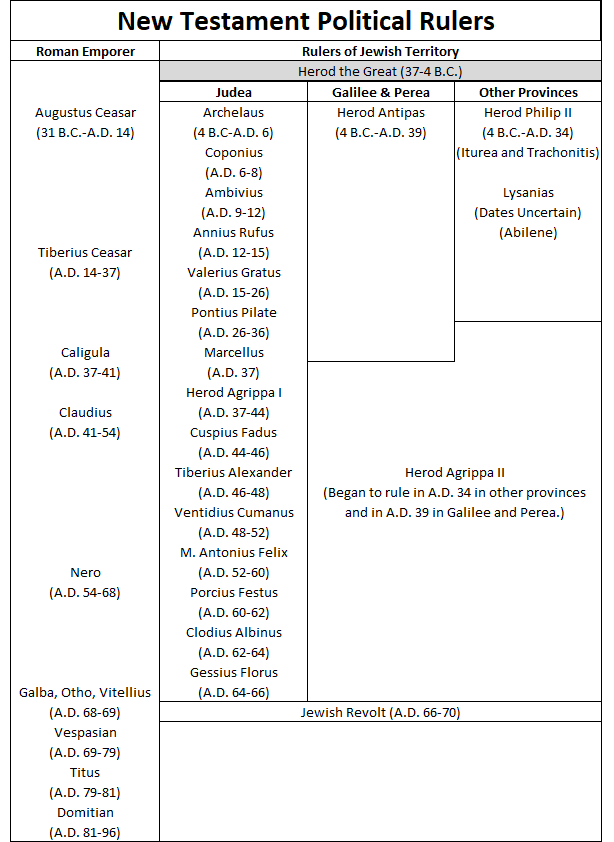
John’s location: The wilderness around Judea. We first saw mention of the wilderness in the last passage from Luke 1:80, where there is a brief mention of John growing in stature and living in the desert until the time came for him to begin his ministry. I wonder how early he began living in the wilderness. His parents were very elderly when he was born, and it is unlikely, in my opinion, that they lived into his adulthood. Given the fact that Jesus had to teach people to care for orphans and widows, we can assume that an orphan would have been financially destitute and often unable to find a caregiver or sponsor. The wilderness, where John chose to make his home, was considered “the wrong side of the tracks” and contributed to the bizarre nature of his magnetism (The Word in Life Study Bible pg. 1622), but it was also one of the similarities he shared with Elijah. The region where he lived outside Judea had come under the rule of a Syrian imperial governor, after Herod Archelaus had been stripped of power and banished to Rome in A.D. 6 (The Word in Life Study Bible pg. 1709). Josephus, a Jewish historian, “refers to [John] by name” (Nelson KJV Bible Commentary pg. 1167), which helps us place him in history and corroborates Luke’s account, which lists the political leaders at the time of John’s ministry.

John’s clothes: camel hair and a leather belt. John’s choice of garment was also important because it is similar to that of Elijah (2 Ki 1:8). “Everything about him recalled the prophet Elijah – his mantle, existing in the wilderness, his message – and people flocked to hear him” (The Zondervan Pictorial Encyclopedia of the Bible, Vol 3 pg. 642). Elijah did not die a natural death, but was taken to Heaven in a chariot of fire, as witnessed by Elisha, and we’ll see more about the expectation of his return as we explore John’s purpose, below.

John’s diet: locusts and wild honey. I have often wondered, with regard to John’s diet, about the dietary restrictions the Jewish people observed. I had thought bugs were off-limits, but I never took the time to look it up. I got my answer in the verse referenced below: Leviticus 11:22. It still didn’t mean it wasn’t strange, though. Despite the fact the Jews could eat certain bugs if they wanted to, it does not appear they were inclined to do so. “His food and clothing indicated his rejection of official Israel of the time and his conviction of a prophetic calling” (The Zondervan Pictorial Encyclopedia of the Bible, Vol 3 pg. 642).

John’s purpose: preparing the way of the Lord. Paving the way for the Lord meant delivering a divinely-received message and also to bear witness, or testify, to the deity of Jesus. “John is presented as the prophet sent in the spirit of Elijah ‘before the coming of the great and dreadful day of the Lord’ (Mal 4:5)” (Nelson KJV Bible Commentary pg. 1167). This is consistent with the angel’s message to Zechariah, that his son John would have the spirit and power of Elijah. Matthew’s gospel assumes the reader (or hearer) is already awaiting the return of Elijah, per the OT prophecies. We see another clue that Elijah’s return was widely anticipated in John 1:25, when priests imply that the only reason John should have the authority to baptize is if he is the Christ or Elijah, and they ask him directly if he is Elijah. His pugnacious and scathing style were similar to Elijah’s (Nelson KJV Bible Commentary pg. 1167). The way he indicates his message from God also uses the same formula as Elijah (1 Kings 18:1), Jeremiah (Jer 1:4), and Ezekiel (Ezk 1:3), among others. However, despite the fact that people were awaiting Elijah to precede the Messiah, and that Jesus later metaphorically calls John Elijah, John confirms to the Sanhedrin’s delegation that he is not literally Elijah (Nelson KJV Bible Commentary pg. 1299). This does not discredit his ministry, since the angel Gabriel was clear that John would embody the ‘spirit’ of Elijah, which by all accounts, he did.

John’s message: baptism of repentance for forgiveness from sin. I’m going to focus on baptism next week, so this week, I’ll focus on repentance. Repent was, at one time, a military term to mean essentially “about face” (https://www.christianity.com/jesus/following-jesus/repentance-faith-and-salvation/what-does-it-mean-to-repent.html). The original Greek work metanoia “is basically ‘a change of mind’ which results in a change of conduct. Repentance is not sorrow. It involves a complete change of attitude regarding God and sin and is often accompanied by a sense of sorrow and a corresponding change in conduct” (Nelson KJV Bible Commentary pg. 1168). John’s exhortation to repent is immediately followed by the reason which would compel his listeners to do so: the kingdom of God at hand. So his message of repentance ties directly with his purpose to pave the way for the Lord.

To add just a few more notes I found about the study passages this week, “The phrase ‘kingdom of heaven’ is used only in the Gospel of Matthew and seems to be based on similar references in the book of Daniel. The phrase ‘the kingdom of God’ is used more frequently by Mark and Luke. The change is perhaps due to Matthew’s Jewish background and outlook. Since the Jews regarded it as blasphemous to refer to God by name, it is possible that Matthew substituted the word heaven for that reason” (Nelson KJV Bible Commentary pg. 1168).

John “epitomized all the OT saints who stood at the threshold of the new order without entering in (Heb 11:39b). He does not deserve the neglect the Church often accords him. His great importance lies in the fact that he bridged the old era and the new and was the link between the two” (The Zondervan Pictorial Encyclopedia of the Bible, Vol 3 pg. 642).

See the next post here https://onthepath.online/2019/03/14/john-the-baptizer/

Scripture References
1, 19 Mt 3:1 Now in those days John the Baptist came, preaching in the wilderness of Judea, saying, 2 “Repent, for the kingdom of heaven is at hand.” 3 For this is the one referred to by Isaiah the prophet when he said, “The voice of one crying in the wilderness, ‘Make ready the way of the Lord, Make His paths straight!’” 4 Now John himself had a garment of camel’s hair and a leather belt around his waist; and his food was locusts and wild honey. 5 Then Jerusalem was going out to him, and all Judea and all the district around the Jordan; 6 and they were being baptized by him in the Jordan River, as they confessed their sins. 7 But when he saw many of the Pharisees and Sadducees coming for baptism, he said to them, “You brood of vipers, who warned you to flee from the wrath to come? 8 Therefore bear fruit in keeping with repentance; 9 and do not suppose that you can say to yourselves, ‘We have Abraham for our father’; for I say to you that from these stones God is able to raise up children to Abraham. 10 The axe is already laid at the root of the trees; therefore every tree that does not bear good fruit is cut down and thrown into the fire. 11 “As for me, I baptize you with water for repentance, but He who is coming after me is mightier than I, and I am not fit to remove His sandals; He will baptize you with the Holy Spirit and fire. 12 His winnowing fork is in His hand, and He will thoroughly clear His threshing floor; and He will gather His wheat into the barn, but He will burn up the chaff with unquenchable fire.”

1, 9 Mk 1:2 As it is written in Isaiah the prophet: “Behold, I send My messenger ahead of You, Who will prepare Your way; 3 The voice of one crying in the wilderness, ‘Make ready the way of the Lord, Make His paths straight.’” 4 John the Baptist appeared in the wilderness preaching a baptism of repentance for the forgiveness of sins. 5 And all the country of Judea was going out to him, and all the people of Jerusalem; and they were being baptized by him in the Jordan River, confessing their sins. 6 John was clothed with camel’s hair and wore a leather belt around his waist, and [c]his diet was locusts and wild honey. 7 And he was preaching, and saying, “After me One is coming who is mightier than I, and I am not fit to stoop down and untie the thong of His sandals. 8 I baptized you with water; but He will baptize you with the Holy Spirit.”

1, 29 Lk 3:2 in the high priesthood of Annas and Caiaphas, the word of God came to John, the son of Zacharias, in the wilderness. 3 And he came into all the district around the Jordan, preaching a baptism of repentance for the forgiveness of sins; 4 as it is written in the book of the words of Isaiah the prophet, “The voice of one crying in the wilderness, ‘Make ready the way of the Lord, Make His paths straight. 5 ‘Every ravine will be filled, And every mountain and hill will be brought low; The crooked will become straight, And the rough roads smooth;6 And all flesh will see the salvation of God.’” 7 So he began saying to the crowds who were going out to be baptized by him, “You brood of vipers, who warned you to flee from the wrath to come? 8 Therefore bear fruits in keeping with repentance, and do not begin to say to yourselves, ‘We have Abraham for our father,’ for I say to you that from these stones God is able to raise up children to Abraham. 9 Indeed the axe is already laid at the root of the trees; so every tree that does not bear good fruit is cut down and thrown into the fire.” 10 And the crowds were questioning him, saying, “Then what shall we do?” 11 And he would answer and say to them, “The man who has two tunics is to share with him who has none; and he who has food is to do likewise.” 12 And some tax collectors also came to be baptized, and they said to him, “Teacher, what shall we do?” 13 And he said to them, “Collect no more than what you have been ordered to.” 14 Some soldiers were questioning him, saying, “And what about us, what shall we do?” And he said to them, “Do not take money from anyone by force, or accuse anyone falsely, and be content with your wages.” 15 Now while the people were in a state of expectation and all were wondering in their hearts about John, as to whether he was the Christ, 16 John answered and said to them all, “As for me, I baptize you with water; but One is coming who is mightier than I, and I am not fit to untie the thong of His sandals; He will baptize you with the Holy Spirit and fire. 17 His winnowing fork is in His hand to thoroughly clear His threshing floor, and to gather the wheat into His barn; but He will burn up the chaff with unquenchable fire.”

1, 26 Jn 1:6 There came a man sent from God, whose name was John. 7 He came as a witness, to testify about the Light, so that all might believe through him. 8 He was not the Light, but he came to testify about the Light.

1,8, 25 Jn 1:19 This is the testimony of John, when the Jews sent to him priests and Levites from Jerusalem to ask him, “Who are you?” 20 And he confessed and did not deny, but confessed, “I am not the Christ.” 21 They asked him, “What then? Are you Elijah?” And he said, “I am not.” “Are you the Prophet?” And he answered, “No.” 22 Then they said to him, “Who are you, so that we may give an answer to those who sent us? What do you say about yourself?” 23 He said, “I am a voice of one crying in the wilderness, ‘Make straight the way of the Lord,’ as Isaiah the prophet said.” 24 Now they had been sent from the Pharisees. 25 They asked him, and said to him, “Why then are you baptizing, if you are not the Christ, nor Elijah, nor the Prophet?” 26 John answered them saying, “I baptize in water, but among you stands One whom you do not know. 27 It is He who comes after me, the thong of whose sandal I am not worthy to untie.” 28 These things took place in Bethany beyond the Jordan, where John was baptizing.

2 Mt 11:11 Truly I say to you, among those born of women there has not arisen anyone greater than John the Baptist! Yet the one who is least in the kingdom of heaven is greater than he. 12 From the days of John the Baptist until now the kingdom of heaven suffers violence, and violent men take it by force. 13 For all the prophets and the Law prophesied until John. 14 And if you are willing to accept it, John himself is Elijah who was to come.

2 Mt 16:14 And they said, “Some say John the Baptist; and others, Elijah; but still others, Jeremiah, or one of the prophets.”

3 Jos 15:61 In the wilderness: Beth-arabah, Middin and Secacah,

3 Jdg 1:16 The descendants of the Kenite, Moses’ father-in-law, went up from the city of palms with the sons of Judah, to the wilderness of Judah which is in the south of Arad; and they went and lived with the people.

4,5 Mt 4:17 From that time Jesus began to preach and say, “Repent, for the kingdom of heaven is at hand.”

5 Da 2:44 In the days of those kings the God of heaven will set up a kingdom which will never be destroyed, and that kingdom will not be left for another people; it will crush and put an end to all these kingdoms, but it will itself endure forever.

5 Mt 4:23 Jesus was going throughout all Galilee, teaching in their synagogues and proclaiming the gospel of the kingdom, and healing every kind of disease and every kind of sickness among the people.

5 Mt 6:10 ‘Your kingdom come. Your will be done, On earth as it is in heaven.

5 Mt 10:7 And as you go, preach, saying, ‘The kingdom of heaven is at hand.’

5 Mk 1:15 and saying, “The time is fulfilled, and the kingdom of God is at hand; repent and believe in the gospel.”

5 Lk 10:9 and heal those in it who are sick, and say to them, ‘The kingdom of God has come near to you.’ 10 But whatever city you enter and they do not receive you, go out into its streets and say,

5 Lk 11:20 But if I cast out demons by the finger of God, then the kingdom of God has come upon you.

5 Lk 21:31 So you also, when you see these things happening, recognize that the kingdom of God is near.

6 Lk 1:17 It is he who will go as a forerunner before Him in the spirit and power of Elijah, to turn the hearts of the fathers back to the children, and the disobedient to the attitude of the righteous, so as to make ready a people prepared for the Lord.”

6 Lk 1:76 “And you, child, will be called the prophet of the Most High; For you will go on before the Lord to prepare His ways;

7 Is 40:3 A voice is calling, “Clear the way for the Lord in the wilderness; Make smooth in the desert a highway for our God.

9 2 Ki 1:8 They answered him, “He was a hairy man with a leather girdle bound about his loins.” And he said, “It is Elijah the Tishbite.”

9 Zec 13:4 Also it will come about in that day that the prophets will each be ashamed of his vision when he prophesies, and they will not put on a hairy robe in order to deceive;

9 Mt 11:8 But what did you go out to see? A man dressed in soft clothing? Those who wear soft clothing are in kings’ palaces!

10 Lv 11:22 These of them you may eat: the locust in its kinds, and the devastating locust in its kinds, and the cricket in its kinds, and the grasshopper in its kinds.

11 Mt 4:3 And the tempter came and said to Him, “If You are the Son of God, command that these stones become bread.”

12 Mal 3:1 “Behold, I am going to send My messenger, and he will clear the way before Me. And the Lord, whom you seek, will suddenly come to His temple; and the messenger of the covenant, in whom you delight, behold, He is coming,” says the Lord of hosts.

12 Mt 11:10 This is the one about whom it is written, ‘Behold, I send My messenger ahead of You, Who will prepare Your way before You.’

12 Lk 7:27 This is the one about whom it is written, ‘Behold, I send My messenger ahead of You, Who will prepare Your way before You.’

13 Ac 13:24 after John had proclaimed before His coming a baptism of repentance to all the people of Israel.

14 Lk 1:77 To give to His people the knowledge of salvation By the forgiveness of their sins,

15 Mt 27:2 and they bound Him, and led Him away and delivered Him to Pilate the governor.

16 Mt 14:1 At that time Herod the tetrarch heard the news about Jesus,

17 Jn 18:13 and led Him to Annas first; for he was father-in-law of Caiaphas, who was high priest that year.

17 Jn 18:24 So Annas sent Him bound to Caiaphas the high priest.

17 Ac 4:6 and Annas the high priest was there, and Caiaphas and John and Alexander, and all who were of high-priestly descent.

18 Mt 26:3 Then the chief priests and the elders of the people were gathered together in the court of the high priest, named Caiaphas;

20 Is 40:4 “Let every valley be lifted up, And every mountain and hill be made low; And let the rough ground become a plain, And the rugged terrain a broad valley;

21 Is 40:5 Then the glory of the Lord will be revealed, And all flesh will see it together; For the mouth of the Lord has spoken.”

22 Lk 2:30 For my eyes have seen Your salvation,

23 Jn 1:15 John testified about Him and cried out, saying, “This was He of whom I said, ‘He who comes after me has a higher rank than I, for He existed before me.’”

23 Jn 1:19 This is the testimony of John, when the Jews sent to him priests and Levites from Jerusalem to ask him, “Who are you?”

23 Jn 1:32 John testified saying, “I have seen the Spirit descending as a dove out of heaven, and He remained upon Him.

23 Jn 3:26 And they came to John and said to him, “Rabbi, He who was with you beyond the Jordan, to whom you have testified, behold, He is baptizing and all are coming to Him.”

23 Jn 5:33 You have sent to John, and he has testified to the truth.

24 Jn 1:12 But as many as received Him, to them He gave the right to become children of God, even to those who believe in His name,

24 Ac 19:4 Paul said, “John baptized with the baptism of repentance, telling the people to believe in Him who was coming after him, that is, in Jesus.”

24 Gal 3:26 For you are all sons of God through faith in Christ Jesus.

27 Jn 2:18 The Jews then said to Him, “What sign do You show us as your authority for doing these things?”

27 Jn 2:20 The Jews then said, “It took forty-six years to build this temple, and will You raise it up in three days?”

27 Jn 5:10 So the Jews were saying to the man who was cured, “It is the Sabbath, and it is not permissible for you to carry your pallet.”

27 Jn 5:15 The man went away, and told the Jews that it was Jesus who had made him well. 16 For this reason the Jews were persecuting Jesus, because He was doing these things on the Sabbath.

27 Jn 5:18 For this reason therefore the Jews were seeking all the more to kill Him, because He not only was breaking the Sabbath, but also was calling God His own Father, making Himself equal with God.

27 Jn 6:41 Therefore the Jews were grumbling about Him, because He said, “I am the bread that came down out of heaven.”

27 Jn 6:52 Then the Jews began to argue with one another, saying, “How can this man give us His flesh to eat?”

27 Jn 7:1 After these things Jesus was walking in Galilee, for He was unwilling to walk in Judea because the Jews were seeking to kill Him.

27 Jn 7:11 So the Jews were seeking Him at the feast and were saying, “Where is He?”

27 Jn 7:13 Yet no one was speaking openly of Him for fear of the Jews.

27 Jn 7:15 The Jews then were astonished, saying, “How has this man become learned, having never been educated?”

27 Jn 7:35 The Jews then said to one another, “Where does this man intend to go that we will not find Him? He is not intending to go to the Dispersion among the Greeks, and teach the Greeks, is He?

27 Jn 8:22 So the Jews were saying, “Surely He will not kill Himself, will He, since He says, ‘Where I am going, you cannot come’?”

27 Jn 8:48 The Jews answered and said to Him, “Do we not say rightly that You are a Samaritan and have a demon?”

27 Jn 8:52 The Jews said to Him, “Now we know that You have a demon. Abraham died, and the prophets also; and You say, ‘If anyone keeps My word, he will never taste of death.’

27 Jn 8:57 So the Jews said to Him, “You are not yet fifty years old, and have You seen Abraham?”

27 Jn 9:18 The Jews then did not believe it of him, that he had been blind and had received sight, until they called the parents of the very one who had received his sight,

27 Jn 9:22 His parents said this because they were afraid of the Jews; for the Jews had already agreed that if anyone confessed Him to be Christ, he was to be put out of the synagogue.

27 Jn 10:24 The Jews then gathered around Him, and were saying to Him, “How long will You keep us in suspense? If You are the Christ, tell us plainly.”

27 Jn 10:31 The Jews picked up stones again to stone Him.

27 Jn 10:33 The Jews answered Him, “For a good work we do not stone You, but for blasphemy; and because You, being a man, make Yourself out to be God.”

28 Mt 15:1 Then some Pharisees and scribes came to Jesus from Jerusalem and said,

29 Jn 3:28 You yourselves are my witnesses that I said, ‘I am not the Christ,’ but, ‘I have been sent ahead of Him.’

30 Dt 18:15 “The Lord your God will raise up for you a prophet like me from among you, from your countrymen, you shall listen to him.

30 Dt 18:18 I will raise up a prophet from among their countrymen like you, and I will put My words in his mouth, and he shall speak to them all that I command him.

30 Mt 21:11 And the crowds were saying, “This is the prophet Jesus, from Nazareth in Galilee.”

30 Jn 1:25 They asked him, and said to him, “Why then are you baptizing, if you are not the Christ, nor Elijah, nor the Prophet?”

Lk 1:80 And the child continued to grow and to become strong in spirit, and he lived in the deserts until the day of his public appearance to Israel.

Mal 4:5 Behold, I am going to send you Elijah the prophet before the coming of the great and terrible day of the Lord.

1 Ki 18:1 Now it happened after many days that the word of the Lord came to Elijah in the third year, saying, “Go, show yourself to Ahab, and I will send rain on the face of the earth.”

Jer 1:4 Now the word of the Lord came to me saying,

Ezk 1:3 the word of the Lord came expressly to Ezekiel the priest, son of Buzi, in the land of the Chaldeans by the river Chebar; and there the hand of the Lord came upon him.)

Heb 11:39 And all these, having gained approval through their faith, did not receive what was promised,

Young Jesus Visits the Teachers

Young Jesus Visits the Teachers, Luke 2:40-52, Luke 1:80

Luke 2:40 The Child continued to grow1 and become strong, [a]increasing in wisdom; and the grace of God was upon Him. 41 Now His parents went to Jerusalem every year at the Feast of the Passover2. 42 And when He became twelve, they went up there according to the custom of the Feast; 43 and as they were returning, after spending the full number of days3, the boy Jesus stayed behind in Jerusalem. But His parents were unaware of it, 44 but supposed Him to be in the caravan, and went a day’s journey; and they began looking for Him among their relatives and acquaintances. 45 When they did not find Him, they returned to Jerusalem looking for Him. 46 Then, after three days they found Him in the temple, sitting in the midst of the teachers, both listening to them and asking them questions. 47 And all who heard Him were amazed4 at His understanding and His answers. 48 When they saw Him, they were astonished; and His mother5 said to Him, “[b]Son, why have You treated us this way? Behold, Your father6 and I [c]have been anxiously looking for You.” 49 And He said to them, “Why is it that you were looking for Me? Did you not know that I had to be in My Father’s6,7 [d]house?” 50 But they did not understand8 the statement which He [e]had made to them. 51 And He went down with them and came to Nazareth9, and He continued in subjection to them; and His mother5 treasured all these [f]things in her heart10. 52 And Jesus kept increasing in wisdom and [g]stature1, and in favor with God and men.

Luke 1:80 And the child continued to grow1 and to become strong in spirit, and he lived in the deserts until the day of his public appearance to Israel.

Footnotes

a. Luke 2:40 Lit becoming full of

b. Luke 2:48 Or Child

c. Luke 2:48 Lit are looking

d. Luke 2:49 Or affairs; lit in the things of My Father

e. Luke 2:50 Lit had spoken

f. Luke 2:51 Lit words

g. Luke 2:52 Or age

Commentary

The next chronological event is Jesus as a young boy getting separated from His parents. I also included a verse about John the Baptist because there are parallel timelines here, with the growth of both Jesus and John the Baptist (who was about 6 months older than Jesus). These are the only accounts of Jesus or John’s boyhood, and they are both found in Luke. Gospel writers did not appear to be concerned with the environmental factors of Jesus’ upbringing, but Luke’s mention of this single event allowed him to “illustrate Jesus’ first contact with the Temple teachers” (The Zondervan Pictorial Encyclopedia of the Bible Vol 3, pg. 527). His allusion to the growth and boyhood of both Jesus and John may also contribute, in my opinion, to the elevation and relevance of children and women in Luke’s gospel.

Along with the parental responsibility to demonstrate and explain the purpose of Passover to their children (Ex 12:26, 13:8), Jewish men were required to appear in the temple three times each year. As far as I can tell, this is the last time Joseph is mentioned alive, so this Passover is the last legacy we see him leaving for Jesus. At twelve years old, Jesus had just become a man, according to the Jewish culture. While Joseph had been going to Jerusalem regularly, this was probably Jesus’ first time appearing in the temple for the ritual (Nelson KJV Bible Commentary pg. 1268). He therefore determined to go to the temple to learn all He could from the scholars there (Word in Life Study Bible pg. 1770). Despite the fact that He appears to have known He was the Son of God, this passage shows us that He still had to go through the process of learning and growth, just like any child. Verse 52 details the four ways He matured as He grew: “ (1) mentally, i.e., ‘in wisdom’; (2) physically, i.e., in ‘stature’; (3) spiritually, i.e., ‘in favor with God’; and (4) socially, i.e., in favor with ‘man’ (Nelson KJV Bible Commentary pg. 1268). However, His aptitude for the subject of the law and prophets astounded everyone who heard Him. In the passage, we see that Mary is specifically called out again as considering these things in her heart. It is possible that the banality of everyday life had allowed Jesus’ parents’ awe to stagnate somewhat. This may have been the first reminder in some while of their son’s divine origins (Nelson KJV Bible Commentary pg. 1268). There is additional evidence to suggest the rest of Jesus’ formative years were relatively unremarkable to those living in His city of Nazareth, “for they were astonished when His ministry was in progress” (The Zondervan Pictorial Encyclopedia of the Bible, Vol. 3 pg. 528).

The one part of this passage that has always intrigued me is the fact that Jesus stayed behind without telling His parents, and when His mother scolded Him for having given them such a scare, He says He assumed they had known. As a parent, I read this through the lens of someone who has heard many excuses, dripping with feigned ignorance of the rules and consequences. However, as Jesus lived a sinless life, it is possible that His parents had never before had an opportunity to explain the house rules against disappearing without telling them, and that His statement truly was guileless. My view is so jaded by the world and my experiences, and I attribute so much wisdom to Him, even as a young child, that it is a real challenge to imagine such genuine innocence in a twelve-year-old. Perhaps that is why Luke tells us, twice, that Jesus was continuing to mature. He didn’t begin life understanding everything. Not only was it a different culture, but Jesus Himself was so different from the other children that He must have learned things in different ways at different times. He may have also demonstrated an insatiable appetite for scriptural teaching whenever it was available to Him, so this being His first trip to the temple, He may have honestly assumed that His parents would realize that He was doing the same thing He always did when He had the chance to learn more about Biblical teaching. What is important to the idea of His sinless nature is that He learned from this experience and continued to live in subjection to His parents afterward, when they returned to Nazareth together.

Since this study takes place during the Passover celebration, I spent some time reflecting on that tradition, as well. In studying the Passover, there are a lot of parallels to absorb, with regard to Jesus’ life. One I would like to call out specifically is that Jesus was missing for 3 days after Passover as a youth. Later in his life, the Last Supper was taken as people gathered for Passover, after which Jesus was crucified and buried for 3 days before rising from the dead. Of course, there is also the sacrificial male lamb without blemish and the fact that God used the original Passover event to liberate His people from slavery. There are so many more, plenty I’m sure I missed, and as I was reading about the Passover in the Pictorial Encyclopedia of the Bible, I saw the myriad scripture citations of the mention of Passover in the Old Testament, from Exodus to Nehemiah to Psalms. I was suddenly overcome with a sense of humility, gratitude, unity, and purpose as I watched the theme pervade the entire Bible. I imagined the warmth of the Jewish families sharing this time with their children and helping them to understand and remember what God had done for them. It was a truly beautiful and moving picture.

The New Testament is also full of references to Passover, many of which we will explore as we move forward with the study of the gospels, and John especially highlights many of the Passovers during Jesus’ ministry in the fourth gospel, a primary theme of which is “that the Messiah is the true bread of life” (The Zondervan Pictorial Encyclopedia of the Bible Vol. 4, pg. 608). As this year’s Passover and Resurrection celebrations near, I plan to give some more thought to the ways God commanded the Israelites to celebrate with various feasts and the relevance of those directives to today’s Gentile Christians. Certainly, I’ll have more opportunity to share my findings as we progress through the gospel accounts of the Passover feasts Jesus celebrated during his life and ministry.

See the next post here https://onthepath.online/2019/03/07/introduction-of-john-the-baptist/

Scripture References

2Ex 12:11 Now you shall eat it in this manner: with your loins girded, your sandals on your feet, and your staff in your hand; and you shall eat it in haste—it is the Lord’s Passover.

2Ex 23:15 You shall observe the Feast of Unleavened Bread; for seven days you are to eat unleavened bread, as I commanded you, at the appointed time in the month Abib, for in it you came out of Egypt. And none shall appear before Me empty-handed.

2Dt 16:1 “Observe the month of Abib and celebrate the Passover to the Lord your God, for in the month of Abib the Lord your God brought you out of Egypt by night. 2 You shall sacrifice the Passover to the Lord your God from the flock and the herd, in the place where the Lord chooses to establish His name. 3 You shall not eat leavened bread with it; seven days you shall eat with it unleavened bread, the bread of affliction (for you came out of the land of Egypt in haste), so that you may remember all the days of your life the day when you came out of the land of Egypt. 4 For seven days no leaven shall be seen with you in all your territory, and none of the flesh which you sacrifice on the evening of the first day shall remain overnight until morning. 5 You are not allowed to sacrifice the Passover in any of your towns which the Lord your God is giving you; 6 but at the place where the Lord your God chooses to establish His name, you shall sacrifice the Passover in the evening at sunset, at the time that you came out of Egypt.

3Ex 12:15 Seven days you shall eat unleavened bread, but on the first day you shall remove leaven from your houses; for whoever eats anything leavened from the first day until the seventh day, that person shall be cut off from Israel.

4Mt 7:28 When Jesus had finished these words, the crowds were amazed at His teaching;

4Mt 13:54 He came to His hometown and began teaching them in their synagogue, so that they were astonished, and said, “Where did this man get this wisdom and these miraculous powers?

4Mt 22:33 When the crowds heard this, they were astonished at His teaching.

4Mk 1:22 They were amazed at His teaching; for He was teaching them as one having authority, and not as the scribes.

4Mk 6:2 When the Sabbath came, He began to teach in the synagogue; and the many listeners were astonished, saying, “Where did this man get these things, and what is this wisdom given to Him, and such miracles as these performed by His hands?

4Mk 11:18 The chief priests and the scribes heard this, and began seeking how to destroy Him; for they were afraid of Him, for the whole crowd was astonished at His teaching.

4Lk 4:32 and they were amazed at His teaching, for His message was with authority.

4Jn 7:15 The Jews then were astonished, saying, “How has this man become learned, having never been educated?”

5Mt 12:46 While He was still speaking to the crowds, behold, His mother and brothers were standing outside, seeking to speak to Him.

6Lk 3:23 When He began His ministry, Jesus Himself was about thirty years of age, being, as was supposed, the son of Joseph, the son of Eli,

6Lk 4:22 And all were speaking well of Him, and wondering at the gracious words which were falling from His lips; and they were saying, “Is this not Joseph’s son?”

7Jn 4:34 Jesus said to them, “My food is to do the will of Him who sent Me and to accomplish His work.

7Jn 5:36 But the testimony which I have is greater than the testimony of John; for the works which the Father has given Me to accomplish—the very works that I do—testify about Me, that the Father has sent Me.

8Mk 9:32 But they did not understand this statement, and they were afraid to ask Him.

8Lk 9:45 But they did not understand this statement, and it was concealed from them so that they would not perceive it; and they were afraid to ask Him about this statement.

8Lk 18:34 But the disciples understood none of these things, and the meaning of this statement was hidden from them, and they did not comprehend the things that were said.

9Lk 2:39 When they had performed everything according to the Law of the Lord, they returned to Galilee, to their own city of Nazareth.

10Lk 2:19 But Mary treasured all these things, pondering them in her heart.

Num 9:12 They shall leave none of it until morning, nor break a bone of it; according to all the statute of the Passover they shall observe it. 13 But the man who is clean and is not on a journey, and yet [a]neglects to observe the Passover, that [b]person shall then be cut off from his people, for he did not present the offering of the Lord at its appointed time. That man will bear his sin. 14 If an alien sojourns among you and [c]observes the Passover to the Lord, according to the statute of the Passover and according to its ordinance, so he shall do; you shall have one statute, both for the alien and for the native of the land.’”

Ex 12:26 And when your children say to you, ‘What does this rite mean to you?’

Ex 13:8 You shall tell your son on that day, saying, ‘It is because of what the Lord did for me when I came out of Egypt.’


The Family Returns to Nazareth

The Family Returns to Nazareth, Matthew 2:19-23, Luke 2:39

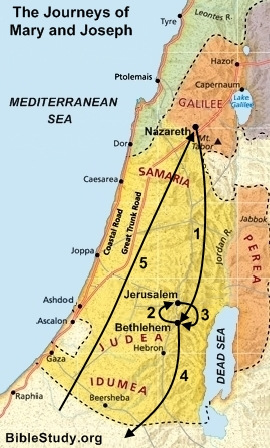
Matthew 2:19 But when Herod died, behold, an angel of the Lord appeared in a dream1 to Joseph in Egypt, and said, 20 “Get up, take the Child and His mother, and go into the land of Israel; for those who sought the Child’s life are dead.” 21 So [a]Joseph got up, took the Child and His mother, and came into the land of Israel. 22 But when he heard that Archelaus was reigning over Judea in place of his father Herod, he was afraid to go there. Then after being warned by God in a dream1, he left for the regions of Galilee, 23 and came and lived in a city called Nazareth2. This was to fulfill what was spoken through the prophets: “He shall be called a Nazarene4.”

Luke 2:39 When they had performed everything according to the Law of the Lord, they returned to Galilee, to their own city of Nazareth2.

Footnotes

a. Matthew 2:21 Lit he

Commentary

Since I have been attempting to keep track of how many times angels or God himself have appeared personally, in dreams, or through the Holy Spirit to the figures in Jesus’ life, I will add to the tally here. In the passage from Matthew, we have the tenth and eleventh divine appearances, both to Joseph. Jesus’ life was preserved many times before His final appointment at Calvary, and it speaks to the credence of Jesus’ position and the reality of spiritual warfare that God was forced to intervene so many times.

When I do these studies, the first thing I do after I figure out which passage should be next in the chronology, is to look up all the references from other parts of the Bible and paste them at the bottom of my commentary. What immediately struck me about the passage in Matthew is that it seems to cite an Old Testament prophecy, but there is no Old Testament passage referenced in my Bible’s reference section. I found an article with a response to this, as well as another question I have had. The other question is from a much earlier post about Jesus being called Immanuel; I had wondered why scripture said He would be called Immanuel when His given name was Jesus. This article clarifies some of the syntax of ancient writers and gives insight into the phrase which we translate as “shall be called”. This phrase can also mean “is by nature”, just the same way Eve was called woman in Genesis. She was woman by nature and Eve by name. This applies to Jesus being called a Nazarene, as well. The allusion Matthew makes is not a direct quote from the Old Testament, but rather a concept that would have been familiar to his readers. The quotation marks were added later by translators because quotation marks were not part of the grammar of ancient writers. Nazareth was a place well-known for wickedness, as we mentioned when discussing the story of Mary and Joseph. The prophets did say that the Messiah would be despised and that He would be a “root out of dry ground” (Isaiah 53:2-3; cf. Psalm 22:6-7). Nazareth was so well-known as a despicable place that it is used here as a synonym for the concepts in prophecy. Although I have abbreviated the content, this author does a great job of explaining it, and I recommend taking a look (http://apologeticspress.org/apPubPage.aspx?pub=1&issue=938&article=1391).

To make my own analogy, let’s say there were a prophecy about a person who would be born in the future. The prophecy says that the person will be selfless, kind, and will care for others. When the prophecy is fulfilled, this person ends up being born in Samaria, so in the retelling of his life, the author says, “This is how he fulfilled the prophecy that he would be a Good Samaritan.” We are so familiar with the phrase “good Samaritan” after having studied Jesus’ parables, that this seems like a perfect, catchy way to summarize the fulfillment of that earlier prophecy. I hope I didn’t make that more confusing with my own feeble attempt to make the context more relevant, but it helped me while I was thinking it through.

So after I sort through all the scripture references, I often go next to the history. If they returned from Egypt immediately following the death of Herod the Great, the family’s stay in Egypt was not very long, based on the historical records of the end of Herod the Great’s reign and the beginning of Archelaus’ and Antipas’. Herod the Great died in 4 B.C., at which time he divided his kingdom into three territories, each ruled by one of three sons. As mentioned in a previous post, the calendar we now use is off by about 6 years, which means by our current calendar, Jesus was born around 6 B.C. If the angel appeared to Joseph shortly after Archelaus gained power, Jesus would still have been just two years old. In a previous post, I may have remarked on Jesus’ time spent in Egypt, not realizing at the time how short their stay actually was. Below is a chart of New Testament Political Rulers, which may be helpful as we see more “Herods” mentioned throughout the life of Jesus.

New Testament Political Rulers

Finally, I directed my attention to the verse in Luke. Although the account in Luke is brief, it seems to represent an alternative history that excludes the entire exodus to Egypt. In Luke, verse 39 immediately follows the family’s visit to the temple to present Jesus as a baby, whereupon Luke says they returned to Nazareth after completing all the necessary offerings and rituals. But in reading some commentary about the apparent discrepancy, I realized it was folly to interpret Luke’s statement as “immediately” following the visit to the temple. “Perhaps the most perplexing differences between parallels occur when one gospel write as condensed the account of an event which took place in two or more stages into one concise paragraph which seems to describe the action taking place all at once. Yet this type of literary abridgement was quite common among ancient writers (cf. Lucian, How to Write History 56), and once again it is unfair to judge them by modern standards of precision which no one in antiquity required.” [BLOM:135] In addition to the practices of ancient historians, we also must take into account the purpose set forth by the respective writers. “Luke takes another opportunity to mention the fidelity of Jesus’ parents to the Jewish law as he continues the narrative (v. 39). He omits mention of the flight to Egypt. It is important to Matthew, providing another example of fulfilled prophecy (Matt 2:13-15); but this is not so significant at this point in Luke. What is significant is that Jesus’ parents were faithful to the Jewish law and that the child grew normally, the object of God’s grace (v. 40; cf. v. 52). [EBCNT]” (http://christianthinktank.com/infancyoff.html). In the end, both gospel stories put Jesus in Nazareth during His formative years.

See the next post here https://onthepath.online/2019/02/28/young-jesus-visits-the-teachers/

Scripture Reference

1Mt 1:20 But when he had considered this, behold, an angel of the Lord appeared to him in a dream, saying, “Joseph, son of David, do not be afraid to take Mary as your wife; for the Child who has been conceived in her is of the Holy Spirit.

1Mt 2:12 And having been warned by God in a dream not to return to Herod, the magi left for their own country by another way. 13 Now when they had gone, behold, an angel of the Lord appeared to Joseph in a dream and said, “Get up! Take the Child and His mother and flee to Egypt, and remain there until I tell you; for Herod is going to search for the Child to destroy Him.”

2Lk 1:26 Now in the sixth month the angel Gabriel was sent from God to a city in Galilee called Nazareth,

2Lk 2:51 And He went down with them and came to Nazareth, and He continued in subjection to them; and His mother treasured all these things in her heart.

2Lk 4:16 And He came to Nazareth, where He had been brought up; and as was His custom, He entered the synagogue on the Sabbath, and stood up to read.

2Jn 1:45 Philip found Nathanael and said to him, “We have found Him of whom Moses in the Law and also the Prophets wrote—Jesus of Nazareth, the son of Joseph.” 46 Nathanael said to him, “Can any good thing come out of Nazareth?” Philip said to him, “Come and see.”

4Mk 1:24 saying, “What business do we have with each other, Jesus of Nazareth? Have You come to destroy us? I know who You are—the Holy One of God!”

4Jn 18:5 They answered Him, “Jesus the Nazarene.” He said to them, “I am He.” And Judas also, who was betraying Him, was standing with them.

4Jn 18:7 Therefore He again asked them, “Whom do you seek?” And they said, “Jesus the Nazarene.”

4Jn 19:19 Pilate also wrote an inscription and put it on the cross. It was written, “JESUS THE NAZARENE, THE KING OF THE JEWS.”

Is 53:2 For He grew up before Him like a tender shoot, And like a root out of parched ground; He has no stately form or majesty That we should look upon Him, Nor appearance that we should be attracted to Him. 3 He was despised and forsaken of men, A man of sorrows and acquainted with grief; And like one from whom men hide their face He was despised, and we did not esteem Him.

Ps 22:6 But I am a worm and not a man, A reproach of men and despised by the people. 7 All who see me sneer at me; They separate with the lip, they wag the head, saying,

Herod Slaughters Babies

Herod Slaughters Babies, Matthew 2:16-18

Matthew 2:16 Then when Herod saw that he had been tricked by the magi1, he became very enraged, and sent and slew2 all the male children who were in Bethlehem and all its vicinity, from two years old and under, according to the time which he had determined from the magi. 17 Then what had been spoken through Jeremiah the prophet was fulfilled:

18 “A voice was heard in Ramah,

Weeping and great mourning,

Rachel weeping for her children;

And she refused to be comforted,

Because they were no more3.”

Commentary

Imagine living in a place where the king can decree that children be slaughtered, and his soldiers actually go and carry it out. You’re a mother, nursing your child or putting him down for a nap, and someone bursts into your home, rips the child from your arms, and kills him in front of you. There have been many such atrocities in the history of humankind, and it’s always so shocking and appalling to consider the depths of depravity into which humans are capable of sinking. For instance, I remember the first time I read the story of another Bethlehemite, the Levite’s concubine, in Judges 19. The free will we enjoy on the earth has been the demise of many innocents at the hands of the sinful.

Rachel, who is cited in the text from Matthew, also has an association with Bethlehem. She died and was buried just outside the city (Genesis 35:19). In the passage from Jeremiah, she, as the mother of Benjamin, metaphorically represents the entire tribe of Benjamin, and “the calamity of Israel’s mourning at the time of the exile is correlated here to this renewed calamity brought on by Herod, whose very act of ruling is a direct result of that captivity which had been caused by Israel’s sin” (Nelson KJV Bible Commentary pg. 1166).

The actual event recorded here in the Bible is not recorded in any other historical records, but this is unsurprising, given that Herod committed so many atrocities during the course of his reign that this event could easily have slipped through the cracks of other records. We do know, as referenced in a previous post, that Herod executed his wife and three sons, and the historian Josephus calls him “a man of great barbarity towards (sic) all men” (Nelson KJV Bible Commentary pg. 1166). The fact that Matthew records this event, as well as Jesus’ special attention toward children in Matthew 18:6-7, demonstrates a theme in Matthew’s record, of Jesus’ recognition and elevation of children in a culture where they had little importance. However, Jesus recognized the pain of Rachel and of other mothers who lose their children still today and surely felt the weight of the children whose lives were lost on His behalf (The Word in Life Study Bible pg. 1621).

In this passage, we also get a clue as to how old Jesus would have been at the time of the visit from the magi. Herod slaughtered all boys 2 years old and under, based on the time frame given to him by the magi. Scholars estimate that, by the time of the wise men’s visit, Jesus could have been anywhere between 5 months and 2 years old. This is just my personal speculation, but I’m guessing He wasn’t quite 2 years old, yet. Herod, being the wicked man he was, would surely have ‘rounded up’ from the timeline the wise men cited and would thus have given himself a comfortable buffer, to be quite sure he eliminated the threat to his throne.

As to how many children were affected by his decree, I read numerous articles, looking for a clue to the population of Bethlehem at the time, and most authors simply say it was “small”. The only numerical estimate I found is from someone citing archeologist W.F. Albright, with whose work I am not familiar enough to give credence, but I will use it for argument’s sake. He states the population would have been around 300, with approximately 6-7 children under 1 year old (https://www.quora.com/What-was-the-population-of-Bethlehem-at-the-time-of-Jesus). Assuming there were another 5 children between 1 and 2, and that half of all children were boys, that would mean the total number of children murdered was around 6. If this is true, it also supports the theory that this event might have fallen through the cracks of secular history, being carried out in a small town and affecting a relatively small group of people, though their devastation was great.

See the next post here https://onthepath.online/2019/02/21/the-family-returns-to-nazareth/

Scripture References

1Mt 2:1 Now after Jesus was born in Bethlehem of Judea in the days of Herod the king, [a]magi from the east arrived in Jerusalem, saying,

2Is 59:7 Their feet run to evil, And they hasten to shed innocent blood; Their thoughts are thoughts of iniquity, Devastation and destruction are in their highways.

3Jer 31:15 Thus says the Lord, “A voice is heard in Ramah, Lamentation and bitter weeping. Rachel is weeping for her children; She refuses to be comforted for her children, Because they are no more.”

Gen 35:19 So Rachel died and was buried on the way to Ephrath (that is, Bethlehem).

Matt 18:6 but whoever causes one of these little ones who believe in Me to stumble, it would be better for him to have a heavy millstone hung around his neck, and to be drowned in the depth of the sea. 7 Woe to the world because of its stumbling blocks! For it is inevitable that stumbling blocks come; but woe to that man through whom the stumbling block comes!

The Family Flees to Egypt

The Family Flees to Egypt, Matthew 2:13-15

Matt 2:13 Now when they had gone, behold, an angel of the Lord1 appeared to Joseph in a dream2 and said, “Get up! Take the Child and His mother and flee to Egypt, and remain there until I tell you; for Herod is going to search for the Child to destroy Him.”

14 So [a]Joseph got up and took the Child and His mother while it was still night, and left for Egypt. 15 He [b]remained there until the death of Herod. This was to fulfill what had been spoken by the Lord through the prophet: “Out of Egypt3 I called My Son4.”

Footnotes

a. Matthew 2:14 Lit he

b. Matthew 2:15 Lit was

Commentary

To segue from the last post, I ended the ‘Magi’ story with a comment about the 8th divine revelation or appearance that had happened surrounding the conception and birth of Jesus. In this passage, we see the 9th, another angelic appearance to Joseph, as well as the 6th direct quote from the Old Testament, not including all the paraphrased references outside the context of direct quotes. It’s no wonder that, throughout the life of Jesus, His family, and later the people who heard His teaching, were struck with utter awe and amazement. This was surely the one who had been foretold.

Whenever possible, I like to review the secular history related to the Bible events I’m studying, just to remind myself that these aren’t characters in a story, but historical figures. Whether you believe in God or any of the supernatural occurrences detailed in the Bible is one thing, but the widely accepted fact is that Jesus was a person who lived on this earth. The calculation of our current calendar is off by about 6 years, so the birth of Christ, per the current calendar, took place in about 5-6 B.C., and the death of Herod, which is recorded in detail by Josephus (a Jewish historian), took place in 4 B.C. The abbreviations A.D. and B.C. are solely to distinguish the relevance of time to the life of Jesus, so the fact there is a discrepancy does not detract from the legitimacy of the Bible’s history. If an error occurred when this designation was first assigned, and the entire world is operating by this erroneous calendar, we’re not going to go back and change today’s date. We just continue to learn, validate our findings, and move on.

Another study tool I find particularly helpful is to go back and study the context of the verses referenced in superscript in my Bible. I try to paste all of them at the bottom of each of my posts, to keep everything convenient and simple for you, but, beyond the verse or two I paste, there is often context that is helpful. For instance, Matthew uses a direct quote from Hosea in the above passage, but the New American Standard Bible also references a passage in Numbers. To start with the Hosea reference, Matthew cites the second half of the verse, but the first half tells us that the term ‘son’ was referring to the nation of Israel, alluding to the way God used Moses to free the Israelites from Egyptian captivity.  The passage in Numbers is specifically about a king God would raise up from the seed of Jacob, and it is part of a prophecy that was given to Balaam to defy the king of Moab. In verse 24:17, it even says, “I see him, but not now; I behold him, but not near; A star shall come forth from Jacob, A scepter shall rise from Israel…” As I’m reviewing messianic prophecy from the Old Testament, I’m also noticing a phenomenon of angelic appearances to the prophets, of whom Balaam was no exception, despite the fact that he was not originally a prophet of God, but became one through divine intervention. Between the two passages in Hosea and Numbers, we see a picture of Jesus emerge as the eternal champion and representative of Israel, as a metaphor for the entire nation. He will not only be king, but he also lived as a Jew, felt pain as a human, and redeemed God’s people from a different kind of slavery: slavery to sin.

In addition to looking at secular history and Bible context, I also wanted to look at the logistics of the trip itself. How long was the trip to Egypt, and how much did it cost? We don’t know where they stayed in Egypt, but historians believe that some one million Jews lived in Alexandria, during the time Jesus and his family were political refugees (The Word in Life Study Bible, pg. 1620). “Coptic (Egyptian) Christians have identified about 25 places they believe that Mary, Joseph and Jesus stayed during their sojourn in Egypt” (https://www.thebiblejourney.org/biblejourney1/3-jesuss-childhood-journeys-b/the-holy-family-flee-to-egypt/). At the very least, to get from Bethlehem to Egyptian-controlled territory was a minimum journey of 40 miles (65 km) (http://www.biblestudy.org/maps/the-journeys-of-mary-and-joseph.html). With the understanding that they were in a hurry, I’ll assume they moved 2 miles per hour and, excluding rest times, were moving 10 hours per day. That would have made the exodus a 2-day journey. However, based on the terrain and the fact that, per Jewish tradition, Mary would not have weaned Jesus until approximately 3 years old, they may have made much more frequent stops and had a much slower pace than I’m approximating. As far as the cost, I wasn’t able to find much about it, except the note that I previously posted, which is that many historians and theologians believe that Jesus’ family would have used some of the gifts of the Magi to pay for the voyage, as well as setting up a home in Egypt.

journeys-of-mary-and-joseph-map

As I continue to study these maps and think about Jesus as an Asian-born refugee, fleeing to Africa, I’m reminded of my skewed sense of color, based on the overwhelmingly white depiction of Bible figures in art and other media. In addition to the dark-complected Jewish people, a number of Africans play significant roles throughout the Bible. Hagar (Gen. 16:1), the pharaohs, The “mixed multitude” of the Exodus (Ex 12:37-38, Num 11:4), Moses’ Ethiopian wife (Num 12:1-2), The Cushite messenger (2 Sam 18:20-33), Labim, Sukkiim, and Ethiopian mercenaries (2 Chr 12:3), The Shulamite (Song 1:5-6; 6:13), Ebed-Melech the Ethiopian (Jer 38:7-16; 39:16-18), Simon of Cyrene (Mark 15:21), The treasurer of Ethiopia (Acts 8:27-39), Simeon/Niger (Acts 13:1), Lucius of Cyrene (Acts 13:1), and Apollos (Acts 18:24-28) (Word in Life Study Bible pg. 1329). I pasted all these passages below, and I encourage you to read them. In particular, it was a striking picture to recall that the man who carried Jesus’ cross was African.

Related to Jesus’ purpose of redeeming the Gentiles (of which I am one), as well as the Jews, the Septuagint was written and used in Egypt, and when Jesus’ family attended the synagogue there, they would likely have heard scripture recited in Greek. The Septuagint is held to have been written in the 2nd century B.C. in Alexandria, and was the first commissioned, collaborative translation of Bible text into another language. Due to the fact the Jews who were living in Egypt had adopted the Greek language, their mother tongue was becoming less familiar to them, and they needed a version of Jewish scripture written in their adopted vernacular (https://www.thebiblejourney.org/biblejourney1/3-jesuss-childhood-journeys-b/the-holy-family-flee-to-egypt/). Handily, this would also have made scripture more accessible to Gentiles, as well as likely being the context of Jesus’ first human exposure to “the law and the prophets”.

That was a lot to look at for just two verses, but for me, the story really comes to life when I can get a clearer picture of the times, places, people, and cultures. It makes me want to go visit – maybe someday I will!

See the next post here https://onthepath.online/2019/02/13/herod-slaughters-babies/

Scriptural References

1Ac 5:19 But during the night an angel of the Lord opened the gates of the prison, and taking them out he said,

1Ac 10:7 When the angel who was speaking to him had left, he summoned two of his servants and a devout soldier of those who were his personal attendants,

1Ac 12:7 And behold, an angel of the Lord suddenly appeared and a light shone in the cell; and he struck Peter’s side and woke him up, saying, “Get up quickly.” And his chains fell off his hands. 8 And the angel said to him, “Gird yourself and put on your sandals.” And he did so. And he said to him, “Wrap your cloak around you and follow me.” 9 And he went out and continued to follow, and he did not know that what was being done by the angel was real, but thought he was seeing a vision. 10 When they had passed the first and second guard, they came to the iron gate that leads into the city, which opened for them by itself; and they went out and went along one street, and immediately the angel departed from him. 11 When Peter came to himself, he said, “Now I know for sure that the Lord has sent forth His angel and rescued me from the hand of Herod and from all that the Jewish people were expecting.”

2Mt 2:12 And having been warned by God in a dream not to return to Herod, the magi left for their own country by another way.

2Mt 2:19 But when Herod died, behold, an angel of the Lord appeared in a dream to Joseph in Egypt, and said,

3Hos 11:1 When Israel was a youth I loved him, And out of Egypt I called My son.

3Nu 24:8 “God brings him out of Egypt, He is for him like the horns of the wild ox. He will devour the nations who are his adversaries, And will crush their bones in pieces, And shatter them with his arrows.

4Ex 4:22 Then you shall say to Pharaoh, ‘Thus says the Lord, “Israel is My son, My firstborn. 23 So I said to you, ‘Let My son go that he may serve Me’; but you have refused to let him go. Behold, I will kill your son, your firstborn.”’”

Gen 16:1 Now Sarai, Abram’s wife had borne him no children, and she had an Egyptian maid whose name was Hagar.

Ex 12:37 Now the sons of Israel journeyed from Rameses to Succoth, about six hundred thousand men on foot, aside from children. 38 A mixed multitude also went up with them, along with flocks and herds, a very large number of livestock.

Num 11:4 The rabble who were among them had greedy desires; and also the sons of Israel wept again and said, “Who will give us meat to eat?

Num 12:1 Then Miriam and Aaron spoke against Moses because of the Cushite woman whom he had married (for he had married a Cushite woman); 2 and they said, “Has the Lord indeed spoken only through Moses? Has He not spoken through us as well?” And the Lord heard it.

2 Sam 18:20 But Joab said to him, “You are not the man to carry news this day, but you shall carry news another day; however, you shall carry no news today because the king’s son is dead.” 21 Then Joab said to the Cushite, “Go, tell the king what you have seen.” So the Cushite bowed to Joab and ran. 22 Now Ahimaaz the son of Zadok said once more to Joab, “But whatever happens, please let me also run after the Cushite.” And Joab said, “Why would you run, my son, since you will have no reward for going?” 23 “But whatever happens,” he said, “I will run.” So he said to him, “Run.” Then Ahimaaz ran by way of the plain and passed up the Cushite. 24 Now David was sitting between the two gates; and the watchman went up to the roof of the gate by the wall, and raised his eyes and looked, and behold, a man running by himself. 25 The watchman called and told the king. And the king said, “If he is by himself there is good news in his mouth.” And he came nearer and nearer. 26 Then the watchman saw another man running; and the watchman called to the gatekeeper and said, “Behold, another man running by himself.” And the king said, “This one also is bringing good news.” 27 The watchman said, “I think the running of the first one is like the running of Ahimaaz the son of Zadok.” And the king said, “This is a good man and comes with good news.” 28 Ahimaaz called and said to the king, “All is well.” And he prostrated himself before the king with his face to the ground. And he said, “Blessed is the Lord your God, who has delivered up the men who lifted their hands against my lord the king.” 29 The king said, “Is it well with the young man Absalom?” And Ahimaaz answered, “When Joab sent the king’s servant, and your servant, I saw a great tumult, but I did not know what it was.” 30 Then the king said, “Turn aside and stand here.” So he turned aside and stood still. 31 Behold, the Cushite arrived, and the Cushite said, “Let my lord the king receive good news, for the Lord has freed you this day from the hand of all those who rose up against you.” 32 Then the king said to the Cushite, “Is it well with the young man Absalom?” And the Cushite answered, “Let the enemies of my lord the king, and all who rise up against you for evil, be as that young man!” 33 The king was deeply moved and went up to the chamber over the gate and wept. And thus he said as he walked, “O my son Absalom, my son, my son Absalom! Would I had died instead of you, O Absalom, my son, my son!”

2 Chr 12:3 with 1,200 chariots and 60,000 horsemen. And the people who came with him from Egypt were without number: the Lubim, the Sukkiim and the Ethiopians.

Song 1:5 I am black but lovely, O daughters of Jerusalem, Like the tents of Kedar, Like the curtains of Solomon. 6 “Do not stare at me because I am swarthy, For the sun has burned me. My mother’s sons were angry with me; They made me caretaker of the vineyards, But I have not taken care of my own vineyard.

Song 6:13 Come back, come back, O Shulammite; Come back, come back, that we may gaze at you!” “Why should you gaze at the Shulammite, As at the dance of the two companies?

Jer 38:7 But Ebed-melech the Ethiopian, a eunuch, while he was in the king’s palace, heard that they had put Jeremiah into the cistern. Now the king was sitting in the Gate of Benjamin; 8 and Ebed-melech went out from the king’s palace and spoke to the king, saying, 9 “My lord the king, these men have acted wickedly in all that they have done to Jeremiah the prophet whom they have cast into the cistern; and he will die right where he is because of the famine, for there is no more bread in the city.” 10 Then the king commanded Ebed-melech the Ethiopian, saying, “Take thirty men from here under your authority and bring up Jeremiah the prophet from the cistern before he dies.” 11 So Ebed-melech took the men under his authority and went into the king’s palace to a place beneath the storeroom and took from there worn-out clothes and worn-out rags and let them down by ropes into the cistern to Jeremiah. 12 Then Ebed-melech the Ethiopian said to Jeremiah, “Now put these worn-out clothes and rags under your armpits under the ropes”; and Jeremiah did so. 13 So they pulled Jeremiah up with the ropes and lifted him out of the cistern, and Jeremiah stayed in the court of the guardhouse. 14 Then King Zedekiah sent and had Jeremiah the prophet brought to him at the third entrance that is in the house of the Lord; and the king said to Jeremiah, “I am going to ask you something; do not hide anything from me.” 15 Then Jeremiah said to Zedekiah, “If I tell you, will you not certainly put me to death? Besides, if I give you advice, you will not listen to me.” 16 But King Zedekiah swore to Jeremiah in secret saying, “As the Lord lives, who made this life for us, surely I will not put you to death nor will I give you over to the hand of these men who are seeking your life.”

Jer 39:16-18 “Go and speak to Ebed-melech the Ethiopian, saying, ‘Thus says the Lord of hosts, the God of Israel, “Behold, I am about to bring My words on this city for disaster and not for prosperity; and they will take place before you on that day. 17 But I will deliver you on that day,” declares the Lord, “and you will not be given into the hand of the men whom you dread. 18 For I will certainly rescue you, and you will not fall by the sword; but you will have your own life as booty, because you have trusted in Me,” declares the Lord.’”

Mark 15:21 They pressed into service a passer-by coming from the country, Simon of Cyrene (the father of Alexander and Rufus), to bear His cross.

Acts 8:27-39 So he got up and went; and there was an Ethiopian eunuch, a court official of Candace, queen of the Ethiopians, who was in charge of all her treasure; and he had come to Jerusalem to worship, 28 and he was returning and sitting in his chariot, and was reading the prophet Isaiah. 29 Then the Spirit said to Philip, “Go up and join this chariot.” 30 Philip ran up and heard him reading Isaiah the prophet, and said, “Do you understand what you are reading?” 31 And he said, “Well, how could I, unless someone guides me?” And he invited Philip to come up and sit with him. 32 Now the passage of Scripture which he was reading was this: “He was led as a sheep to slaughter; And as a lamb before its shearer is silent, So He does not open His mouth. 33 “In humiliation His judgment was taken away; Who will relate His generation? For His life is removed from the earth.” 34 The eunuch answered Philip and said, “Please tell me, of whom does the prophet say this? Of himself or of someone else?” 35 Then Philip opened his mouth, and beginning from this Scripture he preached Jesus to him. 36 As they went along the road they came to some water; and the eunuch said, “Look! Water! What prevents me from being baptized?” 37 [And Philip said, “If you believe with all your heart, you may.” And he answered and said, “I believe that Jesus Christ is the Son of God.”] 38 And he ordered the chariot to stop; and they both went down into the water, Philip as well as the eunuch, and he baptized him. 39 When they came up out of the water, the Spirit of the Lord snatched Philip away; and the eunuch no longer saw him, but went on his way rejoicing.

Acts 13:1 Now there were at Antioch, in the church that was there, prophets and teachers: Barnabas, and Simeon who was called Niger, and Lucius of Cyrene, and Manaen who had been brought up with Herod the tetrarch, and Saul.

Acts 18:24-28 Now a Jew named Apollos, an Alexandrian by birth, an eloquent man, came to Ephesus; and he was mighty in the Scriptures. 25 This man had been instructed in the way of the Lord; and being fervent in spirit, he was speaking and teaching accurately the things concerning Jesus, being acquainted only with the baptism of John; 26 and he began to speak out boldly in the synagogue. But when Priscilla and Aquila heard him, they took him aside and explained to him the way of God more accurately. 27 And when he wanted to go across to Achaia, the brethren encouraged him and wrote to the disciples to welcome him; and when he had arrived, he greatly helped those who had believed through grace, 28 for he powerfully refuted the Jews in public, demonstrating by the Scriptures that Jesus was the Christ.

The Visit of the Magi

The Visit of the Magi, Matthew 2:1-12

Matt 2:1 Now after Jesus was born in Bethlehem1 of Judea in the days of Herod2 the king, [a]magi from the east arrived in Jerusalem, saying, 2 “Where is He who has been born King of the Jews3? For we saw His star4 in the east and have come to worship Him.” 3 When Herod the king heard this, he was troubled, and all Jerusalem with him. 4 Gathering together all the chief priests and scribes of the people, he inquired of them where the [b]Messiah was to be born. 5 They said to him, “In Bethlehem of Judea5; for this is what has been written [c]by the prophet:

6 ‘And you, Bethlehem6, land of Judah,

Are by no means least among the leaders of Judah;

For out of you shall come forth a Ruler

Who will shepherd7 My people Israel.’”

7 Then Herod secretly called the magi and determined from them [d]the exact time the star4 appeared. 8 And he sent them to Bethlehem and said, “Go and search carefully for the Child; and when you have found Him, report to me, so that I too may come and worship Him.” 9 After hearing the king, they went their way; and the star, which they had seen in the east, went on before them until it came and stood over the place where the Child was. 10 When they saw the star, they rejoiced exceedingly with great joy. 11 After coming into the house they saw the Child with Mary His mother8; and they [e]fell to the ground and worshiped Him9. Then, opening their treasures, they presented to Him gifts of gold, frankincense, and myrrh. 12 And having been warned by God10 in a dream11 not to return to Herod, the magi left for their own country by another way.

Footnotes

  1. Matthew 2:1 A caste of wise men specializing in astronomy, astrology, and natural science
  2. Matthew 2:4 Gr Christos (Christ)
  3. Matthew 2:5 Or through
  4. Matthew 2:7 Lit the time of the appearing star
  5. Matthew 2:11 Lit prostrated; i.e. face down in a prone position to indicate worship

Commentary

The star, the light, the quiet herald of the greatest gift ever given. As this narrative continues to unfold, the mystery of God’s ways is further revealed to us. The humility of Jesus’ birth in a stable, the unexpected glory bestowed on lowly shepherds in the night, and the silent celestial movement that showed gentile priests where to find Him, all speak to the wonder of a God whose ways are higher than our ways, who had been writing this story since the beginning of time.

God had told us what to look for hundreds of years before. In this passage, we see the scribes reference OT prophecy directly, when explaining to Herod where the Messiah would be born. In case you find any differing references in either the Old or New Testament, Bethlehem, the town five miles south of Jerusalem, was also called Ephrath (Nelson’s KJV Bible Commentary pg. 1165). Old Testament prophecy may also be the link for the wise men’s presence, as well. “Perhaps, through the science of astronomy, they observed a new star and for some reason correlated that with the birth of a king. Why they would associate this star with Israel is uncertain. ‘It is entirely conceivable that these men had made contact with Jewish exiles, or with the prophecies and influence of Daniel, and thus were in possession of Old Testament prophecies regarding the Messiah’ (Kent p. 6)” (Nelson’s KJV Bible Commentary pg. 1165-1166). If they had heard OT prophecy, they may also have understood the angel Gabriel’s revelation to Daniel regarding the timeline of the Messiah’s coming, being 483 years from the time Nehemiah rebuilt Jerusalem and the temple. They may also have been watching a rare heliocentric astrological configuration, which occurred in March of 5 B.C. and which would not occur again for another 40 million years. This occurrence has been studied by Rick Larson, who determined that “the ‘king’ star (Regulus) crossed the ‘king’ planet (Jupiter) within the constellation of the lion (Leo), ‘king’ of the animals, three times… More than that, the constellation of the lion (which is called that in every language, as far back as records go) has an association with the kingly tribe of Judah. The lion of Judah. The message was all there” (https://www.oneforisrael.org/bible-based-teaching-from-israel/holidays/how-did-the-magi-from-the-east-know/?fbclid=IwAR1yqt1gn9HSQn-7c3esKsC3e9DovT83xDptILHT7ZfPmu_tBczZUUpE8ZY).

Again, very early in the story of Jesus, we see this gentile group of people who are redeemed by the coming of the Messiah. So, who were they? “Wise men were originally the priestly caste among the Persians and Babylonians” (Nelson’s KJV Bible Commentary pg. 1165). “The Magi first appear in history by being identified as a tribe of the emerging Median nation in the 7th cent. B.C. Within this tribe there was a strong tradition which favored the exercise of sacerdotal and occult powers within the frame of their religious system, on the part of those who were capable of such activity” (Zondervan Pictorial Encyclopedia of the Bible Vol. 4, pg. 31). In other words, they were often practicing sorcerers. The Enyclopedia goes on to say they also often possessed great political power, hence the common reference to the Magi as ‘kings’. In the OT (Jer 29:3, 13), Nebuchadnezzar’s chief Magi, Nergal-sharezer, is mentioned by name as one of the principal officials in the court. In secular history, “King Xerxes, son of Darius, is mentioned as having consulted the Magi when formulating his plans for the invasion of Greece” (Zondervan Pictorial Encyclopedia of the Bible Vol. 4 pg. 32). Daniel was also promoted to chief of the Magi while he was a Babylonian captive and was able to interpret the king’s dream, while the other Magi were stumped (https://www.oneforisrael.org/bible-based-teaching-from-israel/holidays/how-did-the-magi-from-the-east-know/?fbclid=IwAR1yqt1gn9HSQn-7c3esKsC3e9DovT83xDptILHT7ZfPmu_tBczZUUpE8ZY).

From their first mention in the 7th cent. B.C. to the time of Jesus’ birth, they went through many iterations of religious practice and political power, sometimes being stripped of their power in certain geographies, and other times overthrowing the ruling body to regain control. By the time of Herod, both the Jews (under Maccabean rule) and Persians (primarily under the priestly and governmental control of the Magi), had lately gained their independence from Seleucid domination (which had been a result of the conquests of Alexander the Great). Part of the office of the Magi was to elect the king of their realm, so the men who entered Jerusalem looking for Jesus were men who were appointers of kings in Persia (Zondervan Pictorial Encyclopedia of the Bible Vol 4 pg. 34). Given their political station in Persia, imagine Herod’s concern when they showed up in Jerusalem, claiming they were there to honor a new king. “In Jerusalem the sudden appearance of the Magi, probably traveling in force with all the imaginable oriental pomp, and accompanied by adequate cavalry escort to insure their safe penetration of Roman territory, certainly alarmed Herod and the populace of Jerusalem, as is recorded by Matthew.” In an abrupt entrance that could have looked like a border incident, “their request of Herod regarding him who ‘has been born king of the Jews’, was a calculated insult to him who had contrived and bribed his way into that office” (Zondervan Pictorial Encyclopedia of the Bible Vol. 4, pg. 34). As a remark on this passage, the three gifts have led us to the picture of three men, but the Bible doesn’t actually say how many were in the convoy. Culturally and for security purposes, it would have been standard for them to travel in numbers.

As we discussed before, Herod was the son of Antipater and was decreed king in 43 B.C. Once he discovered the mission of the magi, the scribes he summoned to explain the messianic prophecy to him would have been mainly Pharisees, functioning as lawyers and judges of the law. Based on the prophetic interpretation they offered Herod, they clearly expected a literal fulfillment of the prophetic scriptures found in Micah and Isaiah. Micah and Isaiah were contemporaries, and their prophecies are interrelated. The scribes would have been expecting a child, or baby (per Isaiah 9:6), born in Bethlehem (per Micah 5:2). After hearing this, Herod ‘secretly’ called the magi, despite the fact that they had likely sought out Herod openly. I suspect he summoned them secretly, however, because he knew he wanted to ask the question of when the star appeared, intending to use that timeline to murder children at his earliest opportunity.

It’s interesting to me that Jesus’ family was still in Bethlehem after the census was over. Some translations say the magi found the baby in a house, possibly a home rented during Mary and Joseph’s stay in the city of David (Nelson’s KJV Bible Commentary pg. 1165). I wonder if the journey from Galilee to Bethlehem had exhausted all their funds, and they didn’t have the means to get back. In any case, their extended stay worked providentially into God’s plan, in order that the Pharisees would validate scriptural prophecy, the Magi would find Jesus in the town that was foretold, and that Herod’s ire would force the family to flee, which would later fulfill other prophecy that God’s son would be called out of Egypt.

As far as means are concerned, let’s take a look at the monetary value of the gifts. The magi must have been wealthy themselves, in order to travel that long and far. Certainly, gold has always had great value, and the other gifts would have been costly, as well. Given that the scripture already established that Mary and Joseph were poor (we discussed that in a previous blog about the sacrifice they brought to the temple for Jesus’ presentation), they likely had no savings, so there is some speculation that these gifts were, in part, used to fund the family’s flight to Egypt, which we’ll look at in the next blog post (The Word in Life Study Bible, pg 1620). In today’s economy, some experts value the gifts in the millions of dollars.

As for the significance of each of the gifts, some have suggested that that the gold was a gift for royalty, but hold that the frankincense was to honor a priest and the myrrh for a prophet (https://www.oneforisrael.org/bible-based-teaching-from-israel/holidays/how-did-the-magi-from-the-east-know/?fbclid=IwAR1yqt1gn9HSQn-7c3esKsC3e9DovT83xDptILHT7ZfPmu_tBczZUUpE8ZY). Other traditions agree they were representative of Jesus’ royalty, His deity, and His future as the Suffering Savior, respectively. Certainly, the wise men recognized His deity, since we are told they ‘worshiped Him’ (Nelson’s KJV Bible Commentary pg. 1166). It is telling that, just as the others who witnessed the Savior, the Magi experienced exceeding joy and prostrate awe, even though they hadn’t spent their lives studying Jewish prophecy and awaiting the day they would see Him. The Holy Spirit moved in them, and the profoundness of the experience did not escape them.

After the Magi worshiped Jesus, we now see an eighth divine revelation or angelic visit surrounding Jesus’ life and purpose – Elizabeth, Zachariah, Mary, Joseph, Shepherds, Simeon, Anna, and now Magi. Once the gifts were delivered, the Magi were warned by God in a dream, not to return to Herod. The authors of the gospels had different themes, styles, and purposes, but one of their primary motives was to validate and corroborate the Messiahship of Jesus. As we see divine revelation and intervention time after time in Jesus’ young life, the reader surely begins to think, “This truly must be Him.”

See the next post here https://onthepath.online/2019/02/06/the-family-flees-to-egypt/

Scripture References

1,6Mic 5:2 But as for you, Bethlehem Ephrathah, Too little to be among the clans of Judah, From you One will go forth for Me to be ruler in Israel. His goings forth are from long ago, From the days of eternity.

1Lk 2:4 Joseph also went up from Galilee, from the city of Nazareth, to Judea, to the city of David which is called Bethlehem, because he was of the house and family of David, 5 in order to register along with Mary, who was engaged to him, and was with child. 6 While they were there, the days were completed for her to give birth. 7 And she gave birth to her firstborn son; and she wrapped Him in cloths, and laid Him in a manger, because there was no room for them in the inn.

2Lk 1:5 In the days of Herod, king of Judea, there was a priest named Zacharias, of the division of Abijah; and he had a wife from the daughters of Aaron, and her name was Elizabeth.

3Jer 23:5 Behold, the days are coming,” declares the Lord, “When I will raise up for David a righteous Branch; And He will reign as king and act wisely And do justice and righteousness in the land.

3Jer 30:9 But they shall serve the Lord their God and David their king, whom I will raise up for them.

3Zec 9:9 Rejoice greatly, O daughter of Zion! Shout in triumph, O daughter of Jerusalem! Behold, your king is coming to you; He is just and endowed with salvation, Humble, and mounted on a donkey, Even on a colt, the foal of a donkey.

3Mt 27:11 Now Jesus stood before the governor, and the governor questioned Him, saying, “Are You the King of the Jews?” And Jesus said to him, “It is as you say.”

3Lk 19:38 shouting: “Blessed is the King who comes in the name of the Lord; Peace in heaven and glory in the highest!”

3Lk 23:38 Now there was also an inscription above Him, “THIS IS THE KING OF THE JEWS.”

3Jn 1:49 Nathanael answered Him, “Rabbi, You are the Son of God; You are the King of Israel.”

4Nu 24:17 “I see him, but not now; I behold him, but not near; A star shall come forth from Jacob, A scepter shall rise from Israel, And shall crush through the forehead of Moab, And tear down all the sons of Sheth

5,6Jn 7:42 Has not the Scripture said that the Christ comes from the descendants of David, and from Bethlehem, the village where David was?”

7Jn 21:16 He said to him again a second time, “Simon, son of John, do you love Me?” He said to Him, “Yes, Lord; You know that I love You.” He said to him, “Shepherd My sheep.”

8Mt 1:18 Now the birth of Jesus Christ was as follows: when His mother Mary had been betrothed to Joseph, before they came together she was found to be with child by the Holy Spirit.

8Mt 12:46 While He was still speaking to the crowds, behold, His mother and brothers were standing outside, seeking to speak to Him.

9Mt 14:33 And those who were in the boat worshiped Him, saying, “You are certainly God’s Son!”

10Mt 2:13 Now when they had gone, behold, an angel of the Lord appeared to Joseph in a dream and said, “Get up! Take the Child and His mother and flee to Egypt, and remain there until I tell you; for Herod is going to search for the Child to destroy Him.”

10Mt 2:19 But when Herod died, behold, an angel of the Lord appeared in a dream to Joseph in Egypt, and said,

10Mt 2:22 But when he heard that Archelaus was reigning over Judea in place of his father Herod, he was afraid to go there. Then after being warned by God in a dream, he left for the regions of Galilee,

10Lk 2:26 And it had been revealed to him by the Holy Spirit that he would not see death before he had seen the Lord’s Christ.

10Ac 10:22 They said, “Cornelius, a centurion, a righteous and God-fearing man well spoken of by the entire nation of the Jews, was divinely directed by a holy angel to send for you to come to his house and hear a message from you.”

10Heb 8:5 who serve a copy and shadow of the heavenly things, just as Moses was warned by God when he was about to erect the tabernacle; for, “See,” He says, “that you make all things according to the pattern which was shown you on the mountain.”

10Heb 11:7 By faith Noah, being warned by God about things not yet seen, in reverence prepared an ark for the salvation of his household, by which he condemned the world, and became an heir of the righteousness which is according to faith.

11Job 33:15 “In a dream, a vision of the night, When sound sleep falls on men, While they slumber in their beds, 16 Then He opens the ears of men, And seals their instruction,

11Mt 1:20 But when he had considered this, behold, an angel of the Lord appeared to him in a dream, saying, “Joseph, son of David, do not be afraid to take Mary as your wife; for the Child who has been conceived in her is of the Holy Spirit.

Jer 39:3 Then all the officials of the king of Babylon came in and sat down at the Middle Gate: Nergal-sar-ezer, Samgar-nebu, Sar-sekim the [a]Rab-saris, Nergal-sar-ezer the [b]Rab-mag, and all the rest of the officials of the king of Babylon.

Jer 39:13 So Nebuzaradan the captain of the bodyguard sent word, along with Nebushazban the [a]Rab-saris, and Nergal-sar-ezer the [b]Rab-mag, and all the leading officers of the king of Babylon;


Anna Proclaims the Messiah

Anna Proclaims the Messiah, Luke 2:36-39

36 And there was a prophetess14, [f]Anna the daughter of Phanuel, of the tribe of Asher15. She was advanced in [g]years and had lived with her husband seven years after her [h]marriage16, 37 and then as a widow to the age of eighty-four. She never left the temple, serving night and day with fastings and prayers17. 38 At that very [i]moment she came up and began giving thanks to God, and continued to speak14 of Him to all those who were looking for the redemption of Jerusalem7. 39 When they had performed everything according to the Law of the Lord, they returned to Galilee, to their own city of Nazareth18.

Footnotes:

  1. Luke 2:36 Or Hannah
  2. Luke 2:36 Lit days
  3. Luke 2:36 Lit virginity
  4. Luke 2:38 Lit hour

Commentary

This passage actually took place simultaneously with Simeon’s utterance in the temple. However, I wanted to take a closer look at Anna’s position as a prophetess, as well as some other, finer points of this passage, and the last post would have gotten too long.

The first thing I thought must be of importance is that Luke offers Anna’s genealogy to add credibility to her testimony. I thought the tribe of Asher must have been of some significance, but when I looked into it, Anna seems to be the only figure of note from this line of Jacob’s sons. In Deuteronomy 33:24, Moses blessed the tribes of Israel and said, “More blessed than sons is Asher; May he be favored by his brothers, And may he dip his foot in oil.” The oil was a reference to the territory that was designated for the tribe of Asher in Joshua 19:24-31. This property was very fertile and is still known for its olive production today (Zondervan Pictorial Encyclopedia of the Bible Vol 1, pg. 354). Moses also said, in Deuteronomy 33:25 “your strength will equal your days”, which was certainly true of Anna, who was advanced in age and still faithfully serving in the temple daily (https://www.biblicalarchaeology.org/daily/people-cultures-in-the-bible/people-in-the-bible/anna-in-the-bible/).

However, despite these blessings, the tribe was later taken into Assyrian captivity and was never officially returned to the promised land. Anna’s family, still faithful to God and claiming their heritage, resumed residence in Jerusalem (Zondervan Pictorial Encyclopedia of the Bible Vol 1, pg. 169). Despite the fact that the tribe of Asher wasn’t notably set apart for greatness, a couple of things occur to me. In the same way that Jesus’ genealogy contains women who were not natural-born Israelites, Asher himself was a product of Jacob’s union with his wife Leah’s slave girl, Zilpah. Zilpah’s heritage notwithstanding, her sons Asher and Gad were given the same inheritance as Jacob’s other children who were born of Rachel and Leah, whose offspring, along with Zilpah’s, became the twelve tribes of Israel. The fact that Anna (whose name means “grace”), daughter of Phanuel (whose name means “face of God”), of the tribe of Asher (whose name means “happy” or “blessed”), was one of the first witnesses to the arrival of the Messiah further speaks to Jesus’ purpose to redeem Jews and Gentiles alike.

The next point of interest I wanted to explore is the fact that she is female. Anna appears to have been given the same revelation as Simeon, and Luke’s inclusion of her testimony is another example of the way Luke’s gospel elevates the role of women, in this case attributing credibility to a female testimony (The Word in Life Study Bible pg. 1771). Anna follows behind other OT female prophets, such as Miriam, Deborah, and Huldah. God had been demonstrating the value of women throughout the Old Testament, but mankind had continued to devalue the lives and importance of females. Luke makes a concerted effort to take every opportunity to dispel this misconception.

It’s interesting that she was called a prophetess, though, because weren’t there 400 years of silence prior to John the Baptist? “The book of 1 Maccabees, which is on the whole a sober history of events during the Jewish revolt against Antiochus Epiphanes, brings out clearly in three places the fact that it was felt that there then was no prophet in Israel and that this had been true for a considerable length of time (1 Macc 9:27). This situation, however, was not accepted as final (4:46, 14:41)” (Zondervan Pictorial Encyclopedia of the Bible Vol 4, pg 884).  I wonder if Luke refers to her as a prophetess because that’s how people came to know her once she began telling the faithful of Jerusalem that the Messiah had come. There are other prophets in the Bible who only received a prophetic word one or two times, so it isn’t a position that the person necessarily fills for an entire lifetime in order to be called a prophet (Zondervan Pictorial Encyclopedia of the Bible, Vol 4, pg. 876). In any case, her closeness with God, as evidenced by Luke’s narration of her life, is unimpeachable, making her an ideal candidate for receiving a special message through the Holy Spirit.

See the next post here https://onthepath.online/2019/01/31/the-visit-of-the-magi/

Scripture References

7Mk 15:43 Joseph of Arimathea came, a prominent member of the Council, who himself was waiting for the kingdom of God; and he gathered up courage and went in before Pilate, and asked for the body of Jesus.

7Lk 1:68 “Blessed be the Lord God of Israel, For He has visited us and accomplished redemption for His people,

7Lk 23:51 (he had not consented to their plan and action), a man from Arimathea, a city of the Jews, who was waiting for the kingdom of God;

14Ac 21:9 Now this man had four virgin daughters who were prophetesses.

15Jos 19:24 Now the fifth lot fell to the tribe of the sons of Asher according to their families. 25 Their territory was Helkath and Hali and Beten and Achshaph, 26 and Allammelech and Amad and Mishal; and it reached to Carmel on the west and to Shihor-libnath. 27 It turned toward the east to Beth-dagon and reached to Zebulun, and to the valley of Iphtahel northward to Beth-emek and Neiel; then it proceeded on north to Cabul, 28 and Ebron and Rehob and Hammon and Kanah, as far as Great Sidon. 29 The border turned to Ramah and to the fortified city of Tyre; then the border turned to Hosah, and it ended at the sea by the region of Achzib. 30 Included also were Ummah, and Aphek and Rehob; twenty-two cities with their villages. 31 This was the inheritance of the tribe of the sons of Asher according to their families, these cities with their villages.

161 Ti 5:9 A widow is to be put on the list only if she is not less than sixty years old, having been the wife of one man,

17Lk 5:33 And they said to Him, “The disciples of John often fast and offer prayers, the disciples of the Pharisees also do the same, but Yours eat and drink.”

17Ac 13:3 Then, when they had fasted and prayed and laid their hands on them, they sent them away.

17Ac 14:23 When they had appointed elders for them in every church, having prayed with fasting, they commended them to the Lord in whom they had believed.

171 Ti 5:5 Now she who is a widow indeed and who has been left alone, has fixed her hope on God and continues in entreaties and prayers night and day.

18Mt 2:23 and came and lived in a city called Nazareth. This was to fulfill what was spoken through the prophets: “He shall be called a Nazarene.”

18Lk 1:26 Now in the sixth month the angel Gabriel was sent from God to a city in Galilee called Nazareth,

18Lk 2:51 And He went down with them and came to Nazareth, and He continued in subjection to them; and His mother treasured all these things in her heart.

18Lk 4:16 And He came to Nazareth, where He had been brought up; and as was His custom, He entered the synagogue on the Sabbath, and stood up to read.

Apocryphal References

1 Macc 9:27 So there was great distress in Israel, the worst since the time when prophets ceased to appear among them.

1 Macc 4:46 They stored the stones in a convenient place on the temple mount until a prophet should arise who could say what to do with them.

1 Macc 14:41 The Jews and their priests have resolved that Simon should be their leader and high priest forever, until a trustworthy prophet should arise.

Jesus Presented at the Temple

Jesus Presented at the Temple, Luke 2:21-35

21 And when eight days1 had passed, [a]before His circumcision, His name was then called Jesus2, the name given by the angel before He was conceived in the womb. 22 And when the days for their purification according to the law3 of Moses were completed, they brought Him up to Jerusalem to present Him to the Lord 23 (as it is written in the Law of the Lord, “Every firstborn male that opens the womb shall be called holy to the Lord”) 4, 24 and to offer a sacrifice according to what was said in the Law of the Lord, “A pair of turtledoves or two young pigeons5.” 25 And there was a man in Jerusalem whose name was Simeon; and this man was righteous6 and devout, looking for the consolation of Israel7; and the Holy Spirit was upon him. 26 And it had been revealed to him by the Holy Spirit8 that he would not see death9 before he had seen the Lord’s [b]Christ. 27 And he came in the Spirit into the temple; and when the parents brought in the child Jesus, [c]to carry out for Him the custom of the Law3, 28 then he took Him into his arms, and blessed God, and said,

29 “Now Lord, You are releasing Your bond-servant to depart in peace, According to Your word8;

30 For my eyes have seen Your salvation10,

31 Which You have prepared in the presence of all peoples,

32 A Light11 [d]of revelation to the Gentiles, And the glory of Your people Israel.”

33 And His father and mother12 were amazed at the things which were being said about Him. 34 And Simeon blessed them and said to Mary His mother12, “Behold, this Child is appointed for the fall13 and [e]rise of many in Israel, and for a sign to be opposed— 35 and a sword will pierce even your own soul—to the end that thoughts from many hearts may be revealed.”

Footnotes:

  1. Luke 2:21 Lit so as to circumcise Him
  2. Luke 2:26 I.e. Messiah
  3. Luke 2:27 Lit to do for Him according to
  4. Luke 2:32 Or for
  5. Luke 2:34 Or resurrection

Commentary

The time of purification lasted forty days after the delivery of a male baby (Lv 12:2-5), so this passage actually has 2 events: naming and circumcision when Jesus was 8 days old, and then traveling five miles to Jerusalem when he was 5 weeks old, to present him at the temple (Nelson’s KJV Bible Commentary pg. 1267). There was another simultaneous event that took place at the temple, but I’m going to save that for next week.

So, going back to purification after delivery, why does verse 22 say “they” were cleansed when the law of Leviticus in 12:1-8 only talks about the woman’s need for cleansing from her blood? Per the instructions in Leviticus 15:19-33, Joseph would have been unclean until evening if he touched Mary during her designated time of impurity. Given that they were in such humble circumstances, he surely ministered to her and made physical contact while he cared for her and their new baby, making him unclean for the day each time he did so. Some of the purification laws seem a little strange to us now, but “one of the marks of Mosaic law was meticulous concern for physical cleanliness. It was essential in the camp life of the Israelites during the wilderness wanderings. In the absence of modern medical knowledge of drugs, germs, and anatomy, cleanliness played a dominant role in good health. By it, contamination and spread of disease was checked” (Zondervan Pictorial Encyclopedia of the Bible Vol. 4, pg. 959).

Another topic of interest to me is the need for a sin offering after a regular occurrence such as menstruation or child birth. At first, the thought of it made me bristle a little because it makes it seem as though women are sinning when they are bleeding. However, as I gave it more thought, I remembered that one of the primary curses on Eve, as she was banished from the garden of Eden, was pain during childbirth. Much of what women experience with their reproductive system is surely part of the curse of original sin. Therefore, this act of atonement is a humbling reminder that we have all been born into the fallen world and are suffering the consequences of that brokenness.

Also of note, given the wealth-based offering structure, the offering of 2 young pigeons or turtle doves demonstrates that Mary and Joseph were indigent. But the reward for the humblest of sacrifices was the redemption of the whole world. There are several times throughout the Bible when doves are mentioned or play a role, but the two that first occurred to me were when Noah’s dove returned with an olive branch in its mouth and when the Holy Spirit, in the form of a dove, alighted on Jesus after his baptism. Give some thought to the symbolism of God’s grace represented in each of those stories and how a dove makes an even more fitting sacrifice as baby Jesus is presented at the temple.

Furthermore, the sanctification of the firstborn was something of a sacrifice, as well. The sanctification of the firstborn males was a command given by God after he preserved Israel’s firstborn sons during the tenth plague on Egypt. Sanctifying sons to God’s use and purpose was essentially committing them to priesthood (I’ll make another nod here to the similarities between Hannah’s and Mary’s songs, as well as the similarities to their children’s sanctification unto God). Later, God designated the Levites as priests, instead, but Israelites still followed the law of sanctification and sacrifice for a firstborn male (https://biblehub.com/commentaries/exodus/13-2.htm). It may not seem like a sacrifice to designate a firstborn son to the service of God, but I suspect that, in an agrarian society, males to support the family and carry on the family trade would have been a difficult thing to give up. The sanctification of Jesus unto God was of course the most fitting of all, since he was not only the ultimate rabbi, but also the ultimate sacrifice.

Simeon’s blessing declares Jesus as a savior of “all peoples”, and this revelation had come to him through the Holy Spirit (The Word in Life Study Bible pg. 1768). The Holy Spirit also revealed to him that Mary and Joseph would be hurt by the things that would ultimately happen to Jesus. Simeon doesn’t appear to have any special credentials as a rabbi or religious figure, but his closeness with God as a faithful and righteous man was rewarded with a promise that he would see the Messiah. Like many of God’s fulfilled promises, Simeon had to wait until he was very old, and he may have been wondering when it would finally come to pass. He may have even witnessed false messiahs prior to seeing Jesus, and he may not have known what form the Messiah would take. But, like Elizabeth when John leaped in her womb, Simeon immediately knew he was in the presence of his Lord (The Word in Life Study Bible pg. 1769).

Like Mary’s Magnificat and Zacharias’ Benedictus, Simeon’s prayer also has a Latin title: Nunc Dimittis. The inclusion of these verses is consistent with Luke’s appreciation of poetry, song, and prayer for their literary value. It is also “apparently quoted by Luke as a part of his program of locating independent witnesses to Christs’s messiahship” (Zondervan Pictorial Encyclopedia of the Bible Vol. 5, pg. 440). As multiple people at the temple independently corroborate Jesus’ legitimacy as the Messiah, we can not only become more convinced ourselves, but we can also share in the amazement of His father and mother, at the things which are continuing to happen to their son.

See the next post here https://onthepath.online/2019/01/23/anna-proclaims-the-messiah/

Scripture References

1Ge 17:12 And every male among you who is eight days old shall be circumcised throughout your generations, a servant who is born in the house or who is bought with money from any foreigner, who is not of your descendants.

1Lv 12:3 On the eighth day the flesh of his foreskin shall be circumcised.

1Lk 1:59 And it happened that on the eighth day they came to circumcise the child, and they were going to call him Zacharias, after his father.

2Mt 1:21 She will bear a Son; and you shall call His name Jesus, for He will save His people from their sins.

2Mt 1:25 but kept her a virgin until she gave birth to a Son; and he called His name Jesus.

2Lk 1:31 And behold, you will conceive in your womb and bear a son, and you shall name Him Jesus.

3, 5Lv 12:6 When the days of her purification are completed, for a son or for a daughter, she shall bring to the priest at the doorway of the tent of meeting a one year old lamb for a burnt offering and a young pigeon or a turtledove for a sin offering. 7 Then he shall offer it before the Lord and make atonement for her, and she shall be cleansed from the flow of her blood. This is the law for her who bears a child, whether a male or a female. 8 But if she cannot afford a lamb, then she shall take two turtledoves or two young pigeons, the one for a burnt offering and the other for a sin offering; and the priest shall make atonement for her, and she will be clean.

4Ex 13:2 Sanctify to Me every firstborn, the first offspring of every womb among the sons of Israel, both of man and beast; it belongs to Me.

4Ex 13:12 you shall devote to the Lord the first offspring of every womb, and the first offspring of every beast that you own; the males belong to the Lord.

4Nu 3:13 For all the firstborn are Mine; on the day that I struck down all the firstborn in the land of Egypt, I sanctified to Myself all the firstborn in Israel, from man to beast. They shall be Mine; I am the Lord.

4Nu 8:17 For every firstborn among the sons of Israel is Mine, among the men and among the animals; on the day that I struck down all the firstborn in the land of Egypt I sanctified them for Myself.

5Lv 5:11 But if his means are insufficient for two turtledoves or two young pigeons, then for his offering for that which he has sinned, he shall bring the tenth of an ephah of fine flour for a sin offering; he shall not put oil on it or place incense on it, for it is a sin offering.

6Lk 1:6 They were both righteous in the sight of God, walking blamelessly in all the commandments and requirements of the Lord.

7Mk 15:43 Joseph of Arimathea came, a prominent member of the Council, who himself was waiting for the kingdom of God; and he gathered up courage and went in before Pilate, and asked for the body of Jesus.

7Lk 1:68 “Blessed be the Lord God of Israel, For He has visited us and accomplished redemption for His people,

7Lk 2:38 At that very [i]moment she came up and began giving thanks to God, and continued to speak14 of Him to all those who were looking for the redemption of Jerusalem.

7Lk 23:51 (he had not consented to their plan and action), a man from Arimathea, a city of the Jews, who was waiting for the kingdom of God;

8Mt 2:12 And having been warned by God in a dream not to return to Herod, the magi left for their own country by another way.

9Ps 89:48 What man can live and not see death? Can he deliver his soul from the power of Sheol? Selah.

9Jn 8:51 Truly, truly, I say to you, if anyone keeps My word he will never see death.

9Heb 11:5 By faith Enoch was taken up so that he would not see death; and he was not found because God took him up; for he obtained the witness that before his being taken up he was pleasing to God.

10Ps 119:166 I hope for Your salvation, O Lord, And do Your commandments.

10Ps 119:174 I long for Your salvation, O Lord, And Your law is my delight.

10Is 52:10 The Lord has bared His holy arm In the sight of all the nations, That all the ends of the earth may see The salvation of our God.

10Lk 3:6 And all flesh will see the salvation of God.

11Is 9:2 The people who walk in darkness Will see a great light; Those who live in a dark land, The light will shine on them.

11Is 42:6 I am the Lord, I have called You in righteousness, I will also hold You by the hand and watch over You, And I will appoint You as a covenant to the people, As a light to the nations,

11Is 49:6 He says, “It is too small a thing that You should be My Servant To raise up the tribes of Jacob and to restore the preserved ones of Israel; I will also make You a light of the nations So that My salvation may reach to the end of the earth.

11Is 49:9 Saying to those who are bound, ‘Go forth,’ To those who are in darkness, ‘Show yourselves.’ Along the roads they will feed, And their pasture will be on all bare heights.

11Is 51:4 Pay attention to Me, O My people, And give ear to Me, O My nation; For a law will go forth from Me, And I will set My justice for a light of the peoples.

11Is 60:1 Arise, shine; for your light has come, And the glory of the Lord has risen upon you. 2 “For behold, darkness will cover the earth And deep darkness the peoples; But the Lord will rise upon you And His glory will appear upon you. 3 “Nations will come to your light, And kings to the brightness of your rising.

11Mt 4:16 The people who were sitting in darkness saw a great Light, And those who were sitting in the land and shadow of death, Upon them a Light dawned.

11Ac 13:47 For so the Lord has commanded us, ‘I have placed You as a light for the Gentiles, That You may bring salvation to the end of the earth.’

11Ac 26:23 that the Christ was to suffer, and that by reason of His resurrection from the dead He would be the first to proclaim light both to the Jewish people and to the Gentiles.

12Mt 12:46 While He was still speaking to the crowds, behold, His mother and brothers were standing outside, seeking to speak to Him.

13Mt 21:44 And he who falls on this stone will be broken to pieces; but on whomever it falls, it will scatter him like dust.

131 Co 1:23 but we preach Christ crucified, to Jews a stumbling block and to Gentiles foolishness,

132 Co 2:16 to the one an aroma from death to death, to the other an aroma from life to life. And who is adequate for these things?

131 Pe 2:8 and, “A stone of stumbling and a rock of offense”; for they stumble because they are disobedient to the word, and to this doom they were also appointed.

Lv 12:2 Speak to the sons of Israel, saying: ‘When a woman gives birth and bears a male child, then she shall be unclean for seven days, as in the days of her menstruation she shall be unclean. 3 On the eighth day the flesh of his foreskin shall be circumcised. 4 Then she shall remain in the blood of her purification for thirty-three days; she shall not touch any consecrated thing, nor enter the sanctuary until the days of her purification are completed. 5 But if she bears a female child, then she shall be unclean for two weeks, as in her menstruation; and she shall remain in the blood of her purification for sixty-six days.

Lv 15:19 ‘When a woman has a discharge, if her discharge in her body is blood, she shall continue in her menstrual impurity for seven days; and whoever touches her shall be unclean until evening. 20 Everything also on which she lies during her menstrual impurity shall be unclean, and everything on which she sits shall be unclean. 21 Anyone who touches her bed shall wash his clothes and bathe in water and be unclean until evening. 22 Whoever touches any thing on which she sits shall wash his clothes and bathe in water and be unclean until evening. 23 Whether it be on the bed or on the thing on which she is sitting, when he touches it, he shall be unclean until evening. 24 If a man actually lies with her so that her menstrual impurity is on him, he shall be unclean seven days, and every bed on which he lies shall be unclean. 25 ‘Now if a woman has a discharge of her blood many days, not at the period of her menstrual impurity, or if she has a discharge beyond [a]that period, all the days of her impure discharge she shall continue as though [b]in her menstrual impurity; she is unclean. 26 Any bed on which she lies all the days of her discharge shall be to her like [c]her bed at menstruation; and every thing on which she sits shall be unclean, like [d]her uncleanness at that time. 27 Likewise, whoever touches them shall be unclean and shall wash his clothes and bathe in water and be unclean until evening. 28 When she becomes clean from her discharge, she shall count off for herself seven days; and afterward she will be clean. 29 Then on the eighth day she shall take for herself two turtledoves or two young pigeons and bring them in to the priest, to the doorway of the tent of meeting. 30 The priest shall offer the one for a sin offering and the other for a burnt offering. So the priest shall make atonement on her behalf before the Lord because of her impure discharge.’ 31 “Thus you shall keep the sons of Israel separated from their uncleanness, so that they will not die in their uncleanness by their defiling My [e]tabernacle that is among them.” 32 This is the law for the one with a discharge, and for the man [f]who has a seminal emission so that he is unclean by it, 33 and for the woman who is ill because of menstrual impurity, and for the one who has a discharge, whether a male or a female, or a man who lies with an unclean woman.