The True Bread of Life, Part 1

89 – The True Bread of Life, Part 1; John 6:22-29 

John 6:22 The next day the crowd that had stayed on the opposite shore of the lake realized that only one boat had been there, and that Jesus had not entered it with his disciples, but that they had gone away alone. 23 Then some boats from Tiberias landed near the place where the people had eaten the bread after the Lord had given thanks. 24 Once the crowd realized that neither Jesus nor his disciples were there, they got into the boats and went to Capernaum in search of Jesus. 

25 When they found him on the other side of the lake, they asked him, “Rabbi, when did you get here?” 

26 Jesus answered, “Very truly I tell you, you are looking for me, not because you saw the signs I performed but because you ate the loaves and had your fill. 27 Do not work for food that spoils, but for food that endures to eternal life, which the Son of Man will give you. For on him God the Father has placed his seal of approval.” 

28 Then they asked him, “What must we do to do the works God requires?” 

29 Jesus answered, “The work of God is this: to believe in the one he has sent.” 

Commentary 

The beginning of this event is following the feeding of the 5,000, meaning it was happening “meanwhile” with the last two passages we studied about Jesus walking on water and healing those who touched His clothes once He arrived to the shore. This story’s setting is importantly connected to the theme of bread, since it occurred during Passover, known as the Feast of Unleavened Bread. (When the Israelite slaves were freed from Egypt, they prepared unleavened bread to take on their journey, since they had to get ready so quickly that they didn’t have time for the bread to rise (Ex 12:8; 13:6-7) (The Word in Life Study Bible pg. 1877).) When the unleavened bread ran out, God later provided the Israelites daily manna, which they could not store for later, except in preparation for the Sabbath. Neither did Jesus allow this crowd to keep the leftovers from the miracle on the hillside. “Comp. Matthew 14:20, note [the fragments were on that occasion gathered up for future use as food, not, as the manna, merely for a memorial: the people were not to carry any away as a curiosity]. The barley harvest was immediately after the Passover; and immediately before the harvest, the price of provisions is usually dearer. Therefore, at that season of the year, His benefit conferred on the five thousand had been especially appropriate” (Bengel’s Gnomen, https://biblehub.com/commentaries/john/6-26.htm). 

Remember that He fed the 5,000 and then went away to the mountain alone, since He saw that the people wanted to make Him king. While Jesus was alone on the mountain, the disciples had set out to cross the sea, but there was a storm, which made it difficult (if not impossible) for them to get across. Jesus walked out to meet them and calmed the storm, and then He transported them immediately to the other shore, where He was met by some people in need of healing. “The fact parenthetically introduced, John 6:23, that boats from Tiberias had put in on the east shore, is an incidental confirmation of the truth that a gale had been blowing the night before” (Expositor’s Greek Testament https://biblehub.com/commentaries/john/6-22.htm). The boats from Tiberias likely would not have landed there if they had not been forced to shore by a storm. 

The opening lines in verse 22 have a complex sentence structure, which was not typical of John’s writing. Ellicott’s Commentary has a helpful explanation of the sequence of events. “They knew there was only one boat, and that the disciples had gone away in it, but Jesus had not. They expected therefore to find Him among themselves, but did not. Meanwhile, other boats had come across from Tiberias. From these they may have learnt that He was not there” (https://biblehub.com/commentaries/john/6-24.htm).  

We rejoin the timeline of the two groups when the crowd from the other shore gets to Capernaum. They find Jesus in the synagogue, and they ask Him how He got there. “They said unto him, Rabbi; or “master”, a name now much in use with the Jewish doctors, and by which they delighted to be called; and these men being convinced by the miracle, that Christ was that prophet that should come, honour him with this title” (Gill’s Exposition of the Entire Bible https://biblehub.com/commentaries/john/6-25.htm ). Jesus does not undertake to prove Himself further by recounting the miraculous way He had crossed the sea. He can see that the people are entertained by His miracles, and because they don’t have an appreciation for the point of these signs, He does not gratify their curiosity. Instead, He rebukes them for their low motive of another meal, when their focus should be on the symbolism of the event and what it means for their eternal souls. “To everlasting life – The strength derived from the doctrines of the gospel is not exhausted. It endures without wasting away. It nourishes the soul to everlasting life. “They that wait upon the Lord shall renew their strength; they shall run and not be weary, and shall walk and not faint,” Isaiah 40:31” (Barnes Notes on the Bible). 

These people had returned to Him because they were hungry again, and now they thought they knew an easy place to get some free food. They missed the point of that miracle and came back, looking for more bread, instead of the spiritual sustenance Jesus offered. Isn’t it interesting how often we receive an unexpected blessing and that thing so quickly becomes the expected standard? These people were so hyper-focused on getting another free lunch that they couldn’t open their ears to Jesus’s very obvious spiritual references. John’s writing, however, refers to the scene of the miracle as “the place where the people had eaten the bread after the Lord had given thanks.” This speaks to John’s understanding of the objective of the miracle. The focus is on Jesus giving thanks, and incidentally, some people got some bread to eat. The Father honored Jesus’s gratitude and sealed His approval by miraculously multiplying the food to feed the crowd.  

Many commentaries remark on the use of the word “sign” rather than miracle in verse 29. Some translations use the word “miracle,” but “sign” is the more accurate translation and has the important connotation of being a demonstration of Jesus’s legitimacy. “His authority to give everlasting life rested in the seal (testimony) of the Father through His signs and miracles” (Nelson KJV Bible Commentary pg. 1308). “Sealing a writing is a mark of the authenticity of it. God the Father sealed his Son, or manifested that he had commissioned him to be the Teacher, Redeemer, Saviour, and Governor of his church, by causing his Holy Spirit to rest on him, by the voice from heaven uttered once and again, and by the testimony he bore to him in signs and wonders” (Meyer’s NT Commentary https://biblehub.com/commentaries/john/6-25.htm). 

To their credit, the people seemed humbled by Jesus’s rebuke because “they supposed him to be the Messiah, and they sincerely desired to be taught the way of life; yet it is observable that they expected to find that way as other sinners commonly do – by their works. The idea of doing something to merit salvation is one of the last that the sinner ever surrenders” (Barnes’ notes on the Bible). Tradition told these people there was something they needed to do in order to be saved, but Jesus tells them the “work” is to believe in Him. “The work is not something man does for God, but it is the act of receiving what God has done for man” (Nelson KJV Bible Commentary pg. 1308). Note the contrast between the plural “works” in the question from verse 28 versus Jesus’s singular reply. The crowd were looking for commandments to fulfill or some checklist to complete, but in some ways acknowledging that Jesus is the Christ is the hardest work of all. Placing your entire life and the fate of the whole world on the shoulders of one man is extremely difficult, especially against the pressure of a culture that tries to convince you otherwise. Having faith requires courage, trust, discernment, and a willingness to take the leap from the known into the unknown. 

The act of faith as “work” is challenging to understand. Having faith doesn’t seem as though it takes a lot of effort. However, if you consider faith in God as an implicit trust, which demands a denial of yourself, faith becomes much more challenging. If I have faith that a chair will hold me up, there is a point in sitting down when I forfeit my strength and balance to rely on the chair. That’s why I would fall completely over if the chair broke or if someone pulled it out from under me; I am no longer standing on my own strength, but in faith relying on the chair. God is like a chair that will never break or move, and to have faith, we must daily, hourly remind ourselves to sit down and give up our control. “Labour not – This does not mean that we are to make no effort for the supply of our wants (compare 1 Timothy 5:1; 2 Thessalonians 3:10), but that we are not to manifest anxiety, we are not to make this the main or supreme object of our desire.” (Barnes Notes on the Bible https://biblehub.com/commentaries/john/6-27.htm).  

You may have noted that Jesus’s response in this case is different than the response He gave to the tax collectors in Luke 3:12-14. Even tax collectors came to be baptized. “Teacher,” they asked, “what should we do?” 13 “Don’t collect any more than you are required to,” he told them. 14 Then some soldiers asked him, “And what should we do?” He replied, “Don’t extort money and don’t accuse people falsely—be content with your pay.” We sometimes see differences in the Bible as contradictions, but often they are different because they are appropriately addressing different audiences. Where in Luke, Jesus was addressing undisciplined sinners in need of repentance, the people in this audience were used to a multitude of rules, and they believed they could check off their works one by one. The idea of faith as the singular work, constant and unmeasurable, was a huge paradigm shift for them. Faith will ultimately result in participation in rituals, laws, evangelism, and worship, anyway, because those things will then be manifested as an overflow of the confidence we have in everything God has told us to do; we have faith that His way is best. “We must be first, and then we shall do… But the true teaching is not that trust is a substitute for work, but that it is the foundation of work” (Mclaren’s Expositions, https://biblehub.com/commentaries/john/6-28.htm).  

References 

John 6:22  

John 6:2 A large crowd followed Him because they saw the signs He was performing on the sick. 
 
John 6:15 Then Jesus, realizing that they were about to come and make Him king by force, withdrew again to a mountain by Himself. 
 
John 6:21 Then they were willing to take Him into the boat, and at once the boat reached the shore where they were heading. 

John 6:23 

Matthew 15:36 Taking the seven loaves and the fish, He gave thanks and broke them. Then He gave them to the disciples, and the disciples gave them to the people. 
 
Luke 7:13 When the Lord saw her, He had compassion on her and said, “Do not weep.” 
 
Luke 7:19 So John called two of his disciples and sent them to ask the Lord, “Are You the One who was to come, or should we look for someone else?” 
 
John 6:1 After this, Jesus crossed to the other side of the Sea of Galilee (that is, the Sea of Tiberias). 
 
John 6:11 Then Jesus took the loaves and the fish, gave thanks, and distributed to those who were seated as much as they wanted. 

John 6:24 

Matthew 14:34 When they had crossed over, they landed at Gennesaret. 
 
Mark 6:53 When they had crossed over, they landed at Gennesaret and moored the boat. 
 
John 6:17 got into a boat, and started across the sea to Capernaum. It was already dark, and Jesus had not yet gone out to them. 

John 6:25 

Matthew 14:34 When they had crossed over, they landed at Gennesaret. 
 
Matthew 23:7 the greetings in the marketplaces, and the title of ‘Rabbi’ by which they are addressed. 
 
Matthew 23:8 But you are not to be called ‘Rabbi,’ for you have one Teacher, and you are all brothers. 
 
Mark 6:53 When they had crossed over, they landed at Gennesaret and moored the boat. 
 
John 4:31 Meanwhile the disciples urged Him, “Rabbi, eat something.” 

John 6:26 

John 6:2 A large crowd followed Him because they saw the signs He was performing on the sick. 
 
John 6:14 When the people saw the sign that Jesus had performed, they began to say, “Truly this is the Prophet who is to come into the world.” 

John 6:27 

Proverbs 9:5 “Come, eat my bread and drink the wine I have mixed. 
 
Isaiah 55:2 Why spend money on that which is not bread, and your labor on that which does not satisfy? Listen carefully to Me, and eat what is good, and your soul will delight in the richest of foods. 
 
Matthew 8:20 Jesus replied, “Foxes have dens and birds of the air have nests, but the Son of Man has no place to lay His head.” 
 
Matthew 25:46 And they will go away into eternal punishment, but the righteous into eternal life.” 
 
Luke 10:42 But only one thing is necessary. Mary has chosen the good portion, and it will not be taken away from her.” 
 
John 3:15 that everyone who believes in Him may have eternal life. 
 
John 3:33 Whoever accepts His testimony has certified that God is truthful. 

John 6:29 

John 3:17 For God did not send His Son into the world to condemn the world, but to save the world through Him. 
 
Romans 4:5 However, to the one who does not work, but believes in Him who justifies the wicked, his faith is credited as righteousness. 
 
1 Thessalonians 1:3 and continually recalling before our God and Father your work of faith, your labor of love, and your enduring hope in our Lord Jesus Christ. 
 
James 2:22 You see that his faith was working with his actions, and his faith was perfected by what he did. 

Healings at Gennesaret

88 – Healings at Gennesaret; Matthew 14:34-36, Mark 6:53-56 

Matthew 14:34 When they had crossed over, they landed at Gennesaret. 35 And when the men of that place recognized Jesus, they sent word to all the surrounding country. People brought all their sick to him 36 and begged him to let the sick just touch the edge of his cloak, and all who touched it were healed. 

 Mark 6:53 When they had crossed over, they landed at Gennesaret and anchored there. 54 As soon as they got out of the boat, people recognized Jesus. 55 They ran throughout that whole region and carried the sick on mats to wherever they heard he was. 56 And wherever he went—into villages, towns or countryside—they placed the sick in the marketplaces. They begged him to let them touch even the edge of his cloak, and all who touched it were healed. 

Commentary 

Gennesaret was an area (what we in the U.S. might think of as a county) on the western shore of the Sea of Galilee, and the area was known for its fertile soil, in which figs, olives, palms, and other trees grew well. In fact, the name means “garden of riches” (The Word in Life Study Bible). According to Josephus, the area measured thirty furlongs in width and twenty in breadth (https://biblehub.com/commentaries/matthew/14-34.htm). There is a town of the same name (often referred to by the Hebrew Chinnereth) in the same vicinity (Joshua 19:35). However, it seems as though the specific town in which Jesus may have arrived was Capernaum, which was part of the Gennesaret district. Scholars believe this to be the case because of the account in John 6:22, 25, 59 (https://biblehub.com/commentaries/matthew/14-34.htm). 

The type of healing people experienced in this passage recalls the healing of the woman with a bleeding disorder, the news of which had surely already spread there, since the two sites are geographically close. Jesus did not announce His plans to visit this area, but because of how quickly the people were able to mobilize, Jesus found those with infirmities everywhere He turned. When I conjure the image of this in my mind, of Jesus being constantly groped, I know He was doing what He came to do, but I can see how it was exhausting. The New King James says that as many people as touched Jesus’s garments were made perfectly well. From the perspective of someone who has ailments that have irritated or even plagued me, the idea of being made “perfectly well” sounds like a dream. I feel sure that I would have made my way to meet Him, without giving a thought to His stamina; it is difficult to reconcile the idea of a boundless God in a fragile human form with finite physical limitations. Remember that Jesus felt power go out of His body when the woman with the bleeding was healed, but He was eager to do what His Father willed and was committed to healing as many people as possible. The fact that people had only to touch Him or His clothing may have meant that He could heal even more people in a short amount of time. 

Gill’s Exposition of the Bible points out that the way the people went out of their way to so quickly spread the word and bring the sick to Jesus is a moving example of the way they loved their neighbors. It is also a stunning example of faith and a demonstration of their sense of unworthiness that they should only be allowed to touch His clothes and not engage the man Himself. Recall that the woman with the bleeding issue was made well because of her faith (not through His actual clothes), and all the people in this study passage who begged to touch the hem of Jesus’s mantle were certainly made well by the same means.  Touching Jesus’s clothes or person did not have power to change anyone without two elements: their own faith and Jesus’s willingness to heal. Remember that those who crucified Jesus touched Him, but they certainly were not changed. The hem, although the extremity of the garment, was in fact significant because it was where the Jewish men wore their tassels with a blue thread that symbolized the divine origin of the commandments (Numbers 15:38, 39) (https://biblehub.com/commentaries/matthew/14-36.htm). This doesn’t mean it held any special power but possibly gives us insight into why the people sought that particular article.  

The hem/tassel of Jewish garments played an important role in the Old Testament, as well as the New Testament. David cut off a corner of Saul’s garment (which may have been the part of his clothes that showed he was royal) to prove he could have killed Saul when Saul was sleeping. Saul tore a corner off Samuel’s garment when Samuel rebuked him for not killing the Amalekites. Elisha was given Elijah’s mantle when Elijah was taken to Heaven. Later, Jesus rebuked the Pharisees for enlarging their fringes because of pride and self-importance. Therefore, the Jews would have held this article in high regard, but there may be even more to it. Why did the woman with the bleeding issue come up with the idea of touching the tassel in the first place and thereby set the precedent of healing through touching Jesus’s clothes? “According to the prophecy in Malachi 4:2 it says “But to you who fear My name The Sun of Righteousness shall arise With healing in His wings’…”  The word “wings” used here is the same as the word “borders” seen in Numbers 15:38. So the woman knew that if this is the Messiah, then surely if I can just get close enough to touch the hem or the borders of His garment, I can surely receive healing. She was embracing the promise that the Messiah had healing in His wings” (https://endofthematter.com/2015/10/why-is-there-healing-in-the-hem-of-jesus-garment/). The woman demonstrated her knowledge of prophecy and sincere faith that Jesus was the Messiah. The others who followed suit on the shores of the Sea of Galilee also had faith and may also have recognized the prophecy in action, but they partly (likely) acted due to the news of the woman’s healing by touching Jesus’s clothes. In either case, they went to great lengths to find Jesus by placing themselves in marketplaces where it was rumored He had gone. They clearly believed, or they would never have dragged litters or limped for miles based on hearsay.  

How much do you love your neighbor? Enough to drag him into town when he can’t get there by his own means? Enough to simply tell him about Jesus? 

References 

Matthew 14:34 

Luke 5:1 On one occasion, while Jesus was standing by the Lake of Gennesaret with the crowd pressing in on Him to hear the word of God, 
 
John 6:24 So when the crowd saw that neither Jesus nor His disciples were there, they got into the boats and went to Capernaum to look for Him. 
 
John 6:25 When they found Him on the other side of the sea, they asked Him, “Rabbi, when did You get here?” 

Matthew 14:35 

Acts 3:10 they recognized him as the man who used to sit begging at the Beautiful Gate of the temple, and they were filled with wonder and amazement at what had happened to him. 
 
Acts 12:14 When she recognized Peter’s voice, she was so overjoyed that she forgot to open the gate, but ran inside and announced, “Peter is standing at the gate!” 

Matthew 14:36 

Matthew 9:20 Suddenly a woman who had suffered from bleeding for twelve years came up behind Him and touched the fringe of His cloak. 
 
Matthew 9:21 She said to herself, “If only I touch His cloak, I will be healed.” 
 
Mark 3:10 For He had healed so many that all who had diseases were pressing forward to touch Him. 
 
Mark 8:22 When they arrived at Bethsaida, some people brought a blind man and begged Jesus to touch him. 
 
Luke 6:19 The entire crowd was trying to touch Him, because power was coming from Him and healing them all. 

Mark 6:53 

John 6:24 So when the crowd saw that neither Jesus nor His disciples were there, they got into the boats and went to Capernaum to look for Him. 
 
John 6:25 When they found Him on the other side of the sea, they asked Him, “Rabbi, when did You get here?” 

Mark 6:55 

Acts 5:15 As a result, people brought the sick into the streets and laid them on cots and mats, so that at least Peter’s shadow might fall on some of them as he passed by. 

Mark 6:56 

Numbers 15:37 Later, the LORD said to Moses, 
 
Matthew 9:20 Suddenly a woman who had suffered from bleeding for twelve years came up behind Him and touched the fringe of His cloak. 
 

Mark 3:10 For He had healed so many that all who had diseases were pressing forward to touch Him. 

Commentary 

Joshua 19:35 The fortified towns were Ziddim, Zer, Hammath, Rakkath, Kinnereth, 

John 6:22 The next day the crowd that stood on the other side of the sea saw that there was no other small boat there except one, and that Jesus had not gotten into the boat with His disciples, but that His disciples had departed alone. 

John 6:25 And when they found Him on the other side of the sea, they said to Him, “Rabbi, when did You get here?” 

John 6:59 These things He said in the synagogue as He taught in Capernaum. 

Numbers 15:38 “Speak to the sons of Israel and tell them that they shall make for themselves tassels on the corners of their garments throughout their generations, and that they shall put on the tassel of each corner a violet thread. 

Numbers 15:39 It shall be a tassel for you to look at and remember all the commandments of the LORD, so that you will do them and not follow your own heart and your own eyes, which led you to prostitute yourselves, 

Walking on Water

87 – Walking on Water; Matthew 14:24-33, Mark 6:47-52, John 6:16-21 

Matthew 14:24 and the boat was already a considerable distance from land, buffeted by the waves because the wind was against it. 25 Shortly before dawn Jesus went out to them, walking on the lake. 26 When the disciples saw him walking on the lake, they were terrified. “It’s a ghost,” they said, and cried out in fear. 27 But Jesus immediately said to them: “Take courage! It is I. Don’t be afraid.” 28 “Lord, if it’s you,” Peter replied, “tell me to come to you on the water.” 29 “Come,” he said. Then Peter got down out of the boat, walked on the water and came toward Jesus. 30 But when he saw the wind, he was afraid and, beginning to sink, cried out, “Lord, save me!” 31 Immediately Jesus reached out his hand and caught him. “You of little faith,” he said, “why did you doubt?” 32 And when they climbed into the boat, the wind died down. 33 Then those who were in the boat worshiped him, saying, “Truly you are the Son of God.” 

Mark 6:47 Later that night, the boat was in the middle of the lake, and he was alone on land. 48 He saw the disciples straining at the oars, because the wind was against them. Shortly before dawn he went out to them, walking on the lake. He was about to pass by them, 49 but when they saw him walking on the lake, they thought he was a ghost. They cried out, 50 because they all saw him and were terrified. Immediately he spoke to them and said, “Take courage! It is I. Don’t be afraid.” 51 Then he climbed into the boat with them, and the wind died down. They were completely amazed, 52 for they had not understood about the loaves; their hearts were hardened. 

John 6:16 When evening came, his disciples went down to the lake, 17 where they got into a boat and set off across the lake for Capernaum. By now it was dark, and Jesus had not yet joined them. 18 A strong wind was blowing and the waters grew rough. 19 When they had rowed about three or four miles,[a] they saw Jesus approaching the boat, walking on the water; and they were frightened. 20 But he said to them, “It is I; don’t be afraid.” 21 Then they were willing to take him into the boat, and immediately the boat reached the shore where they were heading. 

Footnotes 

a. John 6:19 Or about 5 or 6 kilometers 

Commentary 

The Sea of Galilee goes by multiple names in the Bible. In the Old Testament, it is known as the Sea of Chinnereth, but it isn’t mentioned very much in the Old Testament, except for being part of the border of the promised land. However, it is heavily featured in the New Testament because it is the epicenter of Jesus’s ministry. It sits about 60 miles north of Jerusalem, and it is 13 miles long and 7.5 miles wide, at its widest point (https://www.gotquestions.org/Sea-of-Galilee.html). It is prone to tempests, such as the one we hear about in this story, and fishermen regularly would have struggled in terror with the wind and waves. It would have been treacherous travel, and falling out of the boat posed enormous risk for all sailors. It is important to understand how alarming and awe-inspiring Jesus’s presence on the top of the water would have seemed to these men. 

Not only was it stormy, but when Jesus walked on the Sea of Galilee, it was dark outside. The time recorded in the Bible was the fourth watch (translated as “just before dawn”), which scholars estimate to be 3 am to 6 am, so the event could have occurred at any time within that window. The significance of the time of day is that the disciples had been struggling against the waves almost the entire night in an attempt to travel a relatively short distance up the coast, but the wind had driven them three or four miles off shore into the middle of the lake (apparently, Jesus was still able to see them at this distance). So they hadn’t gotten very far (toward their destination) and must have been exhausted by the effort. 

Matthew and Mark both admit to thinking Jesus was a ghost (Mark was of course not there and is probably speaking from Peter’s point of view), and John’s description of their fear corroborates this assumption. “Apparently, the attitude of the disciples when they saw Jesus walking on the water mirrors the beliefs of the Jews in the time of Christ – that ghosts, or spirits, not only surround them in the invisible world, but could on occasion reveal themselves to human eyes” (Pictorial Encyclopedia of the Bible, Vol 2, pg. 711). Since it was dark outside, it is understandable that they couldn’t make out Jesus’s features very well, and since the figure was walking on top of water, which defied the laws of gravity, their minds did not immediately consider their Lord but the folklore they had grown up with. 

Next, I want to ponder that this miracle was performed solely for the benefit of the disciples. No one else witnessed it, but it was another manifestation of Jesus’s messiahship that was meant to prove (again) He was God. Mark even takes the time to mention that the disciples hadn’t understood the miracle of the loaves and fishes, which gives the implication that Jesus needed to perform another miracle in order to open their eyes. When he says their hearts were hardened, remember that he is writing down the story as Peter remembered it because Mark was Peter’s scribe. Peter did not imply that the disciples were hardened against God, but simply that their minds were too dull to comprehend the miracle for what it was. Peter’s version of the story also leaves out the failure of his faith (sinking in the water), which Matthew included as part of the amazing miracle that caused them to open their eyes to the glory of God in their midst. It is good Matthew gave us that additional insight because I think Peter’s participation in the miracle may have gone a long way in persuading the disciples they were dealing with no mere rabbi, but God incarnate, who chose to share His power with whom He pleased.  

Remember that Jesus had already calmed the waves before this, but the act of walking on water was the tipping point when the disciples realized they were dealing with the Son of God. One other aspect of this miracle that we often do not consider is the fact that the boat was in the “middle” of the lake, according to Mark, but that, according to John, once Jesus got in, they immediately reached shore. “Christ demonstrated His power over gravity (walking on the water), over the storm (stilling the winds), and over space (bringing the ship to land)” (Nelson KJV Bible Commentary pg. 1308). Add to that list the incorporation of Peter’s brief miraculous steps on the water, and this event finally caused the disciples to experience and understand Jesus’s identity. “The disciples worshiped him and recognized Him as the Son of God. Their spoken Aramaic of this phrase was a clear recognition of the deity of Jesus. No mere man deserved their worship, and no mere man could do what He had done” (Nelson KJV Bible Commentary pg. 1203). 

I believe the author of the following quoted web article offers significant insight into the purpose of Jesus’s miracle on the lake. “Though they had a long way to go in their spiritual understanding, the disciples were growing in their faith in the Lord. Also, this was the first time the disciples are said to have worshiped Jesus. In Matthew 2:11, the magi from the East worshiped Jesus. Later, a leper is said to have worshiped Jesus (Matthew 8:2). A synagogue ruler does the same thing in Matthew 9:18. But this is the first time the disciples worshiped Him. It is also important to note that their worship is joined to their confession (Matthew 14:33). And this is what worship is, acknowledging who God is and praising Him both for who He is and for what He has done. It was in this story that the disciples took the first step and worshiped Jesus as the Son of God” (https://www.gotquestions.org/walking-on-water.html). 

See the next post here https://onthepath.online/2024/09/17/healings-at-gennesaret/

References 

Matthew 14:24 

Acts 11:24 Barnabas was a good man, full of the Holy Spirit and faith, and a great number of people were brought to the Lord. 
 
Acts 27:4 After putting out from there, we sailed to the lee of Cyprus because the winds were against us. 

Matthew 14:25 

Matthew 24:43 But understand this: If the homeowner had known in which watch of the night the thief was coming, he would have kept watch and would not have let his house be broken into. 
 
Mark 13:35 Therefore keep watch, because you do not know when the master of the house will return–whether in the evening, at midnight, when the rooster crows, or in the morning. 

Matthew 14:26 

Luke 24:23 but they did not find His body. They came and told us they had seen a vision of angels, who said that Jesus was alive. 
 
Luke 24:37 But they were startled and frightened, thinking they had seen a spirit. 

Matthew 14:27 

Matthew 9:2 Just then some men brought to Him a paralytic lying on a mat. When Jesus saw their faith, He said to the paralytic, “Take courage, son; your sins are forgiven.” 
 
Matthew 17:7 Then Jesus came over and touched them. “Get up,” He said. “Do not be afraid.” 
 
Matthew 28:5 But the angel said to the women, “Do not be afraid, for I know that you are looking for Jesus, who was crucified. 
 
Matthew 28:10 “Do not be afraid,” said Jesus. “Go and tell My brothers to go to Galilee. There they will see Me.” 
 
Mark 6:50 for they all saw Him and were terrified. But Jesus spoke up at once: “Take courage! It is I. Do not be afraid.” 
 
Luke 1:13 But the angel said to him, “Do not be afraid, Zechariah, because your prayer has been heard. Your wife Elizabeth will bear you a son, and you are to give him the name John. 

Matthew 14:28 

James 1:6 But he must ask in faith, without doubting, because he who doubts is like a wave of the sea, blown and tossed by the wind. 

Matthew 14:31 

Matthew 6:30 If that is how God clothes the grass of the field, which is here today and tomorrow is thrown into the furnace, will He not much more clothe you, O you of little faith? 
 
Matthew 8:26 “You of little faith,” Jesus replied, “why are you so afraid?” Then He got up and rebuked the winds and the sea, and it was perfectly calm. 
 
Matthew 16:8 Aware of their conversation, Jesus said, “You of little faith, why are you debating among yourselves about having no bread? 
 
Mark 4:40 “Why are you so afraid?” He asked. “Do you still have no faith?” 

Matthew 14:33 

Matthew 2:11 On coming to the house, they saw the Child with His mother Mary, and they fell down and worshiped Him. Then they opened their treasures and presented Him with gifts of gold and frankincense and myrrh. 
 
Matthew 4:3 The tempter came to Him and said, “If You are the Son of God, tell these stones to become bread.” 

Mark 6:47 

Matthew 14:23 And when he had sent the multitudes away, he went up into a mountain apart to pray: and when the evening was come, he was there alone. 

Mark 6:46 After bidding them farewell, He went up on the mountain to pray. 

Mark 6:48 

Matthew 24:43 But understand this: If the homeowner had known in which watch of the night the thief was coming, he would have kept watch and would not have let his house be broken into. 
 
Mark 13:35 Therefore keep watch, because you do not know when the master of the house will return–whether in the evening, at midnight, when the rooster crows, or in the morning. 
 
Luke 24:28 As they approached the village where they were headed, He seemed to be going farther. 

Mark 6:49 

Luke 24:37 But they were startled and frightened, thinking they had seen a spirit. 

Mark 6:50 

Matthew 9:2 Just then some men brought to Him a paralytic lying on a mat. When Jesus saw their faith, He said to the paralytic, “Take courage, son; your sins are forgiven.” 

Mark 6:51 

Matthew 8:10 When Jesus heard this, He marveled and said to those following Him, “Truly I tell you, I have not found anyone in Israel with such great faith. 
 
Mark 6:32 So they went away in a boat by themselves to a solitary place. 

Mark 6:51  

Mark 8:17 Aware of their conversation, Jesus asked them, “Why are you debating about having no bread? Do you still not see or understand? Do you have such hard hearts? 
 
Mark 8:21 Then He asked them, “Do you still not understand?” 
 
John 12:40 “He has blinded their eyes and hardened their hearts, so that they cannot see with their eyes, and understand with their hearts, and turn, and I would heal them.” 
 
Romans 11:7 
What then? What Israel was seeking, it failed to obtain, but the elect did. The others were hardened, 

John 6:16 

John 2:2 and Jesus and His disciples had also been invited to the wedding. 

John 6:17 

John 6:24 So when the crowd saw that neither Jesus nor His disciples were there, they got into the boats and went to Capernaum to look for Him. 
 
John 6:59 Jesus said this while teaching in the synagogue in Capernaum. 

John 6:19 

Luke 9:42 Even while the boy was approaching, the demon slammed him to the ground in a convulsion. But Jesus rebuked the unclean spirit, healed the boy, and gave him back to his father. 

John 6:21 

John 6:22 The next day, the crowd that had remained on the other side of the sea realized that only one boat had been there, and that Jesus had not boarded it with His disciples, but they had gone away alone. 

Trying to Make Jesus King

86 – Trying to Make Jesus King; Matthew 14:22-23, Mark 6:45-46, John 6:14-15 

Matthew 14:22 Immediately Jesus made the disciples get into the boat and go on ahead of him to the other side, while he dismissed the crowd. 23 After he had dismissed them, he went up on a mountainside by himself to pray. Later that night, he was there alone, 

Mark 6:45 Immediately Jesus made his disciples get into the boat and go on ahead of him to Bethsaida, while he dismissed the crowd. 46 After leaving them, he went up on a mountainside to pray. 

John 6:14 After the people saw the sign Jesus performed, they began to say, “Surely this is the Prophet who is to come into the world.” 15 Jesus, knowing that they intended to come and make him king by force, withdrew again to a mountain by himself. 

Commentary 

The people had just witnessed the miraculous feeding of the 5,000 and were persuaded that Jesus was the Messiah.  “Enthusiastic about this prophet, they are ready to make Him king, even to the point of kidnapping Him. But Christ’s kingdom was not of this world (18:36). Thus He went into a mountain himself alone” (Nelson KJV Bible Commentary pg. 1308). It is interesting that He sent His disciples away from Him, and Pulpit Commentary suggests that the disciples may have been caught up in some of the passion of the crowd, to the extent that Jesus needed to separate them from the crowd, as well as from Himself (https://biblehub.com/commentaries/john/6-15.htm).  

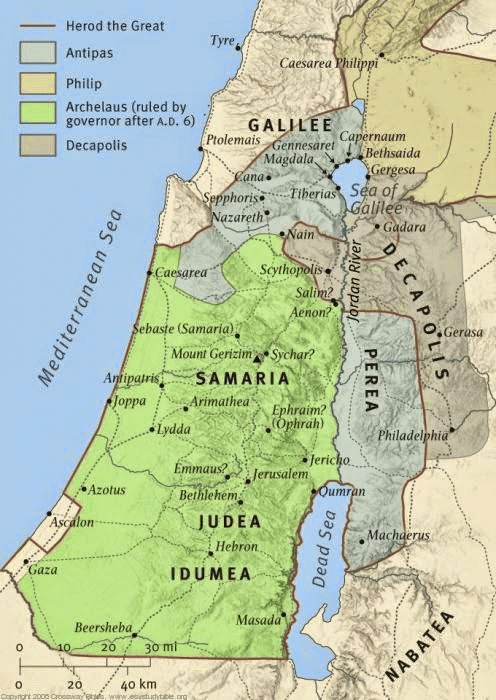
The disciples were headed to Bethsaida, hometown of James and John, Simon (Peter) and Andrew, and Philip. This is the place where some believe the Christian sign of the fish may have originated and also one of the cities that Jesus denounced for their lack of faith. In Aramaic, the name means “fish town,” and the entire population (which was greater in the first century than today) was likely employed in the fishing industry. It was probably located on the northeastern tip of the Sea of Galilee, near the Decapolis, in part of an area that is now known as Golan Heights (The Word in Life Study Bible pg. 1727). There has been considerable debate about the actual location, but since the information is mainly useful as a visual aid, I included a map. I’m not educated enough about the geography of the area to have an opinion about the location of the miracle or Bethsaida, but it does help to have some understanding of the proximity of one city to another. I also like this map because it shows a little of the topography, so you can see how quickly Jesus might have found a mountainside. 

Jesus was born to be a leader, and His charisma attracted many followers; however, those followers misunderstood the purpose and particulars of His leadership and tried to attach their own agenda to his mission. Jesus had already proven that He could overcome the temptation of power because He had withstood Satan’s antagonization in the desert, but we don’t often consider the fact that Jesus may have been tempted at other times, including this attempt to declare Him king. Instead, He held fast to the purpose the Father had designated for Him, and He withdrew to the mountain. His willpower is further displayed in the fact that He had wanted to rest (verse 31), but He decided it was more important to pray.  

He made His usual choice of locations to pray, which was on a mountainside. Mountains have been a favorite place to commune with God throughout the Bible’s history – Moses, Elijah, and many others. In fact, mountains are mentioned over 500 times in the Bible, and many of the mountaintop encounters with God were significant biblical events, such as the writing of the ten commandments on Mount Sinai, the location of the Jerusalem temple on Mount Zion, the landing of the ark on Mount Ararat, and the defeat of the prophets of Baal on Mount Carmel. Jesus famously spent quite a lot of time on mountains: His temptation (Matthew 4:8), the Sermon on the Mount (Matthew 5:1-12), a number of healings (Matthew 15:29-31), His pre-crucifixion prayer vigil on the Mount of Olives (Luke 22:39), the Transfiguration (Matthew 17:1), His final discourse (Matthew 24:3), and the commissioning of the Apostles (Matthew 28:16-20). While some of those events were observed by the disciples and other witnesses, reports of the temptation and other private thoughts of Jesus’s must have been reported by Jesus after the fact and subsequently relayed in the gospel accounts. In this case (His prayer on the mountainside following the feeding of the 5,000), he either did not share His experience with the disciples or they did not deem it crucial to the narrative when writing their accounts. This begs the question: what was so urgent to lift up in prayer that He would forsake the rest He desired and needed? Some commentaries suggest that Jesus purposely avoided disrupting the regular government function at the time, and He would have been anxious to avoid the mantle of a rebel leader so he could focus on His ministry. Other commentaries suggest that He might have been praying for the hearts of His disciples and the crowds, that their violent intentions would be quieted and that their misperceptions about His purpose would be righted. 

The crowd’s interest in making Jesus king has some significant tie-ins with the miracle of loaves and fishes that they just witnessed. Jesus is the bread of life and famously told the woman at the well to forsake her earthly thirst to partake in living water, so we know that Jesus came to Earth to offer spiritual sustenance. Yet the crowd needed and demanded physical sustenance, just like the Israelites in the wilderness, and Jesus symbolically gave thanks, broke the bread (symbolism: passover, crucifixion), and obliged their temporal need. Likewise, Jesus came to Earth to be a spiritual leader, whereas the people were looking for someone to physically liberate them in the short-term. In this, Jesus could not indulge them, and it is clear that all the symbolism and allusions by Jesus went over their heads. They insisted on crowning Him, whether or not He was even willing! How often do we attempt to fit God into the mold we have created, rather than adapt our desires and expectations to who He actually is? 

See next post here https://onthepath.online/2024/09/17/walking-on-water/

References 

Matthew 14:22 

Matthew 14:21 About five thousand men were fed, in addition to women and children. 
 
Acts 18:5 And when Silas and Timothy came down from Macedonia, Paul devoted himself fully to the word, testifying to the Jews that Jesus is the Christ. 

Matthew 14:23 

Mark 1:35 Early in the morning, while it was still dark, Jesus got up and slipped out to a solitary place to pray. 
 

Luke 3:21 When all the people were being baptized, Jesus was baptized too. And as He was praying, heaven was opened, 
 

Luke 5:16 Yet He frequently withdrew to the wilderness to pray. 
 
Luke 6:12 In those days Jesus went out to the mountain to pray, and He spent the night in prayer to God. 
 
Luke 9:18 One day as Jesus was praying in private and the disciples were with Him, He questioned them: “Who do the crowds say I am?” 
 
Luke 9:28 About eight days after Jesus had said these things, He took with Him Peter, John, and James, and went up on a mountain to pray. 

Matthew 14:23 

Mark 1:35 Early in the morning, while it was still dark, Jesus got up and slipped out to a solitary place to pray. 
 
Luke 3:21 When all the people were being baptized, Jesus was baptized too. And as He was praying, heaven was opened, 
 
Luke 5:16 Yet He frequently withdrew to the wilderness to pray. 
 
Luke 6:12 In those days Jesus went out to the mountain to pray, and He spent the night in prayer to God. 
 
Luke 9:18 One day as Jesus was praying in private and the disciples were with Him, He questioned them: “Who do the crowds say I am?” 
 
Luke 9:28 About eight days after Jesus had said these things, He took with Him Peter, John, and James, and went up on a mountain to pray. 

Mark 6:45 

Matthew 11:21 “Woe to you, Chorazin! Woe to you, Bethsaida! For if the miracles that were performed in you had been performed in Tyre and Sidon, they would have repented long ago in sackcloth and ashes. 
 
Mark 6:32 So they went away in a boat by themselves to a solitary place. 
 
Mark 8:22 When they arrived at Bethsaida, some people brought a blind man and begged Jesus to touch him. 
 
John 6:17 got into a boat, and started across the sea to Capernaum. It was already dark, and Jesus had not yet gone out to them. 

Mark 6:46 

Mark 6:47 When evening came, the boat was in the middle of the sea, and Jesus was alone on land. 
 
Acts 18:18 Paul remained in Corinth for quite some time before saying goodbye to the brothers. He had his head shaved in Cenchrea to keep a vow he had made, and then he sailed for Syria, accompanied by Priscilla and Aquila. 
 
Acts 18:21 But as he left, he said, “I will come back to you if God is willing.” And he set sail from Ephesus. 
 
2 Corinthians 2:13 I had no peace in my spirit, because I did not find my brother Titus there. So I said goodbye to them and went on to Macedonia. 

John 6:14 

Matthew 11:3 to ask Him, “Are You the One who was to come, or should we look for someone else?” 
 
Matthew 21:11 
The crowds replied, “This is Jesus, the prophet from Nazareth in Galilee.” 
 
John 1:21 
“Then who are you?” they inquired. “Are you Elijah?” He said, “I am not.” “Are you the Prophet?” He answered, “No.” 
 

John 2:11 Jesus performed this, the first of His signs, at Cana in Galilee. He thus revealed His glory, and His disciples believed in Him. 
 
John 4:19 “Sir,” the woman said, “I see that You are a prophet. 
 
John 6:2 A large crowd followed Him because they saw the signs He was performing on the sick. 
 
John 6:26 Jesus replied, “Truly, truly, I tell you, it is not because you saw these signs that you are looking for Me, but because you ate the loaves and had your fill. 

Commentary 

Mark 6:31 And He said to them, “Come aside by yourselves to a deserted place and rest a while.” For there were many coming and going, and they did not even have time to eat. 

John 18:36  Jesus answered, “My kingdom is not of this world. If My kingdom were of this world, My servants would be fighting so that I would not be handed over to the Jews; but as it is, My kingdom is not of this realm.” 

Mistaken Identification of Jesus

85 – Mistaken Identification of Jesus; Matthew 14:1-2, Mark 6:14-16, Luke 9:7-9 

Matthew 14:1 At that time Herod the tetrarch heard the reports about Jesus, 2 and he said to his attendants, “This is John the Baptist; he has risen from the dead! That is why miraculous powers are at work in him.” 

Mark 6:14 King Herod heard about this, for Jesus’ name had become well known. Some were saying, [a] “John the Baptist has been raised from the dead, and that is why miraculous powers are at work in him.” 15 Others said, “He is Elijah.” And still others claimed, “He is a prophet, like one of the prophets of long ago.” 16 But when Herod heard this, he said, “John, whom I beheaded, has been raised from the dead!” 

Luke 9:7 Now Herod the tetrarch heard about all that was going on. And he was perplexed because some were saying that John had been raised from the dead, 8 others that Elijah had appeared, and still others that one of the prophets of long ago had come back to life. 9 But Herod said, “I beheaded John. Who, then, is this I hear such things about?” And he tried to see him. 

Footnotes (Mark) 

a. Mark 6:14 Some early manuscripts He was saying 

Commentary 

Antipas had executed John, which we discussed in another study. In this passage, he is called Herod the tetrarch, and the term tetrarch referred to a ruler of one-fourth of the kingdom previously ruled by his father, King Herod (see the map below). King Herod ruled at the time Jesus was born, and he sought to eliminate any competition for the throne by killing all baby boys. Similarly, Antipas was anxious to maintain power, and, since he had already proven his callousness by killing John the Baptist, his “interest in Jesus surely had more to do with political expediency than any religious sincerity. So it was with most of the other authorities that encountered Jesus, His followers, and the gospel. Luke says Herod tried to see Jesus, which implies that he was not successful at the time. Luke later refers back to Herod’s interest in seeing Jesus when he describes Herod’s long-awaited meeting with Him “during the mock trials prior to Christ’s death (Lk 23:7-12)” (Nelson KJV Bible Commentary pg. 1276). None of them recognized who it was they were dealing with; if they had, Paul later wrote, “they would not have crucified the Lord of glory” (1 Cor. 2:8)” (The Word in Life Study Bible pg. 1800).  

“[Herod’s] ignorance of Jesus prior to this time is probably due to his self-indulgent, luxurious life-style that had little contact with religious figures. His guilty conscience over John’s death caused him to think Jesus was John the Baptist risen from the dead. His fear of the resurrection indicates its widespread belief in those days” (Nelson KJV Bible Commentary pg. 1202). Most scholars believe Herod was a Sadducee, which means, if he respected the creed of his sect, he should not have believed in angels, demons, Heaven, Hell, or resurrection. Sadducees were commonly in positions of power, and their corruption was well-known and widespread. As a member of a superficial and legalistic sect, Herod could privately think and act in ways that were inconsistent with the tenets of his religious group, but the reason several gospel authors thought it so remarkable that he admitted out loud his premonition about John’s resurrection is that it spoke to his guilt over John’s unjust death. “At that time the views of Pythagoras respecting the transmigration of souls were generally current, and probably influenced the troubled mind of Herod. He had put to death an innocent and holy man; and it is a high testimony to the worth of the Baptist that, under the reproaches of a guilty conscience, Herod should have come to the conclusion that he had risen from the dead, thus probably giving the lie to his own opinions as a Sadducee; and terrified lest the Baptist should now avenge his own murder” (https://biblehub.com/mark/6-14.htm). 

In this sermon Eric Groover Mark 6:14-16 Sermon 

 pastor Eric Groover gives some context to the story, and he raises another interesting suggestion. Not only is it petrifying to think about the ghost of the man you unjustly killed and what he means to do to you, but also, the very message for which he was executed is now preached again – repent, for the kingdom of God is near. Even if it isn’t John the Baptist, but another prophet, the message is still alive and unable to be stifled. It is the same message that fascinated and terrified Herod enough to imprison John in the first place, while causing him to have misgivings about putting John to death. 

Before John was even born, when the angel told Zechariah that his wife would bear a son, he said John would go before the Messiah in the spirit and power of Elijah (Luke 1:17).  Luke 9:8 says some people thought Jesus was Elijah, and some people thought He was one of the old prophets. At the time, the Hebrews were looking for the return of Elijah, but they were also anticipating the return of Isaiah and Jeremiah in advance of the Messiah. It seems the people got it confused; John was the one who was sent in the spirit of Elijah, and Jesus was the Messiah Himself. To affirm John’s reflection of Elijah, we can look from the story of Herod, Herodias, and John to the story of Ahab, Jezebel, and Elijah. “In both cases we have the weak ruler, the beautiful she-devil at his side, inspiring him for all evil, and the stern prophet, the rebuker and the incarnate conscience for them both” (https://biblehub.com/commentaries/mark/6-16.htm).  

Find the next post here https://onthepath.online/2024/04/24/trying-to-make-jesus-king/

References 

Matthew 14:1 

Matthew 9:26 And the news about this spread throughout that region. 

Matthew 9:31 But they went out and spread the news about Him throughout the land. 

Mark 8:15 “Watch out!” He cautioned them. “Beware of the leaven of the Pharisees and of Herod.” 

Luke 3:1 In the fifteenth year of the reign of Tiberius Caesar, while Pontius Pilate was governor of Judea, Herod tetrarch of Galilee, his brother Philip tetrarch of Ituraea and Trachonitis, and Lysanias tetrarch of Abilene, 

Luke 3:19 But when he rebuked Herod the tetrarch regarding his brother’s wife Herodias and all the evils he had done, 

Matthew 14:2 

Matthew 3:1 In those days John the Baptist came, preaching in the wilderness of Judea 

Matthew 16:14 They replied, “Some say John the Baptist; others say Elijah; and still others, Jeremiah or one of the prophets.” 

Mark 6:14 

Matthew 14:3 Now Herod had arrested John and bound him and put him in prison on account of Herodias, his brother Philip’s wife, 

Matthew 14:6 On Herod’s birthday, however, the daughter of Herodias danced before them and pleased Herod 

Mark 8:28 They replied, “Some say John the Baptist; others say Elijah; and still others, one of the prophets.” 

Luke 9:19 They replied, “Some say John the Baptist; others say Elijah; and still others, that a prophet of old has arisen.” 

Mark 6:15 

Matthew 16:14 They replied, “Some say John the Baptist; others say Elijah; and still others, Jeremiah or one of the prophets.” 

Matthew 21:11 The crowds replied, “This is Jesus, the prophet from Nazareth in Galilee.” 

Mark 8:28 They replied, “Some say John the Baptist; others say Elijah; and still others, one of the prophets.” 

Mark 6:16 

Mark 6:17 For Herod himself had ordered that John be arrested and bound and imprisoned, on account of his brother Philip’s wife Herodias, whom Herod had married. 

Luke 9:7 

Matthew 11:2 Meanwhile John heard in prison about the works of Christ, and he sent his disciples 

Mark 8:28 They replied, “Some say John the Baptist; others say Elijah; and still others, one of the prophets.” 

Luke 3:1 In the fifteenth year of the reign of Tiberius Caesar, while Pontius Pilate was governor of Judea, Herod tetrarch of Galilee, his brother Philip tetrarch of Ituraea and Trachonitis, and Lysanias tetrarch of Abilene, 

Luke 13:31 At that very hour, some Pharisees came to Jesus and told Him, “Leave this place and get away, because Herod wants to kill You.” 

Luke 9:8 

Matthew 16:14 They replied, “Some say John the Baptist; others say Elijah; and still others, Jeremiah or one of the prophets.” 

Mark 8:28 They replied, “Some say John the Baptist; others say Elijah; and still others, one of the prophets.” 

Luke 9:9 

Luke 23:8 When Herod saw Jesus, he was greatly pleased. He had wanted to see Him for a long time, because he had heard about Him and was hoping to see Him perform a miracle. 

Luke 23:15 Neither has Herod, for he sent Him back to us. As you can see, He has done nothing deserving of death. 

Commentary 

Luke 23:7-12 When he learned that Jesus was under Herod’s jurisdiction, he sent him to Herod, who was also in Jerusalem at that time. 8 When Herod saw Jesus, he was greatly pleased, because for a long time he had been wanting to see him. From what he had heard about him, he hoped to see him perform a sign of some sort. 9 He plied him with many questions, but Jesus gave him no answer. 10 The chief priests and the teachers of the law were standing there, vehemently accusing him. 11 Then Herod and his soldiers ridiculed and mocked him. Dressing him in an elegant robe, they sent him back to Pilate. 12 That day Herod and Pilate became friends—before this they had been enemies. 

Luke 1:17 It is he who will go as a forerunner before Him in the spirit and power of Elijah, TO TURN THE HEARTS OF THE FATHERS BACK TO THE CHILDREN, and the disobedient to the attitude of the righteous, so as to make ready a people prepared for the Lord. 

Feeding the Five Thousand

84 – Feeding the Five Thousand; Matthew 14:15-21, Mark 6:35-44, Luke 9:12-17, John 6:4-13 

Matthew 14:15 As evening approached, the disciples came to him and said, “This is a remote place, and it’s already getting late. Send the crowds away, so they can go to the villages and buy themselves some food.” 

16 Jesus replied, “They do not need to go away. You give them something to eat.” 

17 “We have here only five loaves of bread and two fish,” they answered. 

18 “Bring them here to me,” he said. 19 And he directed the people to sit down on the grass. Taking the five loaves and the two fish and looking up to heaven, he gave thanks and broke the loaves. Then he gave them to the disciples, and the disciples gave them to the people. 20 They all ate and were satisfied, and the disciples picked up twelve basketfuls of broken pieces that were left over. 21 The number of those who ate was about five thousand men, besides women and children. 

Mark 6:35 By this time it was late in the day, so his disciples came to him. “This is a remote place,” they said, “and it’s already very late. 36 Send the people away so that they can go to the surrounding countryside and villages and buy themselves something to eat.” 

37 But he answered, “You give them something to eat.” 

They said to him, “That would take more than half a year’s wages[a]! Are we to go and spend that much on bread and give it to them to eat?” 

38 “How many loaves do you have?” he asked. “Go and see.” 

When they found out, they said, “Five—and two fish.” 

39 Then Jesus directed them to have all the people sit down in groups on the green grass. 40 So they sat down in groups of hundreds and fifties. 41 Taking the five loaves and the two fish and looking up to heaven, he gave thanks and broke the loaves. Then he gave them to his disciples to distribute to the people. He also divided the two fish among them all. 42 They all ate and were satisfied, 43 and the disciples picked up twelve basketfuls of broken pieces of bread and fish. 44 The number of the men who had eaten was five thousand. 

Luke 9:12 Late in the afternoon the Twelve came to him and said, “Send the crowd away so they can go to the surrounding villages and countryside and find food and lodging, because we are in a remote place here.” 

13 He replied, “You give them something to eat.” 

They answered, “We have only five loaves of bread and two fish—unless we go and buy food for all this crowd.” 14 (About five thousand men were there.) 

But he said to his disciples, “Have them sit down in groups of about fifty each.” 15 The disciples did so, and everyone sat down. 16 Taking the five loaves and the two fish and looking up to heaven, he gave thanks and broke them. Then he gave them to the disciples to distribute to the people. 17 They all ate and were satisfied, and the disciples picked up twelve basketfuls of broken pieces that were left over. 

John 6:4 The Jewish Passover Festival was near. 

5 When Jesus looked up and saw a great crowd coming toward him, he said to Philip, “Where shall we buy bread for these people to eat?” 6 He asked this only to test him, for he already had in mind what he was going to do. 

7 Philip answered him, “It would take more than half a year’s wages[a] to buy enough bread for each one to have a bite!” 

8 Another of his disciples, Andrew, Simon Peter’s brother, spoke up, 9 “Here is a boy with five small barley loaves and two small fish, but how far will they go among so many?” 

10 Jesus said, “Have the people sit down.” There was plenty of grass in that place, and they sat down (about five thousand men were there). 11 Jesus then took the loaves, gave thanks, and distributed to those who were seated as much as they wanted. He did the same with the fish. 

12 When they had all had enough to eat, he said to his disciples, “Gather the pieces that are left over. Let nothing be wasted.” 13 So they gathered them and filled twelve baskets with the pieces of the five barley loaves left over by those who had eaten. 

Footnotes 

Mark 

a. Mark 6:37 Greek take two hundred denarii 

John 

a. John 6:7 Greek take two hundred denarii 

Commentary 

To get a feel for the setting of this miracle, we not only have to look at the descriptions of the hilly wilderness, but also at the timeline. John’s gospel account of this event begins by telling his audience that the time of the Passover feast was drawing near. “This is one of the circumstances of explanation thrown in by John which show that he wrote for those who were unacquainted with Jewish customs” (Barnes’ Notes on the Bible, https://biblehub.com/commentaries/john/6-4.htm). Although some scholars believe it is just a note to mark the time, some believe it is an important detail because the uninformed reader may have disbelieved that such a large crowd could gather in that area. However, because of the pilgrimage of Jews to Jerusalem, people would have been present in the wilderness areas, and a crowd could have assembled quickly.  

To further explore the timeline, we can also look at what was happening in Jesus’s life and ministry at this moment in time. Jesus is under extreme pressure at this point. He has just been informed that John the Baptist was killed, and He knows His life is in danger. Furthermore, He is mourning the loss of his cousin, a great messenger of God, and He has retreated to the wilderness to grieve and find refuge from those who would do Him harm. However, even in this desperate state, He still ministers to the people who find Him there, and He performs two of the greatest miracles we have on record (feeding the five thousand and walking on water).  

At the end of the last study, we recapped the scene where Jesus had retreated with the disciples so they could rest. He and the disciples had not eaten because of the frenzy of the crowds, and they specifically chose a remote area where it would be unlikely they would encounter anyone. This also meant that it would be unlikely that they would encounter a food vendor, and they still hadn’t eaten (at least, not that we know of). The crowds had found them out, and Jesus had shown them compassion by healing them and teaching them many things. They were all situated on a hillside, listening to Jesus teach, when the disciples (still hungry themselves, as many scholars suggest) approached Jesus to remind Him what time it was and that the people needed to go get something to eat. Since the accounts differ slightly in the details of who initiated the discussion about food, it may be helpful to consider that the disciples may have first approached Jesus about sending the crowd away, and then Jesus turned specifically to Philip, who was from Bethsaida (a nearby city) to ask where to procure food (and also to test him). This test wasn’t to shame Philip or prove him a failure, but it was an educational tool Jesus used. Philip, on many other occasions, displayed great faith. “Philip had said in the first instance to Nathanael, “Come and see.” “Seeing is believing;” and Philip, on the night of the Passion, after much hearing and seeing of Jesus, said, “Lord, show us the Father, and it sufficeth us;”” (Pulpit Commentary, https://biblehub.com/commentaries/john/6-6.htm).  

When Jesus asks how much bread there is, notice in Mark and Luke that the authors indicate someone in their party has brought the bread and fish. “There is a lad here (possibly a lad who was brought with themselves, or who had attached himself to the twelve) who has five barley loaves, the bread of the poorest classes” (Pulpit Commentary, https://biblehub.com/commentaries/john/6-8.htm). Most of the time, this scene is depicted with the disciples running around asking the crowd if they have any food with them, but they may not have had to look as far as that. It would have been quite a task to ask everyone, since there could have been up to 15,000 or more people present. “Besides the five thousand men a large uncounted group of women and children were fed” (Nelson KJV Bible Commentary pg. 1203).  

The bread provided by the boy was the Greek word “artos,” which is flat and round like pita. Even though there was such a miniscule quantity, Jesus gave thanks for it before it had ever multiplied. Gratitude is not dependent on the sufficiency of provision but on the heart of the receiver. Remember that the people were not the ones who asked for food; they only wanted to see Jesus and hear Him teach, but He had compassion on them to resolve this unspoken physical need. Further, once there was an abundance of food, Jesus insisted that God’s blessing should not be squandered. Waste due to excess is not part of God’s will when He blesses us. More likely, when we are blessed with “more than we can ask or imagine,” we are meant to use the overflow to bless someone else. “The twelve baskets collected were like little travel bags and probably provided sustenance for the disciples as they went to the Passover which was approaching” (Nelson KJV Bible Commentary pg. 1277). 

Understand what a big deal it is that these four accounts corroborate the same story. This is the only one of Jesus’s ministry miracles recorded in all 4 gospels, so its significance should be obvious. However, the fact that four authors give similar details about the same man’s life and that those accounts have been preserved with such integrity is nothing short of miraculous. Despite what it may seem, the small deviations in the stories actually make them more credible because it shows the authors did not collude. These accounts all independently give credence to their historicity and to the miraculous nature of Jesus’s work. The authors all went to the trouble of describing exactly the materials Jesus was working with, and they explained that the event was very organized (people sitting in groups of about 50 to 100), which made it very easy to calculate the full number of men there. This detail also reduces the chances that a chaotic environment lent itself to confusion or hyperbole in the retelling. The miracle itself is further proven by the fact that the disciples collected leftovers; this means no one could say the crowd restrained themselves due to a scarcity of food, and a record of the specific volume of leftovers increases the believability even more. No one exaggerated how much food was left over because it was measured, and it handily worked out to be the same number of baskets as the number of disciples. 

Had you been present, you may have found yourself convinced of Jesus’s deity when you received healing, insightful teaching, and a full meal out of one boy’s lunch. However, despite that this meal initially convinced people of Jesus’s legitimacy (John 6:14), they soon began to doubt Him because He only fed people one meal (this time – there is another account of a large feeding miracle), whereas Moses had fed the Jews for 40 years in the wilderness (John 6:30-31). They returned seeking more bread from Jesus in John 6:22-26. “Incredibly, they had missed the point of the sign: Jesus was not merely a deliveryman, He was the Bread of Life itself (6:32-58)” (The Word in Life Study Bible pg. 1875). How easily we are distracted from our greatest and noblest objectives when we are consumed with temporal desires. 

Find the next post here https://onthepath.online/2024/04/24/mistaken-identification-of-jesus/

References 

Matthew 14:15 

Matthew 14:13 When Jesus heard about John, He withdrew by boat privately to a solitary place. But the crowds found out about it and followed Him on foot from the towns. 
 
Matthew 14:14 When He stepped ashore and saw a large crowd, He had compassion on them and healed their sick. 

Matthew 14:16 

2 Kings 4:42 Now a man from Baal-shalishah came to the man of God with a sack of twenty loaves of barley bread from the first ripe grain. “Give it to the people to eat,” said Elisha. 

Matthew 14:17 

Matthew 16:9 Do you still not understand? Do you not remember the five loaves for the five thousand, and how many basketfuls you gathered? 

Matthew 14:19 

1 Samuel 9:13 
As soon as you enter the city, you will find him before he goes up to the high place to eat. The people will not eat until he comes, because he must bless the sacrifice; after that, the guests will eat. Go up at once; you will find him.” 
 
Matthew 15:36 Taking the seven loaves and the fish, He gave thanks and broke them. Then He gave them to the disciples, and the disciples gave them to the people. 
 
Matthew 26:26 While they were eating, Jesus took bread, spoke a blessing and broke it, and gave it to the disciples, saying, “Take and eat; this is My body.” 
 
Mark 8:7 They also had a few small fish, and Jesus blessed them and ordered that these be set before them as well. 
 
Mark 14:22 While they were eating, Jesus took bread, spoke a blessing and broke it, and gave it to the disciples, saying, “Take it; this is My body.” 

Matthew 14:20 

2 Kings 4:6 When all the jars were full, she said to her son, “Bring me another.” But he replied, “There are no more jars.” Then the oil stopped flowing. 
 
2 Kings 4:44 So he set it before them, and they ate and had some left over, according to the word of the LORD. 
 
 
Matthew 15:37 They all ate and were satisfied, and the disciples picked up seven basketfuls of broken pieces that were left over. 
 
Matthew 16:9 Do you still not understand? Do you not remember the five loaves for the five thousand, and how many basketfuls you gathered? 
 
Mark 8:8 The people ate and were satisfied, and the disciples picked up seven basketfuls of broken pieces that were left over. 

Matthew 14:21 

Matthew 14:22 Immediately Jesus made the disciples get into the boat and go on ahead of Him to the other side, while He dismissed the crowds. 

Mark 6:35 

Matthew 14:13 When Jesus heard about John, He withdrew by boat privately to a solitary place. But the crowds found out about it and followed Him on foot from the towns. 
 
Mark 6:34 When Jesus stepped ashore and saw a large crowd, He had compassion on them, because they were like sheep without a shepherd. And He began to teach them many things. 

Mark 6:37 

Matthew 18:28 But when that servant went out, he found one of his fellow servants who owed him a hundred denarii. He grabbed him and began to choke him, saying, ‘Pay back what you owe me!’ 
 
Luke 7:41 “Two men were debtors to a certain moneylender. One owed him five hundred denarii, and the other fifty. 

Mark 6:41 

Mark 8:19 When I broke the five loaves for the five thousand, how many basketfuls of broken pieces did you collect?” “Twelve,” they answered. 

Mark 6:44 

Mark 6:45 Immediately Jesus made His disciples get into the boat and go on ahead of Him to Bethsaida, while He dismissed the crowd. 

Luke 9:12 

Matthew 14:13 When Jesus heard about John, He withdrew by boat privately to a solitary place. But the crowds found out about it and followed Him on foot from the towns. 
 
Luke 9:11 But the crowds found out and followed Him. He welcomed them and spoke to them about the kingdom of God, and He healed those who needed healing. 
 
Philippians 1:19 because I know that through your prayers and the provision of the Spirit of Jesus Christ, my distress will turn out for my deliverance. 

Luke 9:13 

2 Kings 4:43 But his servant asked, “How am I to set twenty loaves before a hundred men?” “Give it to the people to eat,” said Elisha, “for this is what the LORD says: ‘They will eat and have some left over.'” 

Luke 9:16 

1 Samuel 9:13 As soon as you enter the city, you will find him before he goes up to the high place to eat. The people will not eat until he comes, because he must bless the sacrifice; after that, the guests will eat. Go up at once; you will find him.” 

John 6:4 

Deuteronomy 16:1 Observe the month of Abib and celebrate the Passover to the LORD your God, because in the month of Abib the LORD your God brought you out of Egypt by night. 
 
John 2:13 When the Jewish Passover was near, Jesus went up to Jerusalem. 

John 6:5 

Numbers 11:13 Where can I get meat for all these people? For they keep crying out to me, ‘Give us meat to eat!’ 
 
Mark 6:32 So they went away in a boat by themselves to a solitary place. 
 
Luke 9:10 Then the apostles returned and reported to Jesus all that they had done. Taking them away privately, He withdrew to a town called Bethsaida. 
 
John 1:43 The next day Jesus decided to set out for Galilee. Finding Philip, He told him, “Follow Me.” 
 
John 1:44 Now Philip was from Bethsaida, the same town as Andrew and Peter. 
 
John 1:45 Philip found Nathanael and told him, “We have found the One Moses wrote about in the Law, the One the prophets foretold–Jesus of Nazareth, the son of Joseph.” 
 
John 1:46 “Can anything good come from Nazareth?” Nathanael asked. “Come and see,” said Philip. 

John 6:6 

2 Corinthians 13:5 Examine yourselves to see whether you are in the faith; test yourselves. Can’t you see for yourselves that Jesus Christ is in you–unless you actually fail the test? 
 
Revelation 2:2 I know your deeds, your labor, and your perseverance. I know that you cannot tolerate those who are evil, and you have tested and exposed as liars those who falsely claim to be apostles. 

John 6:7 

Matthew 18:28 But when that servant went out, he found one of his fellow servants who owed him a hundred denarii. He grabbed him and began to choke him, saying, ‘Pay back what you owe me!’ 
 
John 1:43 The next day Jesus decided to set out for Galilee. Finding Philip, He told him, “Follow Me.” 
 
John 1:44 Now Philip was from Bethsaida, the same town as Andrew and Peter. 
 
John 1:45 Philip found Nathanael and told him, “We have found the One Moses wrote about in the Law, the One the prophets foretold–Jesus of Nazareth, the son of Joseph.” 
 
John 1:46 
“Can anything good come from Nazareth?” Nathanael asked. “Come and see,” said Philip. 
 
John 1:48 “How do You know me?” Nathanael asked. Jesus replied, “Before Philip called you, I saw you under the fig tree.” 

John 6:8 

John 1:40 Andrew, Simon Peter’s brother, was one of the two who heard John’s testimony and followed Jesus. 
 
John 2:2 and Jesus and His disciples had also been invited to the wedding. 

John 6:9 

2 Kings 4:43 But his servant asked, “How am I to set twenty loaves before a hundred men?” “Give it to the people to eat,” said Elisha, “for this is what the LORD says: ‘They will eat and have some left over.'” 
 
John 21:9 When they landed, they saw a charcoal fire there with fish on it, and some bread. 
 
John 21:10 Jesus told them, “Bring some of the fish you have just caught.” 
 
John 21:13 Jesus came and took the bread and gave it to them, and He did the same with the fish. 

John 6:11 

1 Samuel 9:13 As soon as you enter the city, you will find him before he goes up to the high place to eat. The people will not eat until he comes, because he must bless the sacrifice; after that, the guests will eat. Go up at once; you will find him.” 
 
Matthew 15:36 Taking the seven loaves and the fish, He gave thanks and broke them. Then He gave them to the disciples, and the disciples gave them to the people. 
 
John 6:23 However, some boats from Tiberias landed near the place where the people had eaten the bread after the Lord had given thanks. 
 
John 21:9When they landed, they saw a charcoal fire there with fish on it, and some bread. 
 
John 21:10 Jesus told them, “Bring some of the fish you have just caught.” 
 
John 21:13 Jesus came and took the bread and gave it to them, and He did the same with the fish. 

John 6:12 

John 2:2 and Jesus and His disciples had also been invited to the wedding. 

John 6:13 

2 Kings 4:44 So he set it before them, and they ate and had some left over, according to the word of the LORD. 

Disciples Return and Then Withdraw With Jesus

83 – Disciples Return and Then Withdraw With Jesus; Matthew 14:13-14, Mark 6:30-34, Luke 9:10-11, John 6:1-3 

Matthew 14:13 When Jesus heard what had happened, he withdrew by boat privately to a solitary place. Hearing of this, the crowds followed him on foot from the towns. 14 When Jesus landed and saw a large crowd, he had compassion on them and healed their sick. 

Mark 6:30 The apostles gathered around Jesus and reported to him all they had done and taught. 31 Then, because so many people were coming and going that they did not even have a chance to eat, he said to them, “Come with me by yourselves to a quiet place and get some rest.” 

32 So they went away by themselves in a boat to a solitary place. 33 But many who saw them leaving recognized them and ran on foot from all the towns and got there ahead of them. 34 When Jesus landed and saw a large crowd, he had compassion on them, because they were like sheep without a shepherd. So he began teaching them many things. 

Luke 9:10 When the apostles returned, they reported to Jesus what they had done. Then he took them with him and they withdrew by themselves to a town called Bethsaida, 11 but the crowds learned about it and followed him. He welcomed them and spoke to them about the kingdom of God, and healed those who needed healing. 

John 6:1 Some time after this, Jesus crossed to the far shore of the Sea of Galilee (that is, the Sea of Tiberias), 2 and a great crowd of people followed him because they saw the signs he had performed by healing the sick. 3 Then Jesus went up on a mountainside and sat down with his disciples 

Commentary 

Jesus’s response to the people here is a gut check to those of us who let our circumstances dictate our attitudes. Jesus was grieving the loss of His cousin and a great man of God, He was eager to remove Himself from both Herod’s potentially dangerous intentions toward Him and the public’s fanaticism about Him, and He had clearly intended to unplug for a while to rest. He also recognized that the disciples would be tired after their evangelical tour, and He invited them to come along for a respite, as well. When the people so persistently pursued Him, He could have been very annoyed and might have felt justified in turning them away. However, He instead felt compassion for them, and He put aside His own pain and exhaustion in order to heal and teach them. Mark says Jesus saw the people as sheep without a shepherd, and, since I do not personally identify with the shepherd metaphor, I liken this to the perspective of a parent who hasn’t had any sleep and is desperate for rest, but the children are sick and need care. They can’t be held accountable for their role in the parent’s exhaustion, and they can’t be left to fend for themselves. So the parent does what he or she must, and foregoes sleep yet again. 

I’d like to explore each of the possible motives for Jesus’s retreat. First, He was grieving. It is unlikely that Jesus and John were well-acquainted when they were growing up, but Mary probably told Jesus the story of John jumping in Elizabeth’s womb. The two of them met as adults when Jesus went to be baptized, and Jesus was very vocal about the importance of John’s role in preceding Him. He also admired John’s resolute commitment to the lifestyle and message which were the calling on his life. “What did you go out into the wilderness to see? A reed swayed by the wind? 25 If not, what did you go out to see? A man dressed in fine clothes? No, those who wear expensive clothes and indulge in luxury are in palaces. 26 But what did you go out to see? A prophet? Yes, I tell you, and more than a prophet. 27 This is the one about whom it is written: ‘I will send my messenger ahead of you, 
who will prepare your way before you’” (Luke 7:24-27). This message was delivered to the crowd immediately after John sent his question from prison about Jesus’s authenticity, and Jesus did not rebuke him, but patiently responded. Not only did Jesus acknowledge John’s contribution to the work of the kingdom, but He allowed John’s question, as it was John’s honest desire to affirm that he had been properly attending the voice of God and that his work was complete. All this to say Jesus would have been moved by the death of His cousin for many reasons. Being fully God, He knew the cost of the gospel and the beautiful redemption it would bring, but being fully man, He grieved the tragedy of John’s unjust and painful end. 

As I mentioned Jesus may also have been searching for a safe haven in the wake of John’s death. “When Jesus heard of it,… Of the death of John, and of the cruel usage he had met with; and particularly, that his fame had reached the court of Herod, and that he was talked of there, and said by Herod himself to be John the Baptist, that was risen from the dead; he departed thence by ship, into a desert place apart; to avoid Herod, though not through fear of death; but because his time was not yet come: which may teach us, that it is lawful to shun dangers, when there is an opportunity; which may be done, without betraying truth, or sacrificing a good conscience” (Gill’s Exposition of the Entire Bible). “He never threw himself unnecessarily into danger. It was proper that he should secure his life until the appointed time had come for him to die… He went to the country east of the sea, into a place little inhabited. Luke says (Luke 9:10) he went to a place called Bethsaida… “A desert place” means a place little cultivated, where there were few or no inhabitants. On the east of the Sea of Galilee there was a large tract of country of this description rough, uncultivated, and chiefly used to pasture flocks” (Barnes’ Notes on the Bible). Jesus specifically chose a place where it was unlikely He would encounter anyone, as this solitude would facilitate both His safety and His repose. 

Of Jesus’s need for rest, the gospel writers gave several accounts throughout His ministry. Generally, He withdrew to spend time with the Father, either on the heels or on the cusp of a big event that sapped (or would sap) His strength. In this case, He had just finished a period of intense ministry when He and the disciples had gone separately to evangelize in the surrounding area. Their work generated a lot of fame and frenzy, and while the disciples were eager to tell Jesus everything that had happened to each of them, the people were still pressing on the group so urgently that none of them had time to eat. Jesus recognized that all the men needed to attend to their physical and spiritual needs by retiring to someplace lonely for a while. Even those who are doing good work need rest. However, they had to find their second wind as the crowds discovered their plan and preceded them to their destination. Knowing that the disciples had not eaten and that the place Jesus had chosen was intentionally remote, we have set the stage for the next event the gospel writers recorded: the feeding of the five thousand. 

References 

Matthew 14:13 

Matthew 14:12 Then John’s disciples came and took his body and buried it. And they went and informed Jesus. 

Matthew 15:32 Then Jesus called His disciples to Him and said, “I have compassion for this crowd, because they have already been with Me three days and have nothing to eat. I do not want to send them away hungry, or they may faint along the way.” 

Mark 1:35 Early in the morning, while it was still dark, Jesus got up and slipped out to a solitary place to pray. 

Luke 4:42 At daybreak, Jesus went out to a solitary place, and the crowds were looking for Him. They came to Him and tried to keep Him from leaving. 

Matthew 14:14 

Matthew 4:23 Jesus went throughout Galilee, teaching in their synagogues, preaching the gospel of the kingdom, and healing every disease and sickness among the people. 

Matthew 9:36 When He saw the crowds, He was moved with compassion for them, because they were harassed and helpless, like sheep without a shepherd. 

Matthew 14:15 When evening came, the disciples came to Him and said, “This is a desolate place, and the hour is already late. Dismiss the crowds so they can go to the villages and buy themselves some food.” 

Mark 6:30 

Matthew 10:2 These are the names of the twelve apostles: first Simon, called Peter, and his brother Andrew; James son of Zebedee, and his brother John; 

Mark 3:14 He appointed twelve of them, whom He designated as apostles, to accompany Him, to be sent out to preach, 

Mark 6:29 When John’s disciples heard about this, they came and took his body and placed it in a tomb. 

Luke 6:13 When daylight came, He called His disciples to Him and chose twelve of them, whom He also designated as apostles: 

Luke 17:5 The apostles said to the Lord, “Increase our faith!” 

Luke 22:14 When the hour had come, Jesus reclined at the table with His apostles. 

Mark 6:31 

Mark 3:20 Then Jesus went home, and once again a crowd gathered, so that He and His disciples could not even eat. 

Mark 6:32 

Mark 3:9 Jesus asked His disciples to have a boat ready for Him so that the crowd would not crush Him. 

Mark 4:36 After they had dismissed the crowd, they took Jesus with them, since He was already in the boat. And there were other boats with Him. 

Mark 6:45 Immediately Jesus made His disciples get into the boat and go on ahead of Him to Bethsaida, while He dismissed the crowd. 

Mark 6:51 Then He climbed into the boat with them, and the wind died down. And the disciples were utterly astounded, 

Mark 8:2 “I have compassion for this crowd, because they have already been with Me three days and have nothing to eat. 

Mark 6:34 

Numbers 27:17 who will go out and come in before them, and who will lead them out and bring them in, so that the congregation of the LORD will not be like sheep without a shepherd.” 

1 Kings 22:17 So Micaiah declared: “I saw all Israel scattered on the hills like sheep without a shepherd. And the LORD said, ‘These people have no master; let each one return home in peace.'” 

2 Chronicles 18:16 So Micaiah declared: “I saw all Israel scattered on the hills like sheep without a shepherd. And the LORD said, ‘These people have no master; let each one return home in peace.'” 

Isaiah 13:14 Like a hunted gazelle, like a sheep without a shepherd, each will return to his own people, each will flee to his native land. 

Ezekiel 34:5 They were scattered for lack of a shepherd, and when they were scattered they became food for all the wild beasts. 

Zechariah 10:2 For idols speak deceit and diviners see illusions; they tell false dreams and offer empty comfort. Therefore the people wander like sheep, oppressed for lack of a shepherd. 

Matthew 9:36 When He saw the crowds, He was moved with compassion for them, because they were harassed and helpless, like sheep without a shepherd. 

Luke 9:10 

Matthew 11:21 “Woe to you, Chorazin! Woe to you, Bethsaida! For if the miracles that were performed in you had been performed in Tyre and Sidon, they would have repented long ago in sackcloth and ashes. 

Luke 9:11 

Matthew 12:15 Aware of this, Jesus withdrew from that place. Large crowds followed Him, and He healed them all, 

Luke 9:12 As the day neared its end, the Twelve came to Jesus and said, “Dismiss the crowd so they can go to the surrounding villages and countryside for lodging and provisions. For we are in a desolate place here.” 

John 6:1 

Matthew 4:18 As Jesus was walking beside the Sea of Galilee, He saw two brothers, Simon called Peter and his brother Andrew. They were casting a net into the sea, for they were fishermen. 

Luke 5:1 On one occasion, while Jesus was standing by the Lake of Gennesaret with the crowd pressing in on Him to hear the word of God, 

John 6:23 However, some boats from Tiberias landed near the place where the people had eaten the bread after the Lord had given thanks. 

John 7:1 After this, Jesus traveled throughout Galilee. He did not want to travel in Judea, because the Jews there were trying to kill Him. 

John 9:10 “How then were your eyes opened?” they asked. 

John 6:2 

Mark 1:45 But the man went out and openly began to proclaim and spread the news. Consequently, Jesus could no longer enter a town in plain view, but He stayed out in solitary places. Yet people came to Him from every quarter. 

John 2:11 Jesus performed this, the first of His signs, at Cana in Galilee. He thus revealed His glory, and His disciples believed in Him. 

John 2:23 While He was in Jerusalem at the Passover Feast, many people saw the signs He was doing and believed in His name. 

John 3:2 He came to Jesus at night and said, “Rabbi, we know that You are a teacher who has come from God. For no one could perform the signs You are doing if God were not with him.” 

John 6:14 When the people saw the sign that Jesus had performed, they began to say, “Truly this is the Prophet who is to come into the world.” 

John 6:22 The next day, the crowd that had remained on the other side of the sea realized that only one boat had been there, and that Jesus had not boarded it with His disciples, but they had gone away alone. 

John 6:26 Jesus replied, “Truly, truly, I tell you, it is not because you saw these signs that you are looking for Me, but because you ate the loaves and had your fill. 

John 6:3 

Matthew 5:1 When Jesus saw the crowds, He went up on the mountain and sat down. His disciples came to Him, 

Mark 3:13 Then Jesus went up on the mountain and called for those He wanted, and they came to Him. 

Luke 6:12 In those days Jesus went out to the mountain to pray, and He spent the night in prayer to God. 

Luke 9:28 About eight days after Jesus had said these things, He took with Him Peter, John, and James, and went up on a mountain to pray. 

John 6:15 Then Jesus, realizing that they were about to come and make Him king by force, withdrew again to a mountain by Himself. 

Execution of John the Baptist

82 – Execution of John the Baptist; Matthew 14:3-12, Mark 6:17-29 

Matthew 14:3 Now Herod had arrested John and bound him and put him in prison because of Herodias, his brother Philip’s wife, 4 for John had been saying to him: “It is not lawful for you to have her.” 5 Herod wanted to kill John, but he was afraid of the people, because they considered John a prophet. 

6 On Herod’s birthday the daughter of Herodias danced for the guests and pleased Herod so much 7 that he promised with an oath to give her whatever she asked. 8 Prompted by her mother, she said, “Give me here on a platter the head of John the Baptist.” 9 The king was distressed, but because of his oaths and his dinner guests, he ordered that her request be granted 10 and had John beheaded in the prison. 11 His head was brought in on a platter and given to the girl, who carried it to her mother. 12 John’s disciples came and took his body and buried it. Then they went and told Jesus. 

Mark 6:17 For Herod himself had given orders to have John arrested, and he had him bound and put in prison. He did this because of Herodias, his brother Philip’s wife, whom he had married. 18 For John had been saying to Herod, “It is not lawful for you to have your brother’s wife.” 19 So Herodias nursed a grudge against John and wanted to kill him. But she was not able to, 20 because Herod feared John and protected him, knowing him to be a righteous and holy man. When Herod heard John, he was greatly puzzled[a]; yet he liked to listen to him. 

21 Finally the opportune time came. On his birthday Herod gave a banquet for his high officials and military commanders and the leading men of Galilee. 22 When the daughter of[b] Herodias came in and danced, she pleased Herod and his dinner guests. The king said to the girl, “Ask me for anything you want, and I’ll give it to you.” 23 And he promised her with an oath, “Whatever you ask I will give you, up to half my kingdom.” 24 She went out and said to her mother, “What shall I ask for?” 

“The head of John the Baptist,” she answered. 

25 At once the girl hurried in to the king with the request: “I want you to give me right now the head of John the Baptist on a platter.” 

26 The king was greatly distressed, but because of his oaths and his dinner guests, he did not want to refuse her. 27 So he immediately sent an executioner with orders to bring John’s head. The man went, beheaded John in the prison, 28 and brought back his head on a platter. He presented it to the girl, and she gave it to her mother. 29 On hearing of this, John’s disciples came and took his body and laid it in a tomb. 

Footnotes 

a. Mark 6:20 Some early manuscripts he did many things 

b. Mark 6:22 Some early manuscripts When his daughter 

Commentary 

The story of John the Baptist’s death is the only major event in Mark’s gospel account that doesn’t revolve around Jesus. Both Matthew and Mark flash back to this episode after discussing Herod’s fear and misidentification of Jesus earlier in the chapter. Because of the chronology, I am focusing on John the Baptist first, and then we will look at the previous verses in a later study. Previously, we learned that John had been imprisoned, and some scholars believe that he could have been in prison up to two years before his execution. Meanwhile, the gospels covered Jesus’s activity, but now they pick back up on John’s story. 

The monarch referred to in this passage is Herod Antipas, second son of Herod the Great. We did a study of the Herods previously, and this is a worthwhile distinction to understand. It is not the same Herod who was in power when Jesus was born (King Herod died shortly after the Magi visited Jesus). We are introduced to this Herod (the tetrarch) in Luke chapter 3, at the beginning of John the Baptist’s ministry: “In the fifteenth year of the reign of Tiberius Caesar—when Pontius Pilate was governor of Judea, Herod tetrarch of Galilee, his brother Philip tetrarch of Iturea and Traconitis, and Lysanias tetrarch of Abilene— 2 during the high-priesthood of Annas and Caiaphas, the word of God came to John son of Zechariah in the wilderness.” Previously, we extensively explored Herod’s sinful family situation, but as a review, here is what the Nelson KJV Bible Commentary reminds us. “Herodias was the daughter of Aristobulus, a half-brother of Antipas. She had been married to her [other] uncle, Herod Philip, and had borne him a daughter, Salome. However, she divorced her husband and married Antipas, who was already married himself” (Nelson KJV Bible Commentary, pg. 1202). Antipas divorced his previous wife to marry his niece Herodias, who was not only the daughter of one of his half-brothers, but the wife of his other half-brother. Furthermore, his lust extended his sin further as he watched his great-niece/stepdaughter dance. The author of the Nelson KJV Bible Commentary suggests that Herodias orchestrated her daughter’s performance for the king, coaching Salome into a tantalizing and provocative dance that she knew would entice Antipas if it were performed at the right time of the evening, when he was suitably intoxicated. There is an even more in-depth explanation of the Herodian family here https://www.youtube.com/watch?v=WmFZmk0QAro. I highly recommend watching it because it not only details the family relationships, but further exposes the many sins all converging in this one situation (such as the fact that Salome was probably a pre-teen girl when she was basically trafficked by her mother and ogled by a large group of grown men). 

If you read the references for the verses in Mark, you will see several verses with references to Esther. The Old Testament tells us that king Xerxes/Ahasuerus also held a banquet, like Herod, and that he also offered Esther anything she wanted, up to half his kingdom. Xerxes, on the one hand, was a king and had the power to offer whatever portion of his kingdom he chose, but Antipas was a tetrarch, and, as such, only managed a territory for the Roman empire; he didn’t actually have the authority to offer Salome any part of the property he stewarded. According to Jewish law (see Leviticus 5:4-6 in the references), Herod’s promise constituted a careless oath, regardless of whether or not he had the authority to do so. The ironic difference between the two outcomes is that Esther asked for the king to save her people’s lives, which the king could not command because he was bound by a previous decree (it was a creative subsequent decree, designed by Esther’s uncle, which saved the Jews), whereas Herodias (through Salome) asked for the tetrarch to take a life, and Antipas, who had the power to decline, fulfilled her wish out of weakness. Both royal women (Esther and Herodias) used their wiles to circumvent the system and achieve their desired ends, but one aimed to use the king’s power for good and the other abused the ruler’s power for the sake of vengeance. 

Herod, having been caught in Herodias’s trap, finally committed the sin that he had been putting off for the entirety of John’s imprisonment, and this foreshadowed Herod’s fate. “The secular world during the New Testament era was filled with mysticism and superstition. Thus, even though Herod did not understand his message, he feared John. Recognizing his dedicated life-style, Herod was reluctant to harm John lest God be vengeful” (Nelson KJV Bible Commentary, pg. 1246). He may not have been wrong to think so. Antipas’s army was defeated by an attack in AD 36 (approximately 4-5 years after the death of John), and after the defeat, Antipas was politically banished by emperor Caligula (The Pictorial Encyclopedia of the Bible, Vol 3 pg. 142). “Years later, Josephus could still write that many people in his day held to the theory that Herod suffered defeat because of his treatment of John, and this proves how deep a loyalty and impression John created in the minds of the men of his generation” (The Pictorial Encyclopedia of the Bible, Vol 3 pg. 647). 

References 

Matthew 14:3 

Matthew 4:12 When Jesus heard that John had been imprisoned, He withdrew to Galilee. 

Matthew 11:2 Meanwhile John heard in prison about the works of Christ, and he sent his disciples 

Matthew 14:4 

Leviticus 18:16 You must not have sexual relations with your brother’s wife; that would shame your brother. 

Leviticus 20:21 If a man marries his brother’s wife, it is an act of impurity. He has uncovered the nakedness of his brother; they shall be childless. 

Proverbs 28:4 Those who forsake the law praise the wicked, but those who keep the law resist them. 

Matthew 14:5 

Jeremiah 26:21 King Jehoiakim and all his mighty men and officials heard his words, and the king sought to put him to death. But when Uriah found out about it, he fled in fear and went to Egypt. 

Matthew 11:9 What then did you go out to see? A prophet? Yes, I tell you, and more than a prophet. 

Matthew 14:6 

Genesis 40:20 On the third day, which was Pharaoh’s birthday, he held a feast for all his officials, and in their presence he lifted up the heads of the chief cupbearer and the chief baker. 

Mark 6:14 Now King Herod heard about this, for Jesus’ name had become well known, and people were saying, “John the Baptist has risen from the dead! That is why miraculous powers are at work in him.” 

Mark 8:15 “Watch out!” He cautioned them. “Beware of the leaven of the Pharisees and of Herod.” 

Matthew 14:8 

Numbers 7:13 His offering was one silver platter weighing a hundred and thirty shekels, and one silver bowl weighing seventy shekels, both according to the sanctuary shekel and filled with fine flour mixed with oil for a grain offering; 

Matthew 14:9 

Jeremiah 44:25 This is what the LORD of Hosts, the God of Israel, says: As for you and your wives, you have spoken with your mouths and fulfilled with your hands your words: ‘We will surely perform our vows that we have made to burn incense to the Queen of Heaven and to pour out drink offerings to her.’ Go ahead, then, do what you have promised! Keep your vows! 

Matthew 14:12 

Matthew 14:13 When Jesus heard about John, He withdrew by boat privately to a solitary place. But the crowds found out about it and followed Him on foot from the towns. 

Mark 6:17 

Matthew 11:2 Meanwhile John heard in prison about the works of Christ, and he sent his disciples 

Mark 6:16 But when Herod heard this, he said, “John, whom I beheaded, has risen from the dead!” 

Luke 3:19 But when he rebuked Herod the tetrarch regarding his brother’s wife Herodias and all the evils he had done, 

John 3:24 (For John had not yet been thrown into prison.) 

Mark 6:18 

Matthew 27:30 Then they spit on Him and took the staff and struck Him on the head repeatedly. 

Mark 6:20 

Ezekiel 33:32 Indeed, you are to them like a singer of love songs with a beautiful voice, who skillfully plays an instrument. They hear your words but do not put them into practice. 

Matthew 21:26 But if we say, ‘From men,’ we are afraid of the people, for they all regard John as a prophet.” 

Acts 2:12 Astounded and perplexed, they asked one another, “What does this mean?” 

Acts 5:24 When the captain of the temple guard and the chief priests heard this account, they were perplexed as to what was happening. 

Mark 6:21 

Esther 1:3 In the third year of his reign, Xerxes held a feast for all his officials and servants. The military leaders of Persia and Media were there, along with the nobles and princes of the provinces. 

Esther 2:18 Then the king held a great banquet, Esther’s banquet, for all his officials and servants. He proclaimed a tax holiday in the provinces and gave gifts worthy of the king’s bounty. 

Luke 3:1 In the fifteenth year of the reign of Tiberius Caesar, while Pontius Pilate was governor of Judea, Herod tetrarch of Galilee, his brother Philip tetrarch of Ituraea and Trachonitis, and Lysanias tetrarch of Abilene, 

Acts 25:23 The next day Agrippa and Bernice came with great pomp and entered the auditorium, along with the commanders and leading men of the city. And Festus ordered that Paul be brought in. 

Mark 6:22 

Matthew 11:17 We played the flute for you, and you did not dance; we sang a dirge, and you did not mourn.’ 

Mark 6:23 

Esther 5:3 “What is it, Queen Esther?” the king inquired. “What is your request? Even up to half the kingdom, it will be given to you.” 

Esther 5:6 And as they drank their wine, the king said to Esther, “What is your petition? It will be given to you. What is your request? Even up to half the kingdom, it will be fulfilled.” 

Esther 7:2 and as they drank their wine on that second day, the king asked once more, “Queen Esther, what is your petition? It will be given to you. What is your request? Even up to half the kingdom, it will be fulfilled.” 

Mark 6:24 

Matthew 3:1 In those days John the Baptist came, preaching in the wilderness of Judea 

Mark 6:25 

Matthew 3:1 In those days John the Baptist came, preaching in the wilderness of Judea 

Mark 6:26 

Daniel 6:14 As soon as the king heard this, he was deeply distressed and set his mind on delivering Daniel, and he labored until sundown to rescue him. 

Mark 6:29 

Mark 6:30 Meanwhile, the apostles gathered around Jesus and brought Him news of all they had done and taught. 

Commentary 

Leviticus 5:4 or if anyone thoughtlessly takes an oath to do anything, whether good or evil (in any matter one might carelessly swear about) even though they are unaware of it, but then they learn of it and realize their guilt— 5 when anyone becomes aware that they are guilty in any of these matters, they must confess in what way they have sinned. 6 As a penalty for the sin they have committed, they must bring to the Lord a female lamb or goat from the flock as a sin offering; and the priest shall make atonement for them for their sin. 

Workers Sent Out

81 – Workers Sent Out; Matthew 11:1, Mark 6:12-13, Luke 9:6 

Matthew 11:1 When Jesus had finished [a]giving instructions to His twelve disciples, He departed from there to teach and [b]preach in their cities. 

Mark 6:12 They went out and [a]preached that men should repent. 13 And they were casting out many demons and were anointing with oil many sick people and healing them. 

Luke 9:6 Departing, they began going [a]throughout the villages, preaching the gospel and healing everywhere. 

Footnotes (Matthew) 

a. Matthew 11:1 Or commanding

b. Matthew 11:1 Or proclaim 

Footnotes (Mark) 

a. Mark 6:12 Or proclaimed as a herald 

Footnotes (Luke) 

a. Luke 9:6 Or from village to village 

Commentary 

This study covers very short passages, but, as they represent distinct action, separate from the verses that follow in each of the accounts, I wanted to focus on them before moving on.  

The variance between the account in Matthew 11:1 and the other two gospels demonstrates that the entire group dispersed after Jesus’s instructions, to carry out their responsibilities (including Jesus, who went on preaching in the surrounding area while the disciples were testing their wings teaching and healing in various villages and towns). Ellicott’s Commentary confirms that they were separated, when it discusses the place where John the Baptist’s disciples found Jesus in Matthew 11:2. “Matthew 9:36 makes it probable that [Jesus’s teaching] was not in Capernaum nor any other city, but from some spot in the open country where He had rested with them. Their return is narrated, or at least implied, in Matthew 11:25, and hence we must infer that the messengers of the Baptist arrived while He was carrying on His work without them” (https://biblehub.com/matthew/11-1.htm). Their return from being apart is also indicated in Mark 6:30; “Meanwhile, the apostles gathered around Jesus and brought Him news of all they had done and taught.” 

Mark’s account gives us some specific insight into what the disciples were teaching. The disciples told people to repent, which the Pictorial Encyclopedia defines as turning about, with a connotation of regret. The work of the disciples here is an interesting continuation of the work of John the Baptist and Jesus, especially on the cusp of John’s question to Jesus about whether He is the Messiah (Matt 11:2-6). “the same message had been preached by John the Baptist and by our Lord himself, and now it was preached by the apostles. The message was confirmed by genuine miracles” (Nelson KJV Bible Commentary pg. 1245). “Indeed, repentance became the main theme of John the Baptist and in his preaching the emphasis changed from national repentance, which Ezra and Daniel called upon the people to render, to individual repentance. He insisted that repentance be accompanied by the fruits of repentance in a changed life” (Zondervan Pictorial Encyclopedia of the Bible, Vol 5 pg. 63). The disciples, while they carried on with the message of the nearness of the kingdom of God, the need for repentance, and the outward display of baptism, they did not yet begin to proclaim the Messiahship of Jesus, as the head of the kingdom. Again, at this time, they were following the examples of John the Baptist and Jesus, who made limited references to Jesus as the Christ, but primarily taught repentance as a means to entry in the coming kingdom. 

The disciples also anointed the sick with oil, and The Zondervan Pictorial Encyclopedia of the Bible refers to Mark 6:13 as one example of the fact that oil was used as a remedy for wounds. The Pulpit Commentary has some further explanation. Paraphrased, it states that James 5:14 contains a reference to using oil when healing the sick (see the reference verses below), and the significance of the oil is both due to its supposed healing properties (Josephus recorded that Herod experienced improvement in a particular ailment when he immersed himself in a bath of oil) and the symbolism that it carried from Old Testament writings (“the oil of gladness”). The use of oil in healing was/is referred to as unction, but “neither this passage nor that in St. James can properly be adduced to support the ceremony of “extreme unction;” for in both these cases the result was that the sick were restored to health. The so-called sacrament of” extreme unction “is administered immediately before death, when the sick person is in articulo morris” (https://biblehub.com/mark/6-13.htm). 

The point is that their power to heal the sick did not come from the oil itself. If they chose to use oil, it had more to do with cultural traditions than the oil’s healing properties. Their prayer and communion with God were the Key factors that separated them from others and made their healing effective. Also, healing wasn’t the main point of their work. The ability to heal proved that they were doing God’s work, and the people therefore opened their ears to the messages of the gospel and repentance. They were always careful to get back to the real business at hand. Saving souls is much more important than saving bodies. 

References 

Matthew 11:1 

Matthew 7:28 When Jesus had finished saying these things, the crowds were astonished at His teaching, 

Matthew 9:35 Jesus went through all the towns and villages, teaching in their synagogues, preaching the gospel of the kingdom, and healing every disease and sickness. 

Luke 23:5 But they kept insisting, “He stirs up the people all over Judea with His teaching. He began in Galilee and has come all the way here.” 

Mark 6:13 

Matthew 4:24 News about Him spread all over Syria, and people brought to Him all who were ill with various diseases, those suffering acute pain, the demon-possessed, those having seizures, and the paralyzed–and He healed them. 

James 5:14 Is any one of you sick? He should call the elders of the church to pray over him and anoint him with oil in the name of the Lord. 

Luke 9:6 

Luke 8:1 Soon afterward, Jesus traveled from one town and village to another, preaching and proclaiming the good news of the kingdom of God. The Twelve were with Him, 

Commentary 

Matthew 11:2 Now when John, while imprisoned, heard of the works of Christ, he sent word by his disciples 3 and said to Him, “Are You the Expected One, or shall we look for someone else?” 4 Jesus answered and said to them, “Go and report to John what you hear and see: 5 the blind receive sight and the lame walk, the lepers are cleansed and the deaf hear, the dead are raised up, and the poor have the gospel preached to them. 6 And blessed is he who does not take offense at Me.” 

Matthew 11:25 At that time Jesus said, “I praise You, Father, Lord of heaven and earth, that You have hidden these things from the wise and intelligent, and have revealed them to infants.” 

The Meaning of Discipleship

80 – The Meaning of Discipleship, Matthew 10:24-42 

Matthew 10:24 “A [a]disciple is not above his teacher, nor a slave above his master. 25 It is enough for the disciple that he become like his teacher, and the slave like his master. If they have called the head of the house [b]Beelzebul, how much more will they malign the members of his household! 

26 “Therefore do not fear them, for there is nothing concealed that will not be revealed, or hidden that will not be known. 27 What I tell you in the darkness, speak in the light; and what you hear whispered in your ear, proclaim upon the housetops. 28 Do not fear those who kill the body but are unable to kill the soul; but rather fear Him who is able to destroy both soul and body in [c]hell. 29 Are not two sparrows sold for a [d]cent? And yet not one of them will fall to the ground apart from your Father. 30 But the very hairs of your head are all numbered. 31 So do not fear; you are more valuable than many sparrows. 

32 “Therefore everyone who [e]confesses Me before men, I will also confess [f]him before My Father who is in heaven. 33 But whoever [g]denies Me before men, I will also deny him before My Father who is in heaven. 

34 “Do not think that I came to [h]bring peace on the earth; I did not come to bring peace, but a sword. 35 For I came to set a man against his father, and a daughter against her mother, and a daughter-in-law against her mother-in-law; 36 and a man’s enemies will be the members of his household. 

37 “He who loves father or mother more than Me is not worthy of Me; and he who loves son or daughter more than Me is not worthy of Me. 38 And he who does not take his cross and follow after Me is not worthy of Me. 39 He who has found his [i]life will lose it, and he who has lost his [j]life for My sake will find it. 

40 “He who receives you receives Me, and he who receives Me receives Him who sent Me. 41 He who receives a prophet in the name of a prophet shall receive a prophet’s reward; and he who receives a righteous man in the name of a righteous man shall receive a righteous man’s reward. 42 And whoever in the name of a disciple gives to one of these [k]little ones even a cup of cold water to drink, truly I say to you, he shall not lose his reward.” 

Footnotes 

a. Matthew 10:24 Or student 

b. Matthew 10:25 Or Beezebul: ruler of demons 

c. Matthew 10:28 Gr Gehenna 

d. Matthew 10:29 Gr assarion, the smallest copper coin 

e, Matthew 10:32 Lit will confess in Me 

f. Matthew 10:32 Lit in him 

g. Matthew 10:33 Lit will deny 

h. Matthew 10:34 Lit cast 

i. Matthew 10:39 Or soul 

j. Matthew 10:39 Or soul 

k. Matthew 10:42 I.e. humble 

Commentary 

This passage, while often invoked as a threat in chain email or viral social media posts (“if you don’t forward this, it’s because you’re denying Jesus”), was delivered by Jesus as an encouragement to His disciples. The literal translation of the word for disciple is listed in the footnotes as “student”. These are people who are learning from Jesus and preparing for action as apostles. Jesus told the disciples that they should not expect to be above Him, but that they could expect to be like Him. At first, the idea of being “like” Jesus seemed to me to be about thought processes, wisdom, and closeness with God. As I was reading the Word in Life Study Bible, the authors of the supplemental materials had a completely different take on what it meant to be like Jesus, and their editorial comments focused almost exclusively on Jesus’s actions, such as serving others, acknowledging personal vulnerability, and openly evangelizing. “In reality, secret discipleship is a practical impossibility. Jesus constantly called for an open confession of Himself by His followers. We must be willing to acknowledge Jesus as Lord and Saviour, with all that those terms imply” (Nelson KJV Bible Commentary pg. 1195). These behaviors are probably a natural outflow of the change of heart a disciple experiences, but it is definitely helpful to consider specific actions you could emulate if you run dry on inspiration. Then again, the Holy Spirit is a never-ending source of inspiration, so it may not be necessary to index all of Jesus’s specific actions if we rely on the prompting of the Holy Spirit. 

Other scholars have stayed a little closer to the text when interpreting what it means to be like Jesus. If Jesus’s first and second sentence foreshadow His third sentence, we can read it like this: “If I am persecuted for this teaching, do not think that you will escape the same treatment (you are not above Me). In fact, it is your privilege to share in these trials and thereby become more like Me” (paraphrase mine). “Persecution follows naturally when we expose evil—challenge power—demand change—undermine the status quo. If we are faithful, there is a good chance that we will face opposition. When that happens, we share Christ’s cross—and are like our master” (https://sermonwriter.com/biblical-commentary/new-testament-matthew-1024-39/). 

In this case, Jesus uses the specific example of name-calling as a type of opposition He was facing, but not just run-of-the-mill playground bullying. The word Beelzebub comes from the rabbinic words for “dung” and “lord,” so it is literally translated as “lord of dung or filth.” Some translations use Beelzebub in this passage, and some use Beelzebul (the root word “zebul” means temple). Beelzebub may be derived from Baalzebub (a word which can be found in the Old Testament), which means “Lord of the flies.” We don’t see the word Beelzebub until the New Testament, and it is first used by Jesus (here in this passage). But it is obviously a reference to something the Pharisees have been calling Him previously. The Greek term for “lord of the house” (Matthew 10:25) would have been very close to the same spelling as Beelzebub when translated into Hebrew, so “possibly here a play on words was intended by Jesus. Jesus then contrasts His true identity with this degrading epithet hurled at Him by His enemies. He is ”Lord of the house,” but they have called him “Lord of the dung heaps” (The Pictorial Encyclopedia of the Bible, Vol 1, pg. 505). Based on its use throughout the New Testament, scholars are unclear if the terms Beelzebub and Beelzebul were meant to refer to Satan himself or some lesser prince, but regardless of the specific evil spirit to which the name referred, Jesus offered logic in Matthew 12:24-32, which proved that He not only was NOT affiliated with this character, but that to purport that He was would be blasphemous (see reference verses below). 

Because we can rely on the future judgment, both to vindicate committed disciples and condemn the blasphemous, we can proclaim Jesus’s message without fear. In fact, Jesus encourages His disciples, whether practically or metaphorically, to get up on top of the flat rooftops of the day, where they can be seen and heard by all. Jesus charges the disciples to live with only eternity in mind. Earthly powers can only steal our earthly life – not our everlasting communion with God in eternity. It is therefore more important to do what God (the eternal judge) calls us to do, rather than what earthly judges command us to do. “It should be noted that God is the One who has authority to cast men into hell, and not Satan, who will himself be ultimately cast into everlasting fire” (Nelson KJV Bible Commentary pg. 1195). For an interesting note about the reference Jesus made in footnote C, to Gehenna, see this commentary https://sermonwriter.com/biblical-commentary/new-testament-matthew-1024-39/.  

Jesus then juxtaposes the Father’s judgment with the Father’s love. While God is capable of casting souls into Hell, He also cares so much for all His creation that He is aware of the life and death of each small sparrow and counts each hair on our heads. His love is another reason we can execute His will without fear from earthly powers. Not only does He have the power to see justice done, but He loves us enough to do it, as long as we are justified by Jesus’s testimony of us. Because of this, Jesus warns the disciples against denying Him, and it is important to distinguish that, while Peter denied Christ before the crucifixion, he was still a key disciple and a leader of the church afterward. The type of denial Jesus warns against is an ongoing refusal to acknowledge the Messiahship and saving power of Christ (Nelson KJV Bible Commentary pg. 1195). 

Jesus then switches gears to talk about why He came, and it may seem at first that Jesus purposely came to stir up trouble. However, as we learned in the opening verses, trouble will naturally arise when the truth is brought to light, and Jesus came to bring the truth. Additionally, as we studied in the last post, there were many who were already suffering the loss of close family relationships because of their faith in Christ, so they identified with Jesus’s proclamation that relationships would be severed. Furthermore, the disciples discover that they must even lose their own lives by taking up their crosses. The reference to the cross in verse 38 is “the first mention of the cross in the New Testament … It was the custom for the condemned man to carry his cross on the way to his own execution … These words come as the climax of His warning to the apostles that their mission would involve arrest and persecution, potentially culminating in condemnation to death” (Nelson KJV Bible Commentary pg. 1195). As Jesus foreshadows the manner of His own execution, it not only speaks to His physical audience at the time, but to all Christians throughout the ages. In fact, the idea of identifying with the cross is one of Paul’s primary focuses in some of his epistles to the churches. However, Jesus reassures His audience that those losses are not for naught. By submitting to all these trials in the name of Jesus, they will save their souls.  

The saving of souls has lost its gravity in our modern Christian-ese, so I want to explore that a little more. The word “life” in verse 39 is literally translated in the footnotes as “soul”. 38 And he who does not take his cross and follow after Me is not worthy of Me. 39 He who has found his [i]life will lose it, and he who has lost his [j]life for My sake will find it. The distinction of life and soul is important to me because when I read this, I thought, “Jesus gave His life so I wouldn’t have to – why would He then say I couldn’t be part of the kingdom unless I die also?” I understand that “dying to self” is different from eternal death and damnation, but the statement in verse 39 still confused me. When the word is interpreted as soul, it makes much more sense. Whether you live or die in the commission of evangelism, the important thing is that you have forfeited your soul to the keeping and the will of God. 

Also, while submitting themselves to trials of all kinds (up to, and including, physical death), they are also told to go out of their way to care for other followers of Christ. When Jesus encourages others to do good in the name of the disciples or prophets, it reminds us that we do not have to be prophets ourselves in order to support the ministries of those who are serving the Lord as a vocation. Even those for whom it is not a vocation (the littlest ones) need support (financial or otherwise) and encouragement from their fellow believers, and those who offer that support will be rewarded by the Lord (Nelson KJV Bible Commentary pg. 1195). The word “little” in verse 42 is analogous to “humble,” according to footnote k. This phrase appears throughout the gospel accounts, and the first image that always comes to mind when I read “little” is some kind of orphan or waif. It is helpful to describe the recipient of water in this illustration as “humble” in order to better understand the scope of humanity to which Jesus referred. The verses in the references for Matt 10:42 are also interesting because they demonstrate that “the least of these” were/are especially those who claim the name of Jesus, not necessarily just any lowly or humble person. 

This was an especially long commentary, so rather than try to append a conclusion, I will just close by saying, “God sees the heart.” These instructions from Jesus are specific and intimidating, but if you make the heart your primary focus, God will work however He needs to. 

References 

Matthew 10:24 

Luke 6:40 A disciple is not above his teacher, but everyone who is fully trained will be like his teacher. 

John 13:16 Truly, truly, I tell you, no servant is greater than his master, nor is a messenger greater than the one who sent him. 

John 15:20 Remember the word that I spoke to you: ‘No servant is greater than his master.’ If they persecuted Me, they will persecute you as well; if they kept My word, they will keep yours as well. 

Matthew 10:25 

2 Kings 1:2 Now Ahaziah had fallen through the lattice of his upper room in Samaria and injured himself. So he sent messengers and instructed them: “Go inquire of Baal-zebub, the god of Ekron, whether I will recover from this injury.” 

Matthew 9:34 But the Pharisees said, “It is by the prince of demons that He drives out demons.” 

Matthew 12:24 But when the Pharisees heard this, they said, “Only by Beelzebul, the prince of demons, does this man drive out demons.” 

Matthew 12:27 And if I drive out demons by Beelzebul, by whom do your sons drive them out? So then, they will be your judges. 

Mark 3:22 And the scribes who had come down from Jerusalem were saying, “He is possessed by Beelzebul,” and, “By the prince of the demons He drives out demons.” 

Luke 11:15 but some of them said, “It is by Beelzebul, the prince of the demons, that He drives out demons.” 

Matthew 10:26 

Proverbs 10:9 He who walks in integrity walks securely, but he who perverts his ways will be found out. 

Ecclesiastes 12:14 For God will bring every deed into judgment, along with every hidden thing, whether good or evil. 

Mark 4:22 For there is nothing hidden that will not be disclosed, and nothing concealed that will not be brought to light. 

Luke 8:17 For there is nothing hidden that will not be disclosed, and nothing concealed that will not be made known and brought to light. 

Luke 12:2 There is nothing concealed that will not be disclosed, and nothing hidden that will not be made known. 

1 Corinthians 4:5 Therefore judge nothing before the appointed time; wait until the Lord comes. He will bring to light what is hidden in darkness and will expose the motives of men’s hearts. At that time each will receive his praise from God. 

Luke 11:18 If Satan is divided against himself, how can his kingdom stand? After all, you say that I drive out demons by Beelzebul. 

Matthew 10:27 

Isaiah 22:1 This is the burden against the Valley of Vision: What ails you now, that you have all gone up to the rooftops, 

Matthew 24:17 Let no one on the housetop come down to retrieve anything from his house. 

Luke 12:3 What you have spoken in the dark will be heard in the daylight, and what you have whispered in the inner rooms will be proclaimed from the housetops. 

Acts 5:20 “Go, stand in the temple courts and tell the people the full message of this new life.” 

Matthew 10:28 

Job 37:24 Therefore, men fear Him, for He is not partial to the wise in heart.” 

Matthew 5:22 But I tell you that anyone who is angry with his brother will be subject to judgment. Again, anyone who says to his brother, ‘Raca,’ will be subject to the Sanhedrin. But anyone who says, ‘You fool!’ will be subject to the fire of hell. 

Luke 12:5 But I will show you whom you should fear: Fear the One who, after you have been killed, has authority to throw you into hell. Yes, I tell you, fear Him! 

Hebrews 10:31 It is a fearful thing to fall into the hands of the living God. 

James 4:12 There is only one Lawgiver and Judge, the One who is able to save and destroy. But who are you to judge your neighbor? 

Matthew 10:29 

Matthew 5:26 Truly I tell you, you will not get out until you have paid the last penny. 

Matthew 6:26 Look at the birds of the air: They do not sow or reap or gather into barns–and yet your heavenly Father feeds them. Are you not much more valuable than they? 

Mark 12:42 Then one poor widow came and put in two small copper coins, which amounted to a small fraction of a denarius. 

Luke 12:6 Are not five sparrows sold for two pennies? Yet not one of them is forgotten by God. 

Matthew 10:30 

1 Samuel 14:45 But the people said to Saul, “Must Jonathan die–he who accomplished such a great deliverance for Israel? Never! As surely as the LORD lives, not a hair of his head will fall to the ground, for with God’s help he has accomplished this today.” So the people rescued Jonathan, and he did not die. 

2 Samuel 14:11 “Please,” she replied, “may the king invoke the LORD your God to prevent the avenger of blood from increasing the devastation, so that my son may not be destroyed!” “As surely as the LORD lives,” he vowed, “not a hair of your son’s head will fall to the ground.” 

1 Kings 1:52 And Solomon replied, “If he is a man of character, not a single hair of his will fall to the ground. But if evil is found in him, he will die.” 

Luke 12:7 And even the very hairs of your head are all numbered. So do not be afraid; you are worth more than many sparrows. 

Luke 21:18 Yet not even a hair of your head will perish. 

Acts 27:34 So for your own preservation, I urge you to eat something, because not a single hair of your head will be lost.” 

Matthew 10:31 

Matthew 6:26 Look at the birds of the air: They do not sow or reap or gather into barns–and yet your heavenly Father feeds them. Are you not much more valuable than they? 

Matthew 12:12 How much more valuable is a man than a sheep! Therefore it is lawful to do good on the Sabbath.” 

Matthew 10:32 

Luke 12:8 I tell you, everyone who confesses Me before men, the Son of Man will also confess him before the angels of God. 

Luke 15:10 In the same way, I tell you, there is joy in the presence of God’s angels over one sinner who repents.” 

Romans 10:9 that if you confess with your mouth, “Jesus is Lord,” and believe in your heart that God raised Him from the dead, you will be saved. 

Revelation 3:5 Like them, he who overcomes will be dressed in white. And I will never blot out his name from the Book of Life, but I will confess his name before My Father and His angels. 

Matthew 10:33 

Isaiah 59:13 rebelling and denying the LORD, turning away from our God, speaking oppression and revolt, conceiving and uttering lies from the heart. 

Mark 8:38 If anyone is ashamed of Me and My words in this adulterous and sinful generation, the Son of Man will also be ashamed of him when He comes in His Father’s glory with the holy angels.” 

Luke 9:26 If anyone is ashamed of Me and My words, the Son of Man will be ashamed of him when He comes in His glory and in the glory of the Father and of the holy angels. 

Luke 12:9 But whoever denies Me before men will be denied before the angels of God. 

2 Timothy 2:12 if we endure, we will also reign with Him; if we deny Him, He will also deny us; 

Matthew 10:34 

Luke 12:51 Do you think that I have come to bring peace to the earth? No, I tell you, but division. 

Revelation 6:4 Then another horse went forth. It was bright red, and its rider was granted permission to take away peace from the earth and to make men slay one another. And he was given a great sword. 

Matthew 10:35 

Micah 7:6 For a son dishonors his father, a daughter rises against her mother, and a daughter-in-law against her mother-in-law. A man’s enemies are the members of his own household. 

Matthew 10:21 Brother will betray brother to death, and a father his child; children will rise against their parents and have them put to death. 

Luke 12:53 They will be divided, father against son and son against father, mother against daughter and daughter against mother, mother-in-law against daughter-in-law and daughter-in-law against mother-in-law.” 

Matthew 10:36 

1 Samuel 17:28 Now when David’s oldest brother Eliab heard him speaking to the men, his anger burned against David. “Why have you come down here?” he asked. “And with whom did you leave those few sheep in the wilderness? I know your pride and wickedness of heart–you have come down to see the battle!” 

Isaiah 19:2 “So I will incite Egyptian against Egyptian; brother will fight against brother, neighbor against neighbor, city against city, and kingdom against kingdom. 

Micah 7:6 For a son dishonors his father, a daughter rises against her mother, and a daughter-in-law against her mother-in-law. A man’s enemies are the members of his own household. 

Matthew 10:21 Brother will betray brother to death, and a father his child; children will rise against their parents and have them put to death. 

Matthew 10:37 

Deuteronomy 33:9 He said of his father and mother, ‘I do not consider them.’ He disregarded his brothers and did not know his own sons, for he kept Your word and maintained Your covenant. 

1 Samuel 2:29 Why then do you kick at My sacrifice and offering that I have prescribed for My dwelling place? You have honored your sons more than Me by fattening yourselves with the best of all the offerings of My people Israel.’ 

Zechariah 13:3 And if anyone still prophesies, his father and mother who bore him will say to him, ‘You shall not remain alive, because you have spoken falsely in the name of the LORD.’ When he prophesies, his father and mother who bore him will pierce him through. 

Luke 14:26 “If anyone comes to Me and does not hate his father and mother and wife and children and brothers and sisters–yes, even his own life–he cannot be My disciple. 

Matthew 10:38 

Matthew 16:24 Then Jesus told His disciples, “If anyone wants to come after Me, he must deny himself and take up his cross and follow Me. 

Mark 8:34 Then Jesus called the crowd to Him along with His disciples, and He told them, “If anyone wants to come after Me, he must deny himself and take up his cross and follow Me. 

Luke 9:23 Then Jesus said to all of them, “If anyone wants to come after Me, he must deny himself and take up his cross daily and follow Me. 

Luke 14:27 And whoever does not carry his cross and follow Me cannot be My disciple. 

Matthew 10:39 

Matthew 16:25 For whoever wants to save his life will lose it, but whoever loses his life for My sake will find it. 

Mark 8:35 For whoever wants to save his life will lose it, but whoever loses his life for My sake and for the gospel will save it. 

Luke 9:24 For whoever wants to save his life will lose it, but whoever loses his life for My sake will save it. 

Luke 17:33 Whoever tries to save his life will lose it, but whoever loses his life will preserve it. 

John 12:25 Whoever loves his life will lose it, but whoever hates his life in this world will keep it for eternal life. 

Matthew 10:40 

1 Kings 18:4 for when Jezebel had slaughtered the prophets of the LORD, Obadiah had taken a hundred prophets and hidden them, fifty men per cave, providing them with food and water.) 

Matthew 18:5 And whoever welcomes a little child like this in My name welcomes Me. 

Mark 9:37 “Whoever welcomes one of these little children in My name welcomes Me, and whoever welcomes Me welcomes not only Me, but the One who sent Me.” 

Luke 9:48 And He said to them, “Whoever welcomes this little child in My name welcomes Me, and whoever welcomes Me welcomes the One who sent Me. For whoever is the least among all of you, he is the greatest.” 

Luke 10:16 Whoever listens to you listens to Me; whoever rejects you rejects Me; and whoever rejects Me rejects the One who sent Me.” 

John 12:44 Then Jesus cried out, “Whoever believes in Me does not believe in Me alone, but in the One who sent Me. 

John 13:20 Truly, truly, I tell you, whoever receives the one I send receives Me, and whoever receives Me receives the One who sent Me.” 

Matthew 10:41 

2 Kings 4:10 Please let us make a small room upstairs and put in it a bed, a table, a chair, and a lamp for him. Then when he comes to us, he can stay there.” 

Matthew 7:8 For everyone who asks receives; he who seeks finds; and to him who knocks, the door will be opened. 

Matthew 25:44 And they too will reply, ‘Lord, when did we see You hungry or thirsty or a stranger or naked or sick or in prison, and did not minister to You?’ 

Matthew 25:45 Then the King will answer, ‘Truly I tell you, whatever you did not do for one of the least of these, you did not do for Me.’ 

Matthew 10:42 

2 Kings 4:10 Please let us make a small room upstairs and put in it a bed, a table, a chair, and a lamp for him. Then when he comes to us, he can stay there.” 

Proverbs 19:17 Kindness to the poor is a loan to the LORD, and He will repay the lender. 

Ecclesiastes 11:1 Cast your bread upon the waters, for after many days you will find it again. 

Matthew 25:40 And the King will reply, ‘Truly I tell you, whatever you did for one of the least of these brothers of Mine, you did for Me.’ 

Mark 9:41 Indeed, if anyone gives you even a cup of water because you bear the name of Christ, truly I tell you, he will never lose his reward. 

Hebrews 6:10 For God is not unjust. He will not forget your work and the love you have shown for His name as you have ministered to the saints and continue to do so. 

Commentary 

Matthew 12:24 But when the Pharisees heard this, they said, “This man casts out demons only by Beelzebul the ruler of the demons.” 25 And knowing their thoughts Jesus said to them, “Any kingdom divided against itself is laid waste; and any city or house divided against itself will not stand. 26 If Satan casts out Satan, he is divided against himself; how then will his kingdom stand? 27 If I by Beelzebul cast out demons, by whom do your sons cast them out? For this reason they will be your judges. 28 But if I cast out demons by the Spirit of God, then the kingdom of God has come upon you. 29 Or how can anyone enter the strong man’s house and carry off his property, unless he first binds the strong man? And then he will plunder his house. 30 He who is not with Me is against Me; and he who does not gather with Me scatters. 31 “Therefore I say to you, any sin and blasphemy shall be forgiven people, but blasphemy against the Spirit shall not be forgiven. 32 Whoever speaks a word against the Son of Man, it shall be forgiven him; but whoever speaks against the Holy Spirit, it shall not be forgiven him, either in this age or in the age to come.