
85 – Mistaken Identification of Jesus; Matthew 14:1-2, Mark 6:14-16, Luke 9:7-9
Matthew 14:1 At that time Herod the tetrarch heard the reports about Jesus, 2 and he said to his attendants, “This is John the Baptist; he has risen from the dead! That is why miraculous powers are at work in him.”
Mark 6:14 King Herod heard about this, for Jesus’ name had become well known. Some were saying, [a] “John the Baptist has been raised from the dead, and that is why miraculous powers are at work in him.” 15 Others said, “He is Elijah.” And still others claimed, “He is a prophet, like one of the prophets of long ago.” 16 But when Herod heard this, he said, “John, whom I beheaded, has been raised from the dead!”
Luke 9:7 Now Herod the tetrarch heard about all that was going on. And he was perplexed because some were saying that John had been raised from the dead, 8 others that Elijah had appeared, and still others that one of the prophets of long ago had come back to life. 9 But Herod said, “I beheaded John. Who, then, is this I hear such things about?” And he tried to see him.
Footnotes (Mark)
a. Mark 6:14 Some early manuscripts He was saying
Commentary
Antipas had executed John, which we discussed in another study. In this passage, he is called Herod the tetrarch, and the term tetrarch referred to a ruler of one-fourth of the kingdom previously ruled by his father, King Herod (see the map below). King Herod ruled at the time Jesus was born, and he sought to eliminate any competition for the throne by killing all baby boys. Similarly, Antipas was anxious to maintain power, and, since he had already proven his callousness by killing John the Baptist, his “interest in Jesus surely had more to do with political expediency than any religious sincerity. So it was with most of the other authorities that encountered Jesus, His followers, and the gospel. Luke says Herod tried to see Jesus, which implies that he was not successful at the time. Luke later refers back to Herod’s interest in seeing Jesus when he describes Herod’s long-awaited meeting with Him “during the mock trials prior to Christ’s death (Lk 23:7-12)” (Nelson KJV Bible Commentary pg. 1276). None of them recognized who it was they were dealing with; if they had, Paul later wrote, “they would not have crucified the Lord of glory” (1 Cor. 2:8)” (The Word in Life Study Bible pg. 1800).
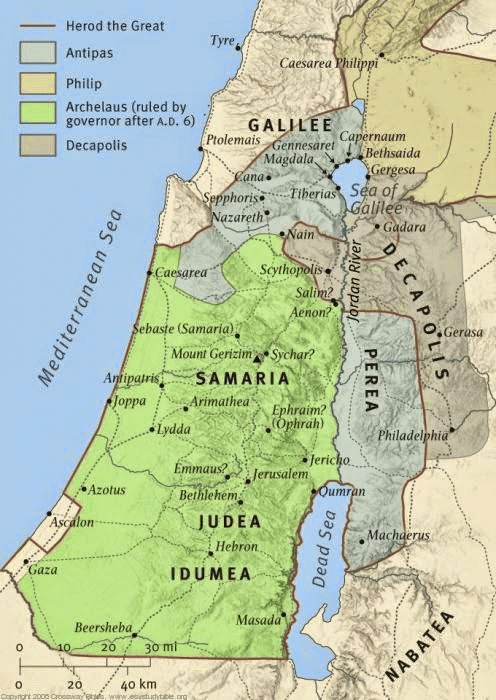
“[Herod’s] ignorance of Jesus prior to this time is probably due to his self-indulgent, luxurious life-style that had little contact with religious figures. His guilty conscience over John’s death caused him to think Jesus was John the Baptist risen from the dead. His fear of the resurrection indicates its widespread belief in those days” (Nelson KJV Bible Commentary pg. 1202). Most scholars believe Herod was a Sadducee, which means, if he respected the creed of his sect, he should not have believed in angels, demons, Heaven, Hell, or resurrection. Sadducees were commonly in positions of power, and their corruption was well-known and widespread. As a member of a superficial and legalistic sect, Herod could privately think and act in ways that were inconsistent with the tenets of his religious group, but the reason several gospel authors thought it so remarkable that he admitted out loud his premonition about John’s resurrection is that it spoke to his guilt over John’s unjust death. “At that time the views of Pythagoras respecting the transmigration of souls were generally current, and probably influenced the troubled mind of Herod. He had put to death an innocent and holy man; and it is a high testimony to the worth of the Baptist that, under the reproaches of a guilty conscience, Herod should have come to the conclusion that he had risen from the dead, thus probably giving the lie to his own opinions as a Sadducee; and terrified lest the Baptist should now avenge his own murder” (https://biblehub.com/mark/6-14.htm).
In this sermon Eric Groover Mark 6:14-16 Sermon
pastor Eric Groover gives some context to the story, and he raises another interesting suggestion. Not only is it petrifying to think about the ghost of the man you unjustly killed and what he means to do to you, but also, the very message for which he was executed is now preached again – repent, for the kingdom of God is near. Even if it isn’t John the Baptist, but another prophet, the message is still alive and unable to be stifled. It is the same message that fascinated and terrified Herod enough to imprison John in the first place, while causing him to have misgivings about putting John to death.
Before John was even born, when the angel told Zechariah that his wife would bear a son, he said John would go before the Messiah in the spirit and power of Elijah (Luke 1:17). Luke 9:8 says some people thought Jesus was Elijah, and some people thought He was one of the old prophets. At the time, the Hebrews were looking for the return of Elijah, but they were also anticipating the return of Isaiah and Jeremiah in advance of the Messiah. It seems the people got it confused; John was the one who was sent in the spirit of Elijah, and Jesus was the Messiah Himself. To affirm John’s reflection of Elijah, we can look from the story of Herod, Herodias, and John to the story of Ahab, Jezebel, and Elijah. “In both cases we have the weak ruler, the beautiful she-devil at his side, inspiring him for all evil, and the stern prophet, the rebuker and the incarnate conscience for them both” (https://biblehub.com/commentaries/mark/6-16.htm).
Find the next post here https://onthepath.online/2024/04/24/trying-to-make-jesus-king/
References
Matthew 14:1
Matthew 9:26 And the news about this spread throughout that region.
Matthew 9:31 But they went out and spread the news about Him throughout the land.
Mark 8:15 “Watch out!” He cautioned them. “Beware of the leaven of the Pharisees and of Herod.”
Luke 3:1 In the fifteenth year of the reign of Tiberius Caesar, while Pontius Pilate was governor of Judea, Herod tetrarch of Galilee, his brother Philip tetrarch of Ituraea and Trachonitis, and Lysanias tetrarch of Abilene,
Luke 3:19 But when he rebuked Herod the tetrarch regarding his brother’s wife Herodias and all the evils he had done,
Matthew 14:2
Matthew 3:1 In those days John the Baptist came, preaching in the wilderness of Judea
Matthew 16:14 They replied, “Some say John the Baptist; others say Elijah; and still others, Jeremiah or one of the prophets.”
Mark 6:14
Matthew 14:3 Now Herod had arrested John and bound him and put him in prison on account of Herodias, his brother Philip’s wife,
Matthew 14:6 On Herod’s birthday, however, the daughter of Herodias danced before them and pleased Herod
Mark 8:28 They replied, “Some say John the Baptist; others say Elijah; and still others, one of the prophets.”
Luke 9:19 They replied, “Some say John the Baptist; others say Elijah; and still others, that a prophet of old has arisen.”
Mark 6:15
Matthew 16:14 They replied, “Some say John the Baptist; others say Elijah; and still others, Jeremiah or one of the prophets.”
Matthew 21:11 The crowds replied, “This is Jesus, the prophet from Nazareth in Galilee.”
Mark 8:28 They replied, “Some say John the Baptist; others say Elijah; and still others, one of the prophets.”
Mark 6:16
Mark 6:17 For Herod himself had ordered that John be arrested and bound and imprisoned, on account of his brother Philip’s wife Herodias, whom Herod had married.
Luke 9:7
Matthew 11:2 Meanwhile John heard in prison about the works of Christ, and he sent his disciples
Mark 8:28 They replied, “Some say John the Baptist; others say Elijah; and still others, one of the prophets.”
Luke 3:1 In the fifteenth year of the reign of Tiberius Caesar, while Pontius Pilate was governor of Judea, Herod tetrarch of Galilee, his brother Philip tetrarch of Ituraea and Trachonitis, and Lysanias tetrarch of Abilene,
Luke 13:31 At that very hour, some Pharisees came to Jesus and told Him, “Leave this place and get away, because Herod wants to kill You.”
Luke 9:8
Matthew 16:14 They replied, “Some say John the Baptist; others say Elijah; and still others, Jeremiah or one of the prophets.”
Mark 8:28 They replied, “Some say John the Baptist; others say Elijah; and still others, one of the prophets.”
Luke 9:9
Luke 23:8 When Herod saw Jesus, he was greatly pleased. He had wanted to see Him for a long time, because he had heard about Him and was hoping to see Him perform a miracle.
Luke 23:15 Neither has Herod, for he sent Him back to us. As you can see, He has done nothing deserving of death.
Commentary
Luke 23:7-12 When he learned that Jesus was under Herod’s jurisdiction, he sent him to Herod, who was also in Jerusalem at that time. 8 When Herod saw Jesus, he was greatly pleased, because for a long time he had been wanting to see him. From what he had heard about him, he hoped to see him perform a sign of some sort. 9 He plied him with many questions, but Jesus gave him no answer. 10 The chief priests and the teachers of the law were standing there, vehemently accusing him. 11 Then Herod and his soldiers ridiculed and mocked him. Dressing him in an elegant robe, they sent him back to Pilate. 12 That day Herod and Pilate became friends—before this they had been enemies.
Luke 1:17 It is he who will go as a forerunner before Him in the spirit and power of Elijah, TO TURN THE HEARTS OF THE FATHERS BACK TO THE CHILDREN, and the disobedient to the attitude of the righteous, so as to make ready a people prepared for the Lord.
 On The Path
One thought on “Mistaken Identification of Jesus”