
The Family Returns to Nazareth, Matthew 2:19-23, Luke 2:39
Matthew 2:19 But when Herod died, behold, an angel of the Lord appeared in a dream1 to Joseph in Egypt, and said, 20 “Get up, take the Child and His mother, and go into the land of Israel; for those who sought the Child’s life are dead.” 21 So [a]Joseph got up, took the Child and His mother, and came into the land of Israel. 22 But when he heard that Archelaus was reigning over Judea in place of his father Herod, he was afraid to go there. Then after being warned by God in a dream1, he left for the regions of Galilee, 23 and came and lived in a city called Nazareth2. This was to fulfill what was spoken through the prophets: “He shall be called a Nazarene4.”
Luke 2:39 When they had performed everything according to the Law of the Lord, they returned to Galilee, to their own city of Nazareth2.
Footnotes
a. Matthew 2:21 Lit he
Commentary
Since I have been attempting to keep track of how many times angels or God himself have appeared personally, in dreams, or through the Holy Spirit to the figures in Jesus’ life, I will add to the tally here. In the passage from Matthew, we have the tenth and eleventh divine appearances, both to Joseph. Jesus’ life was preserved many times before His final appointment at Calvary, and it speaks to the credence of Jesus’ position and the reality of spiritual warfare that God was forced to intervene so many times.
When I do these studies, the first thing I do after I figure out which passage should be next in the chronology, is to look up all the references from other parts of the Bible and paste them at the bottom of my commentary. What immediately struck me about the passage in Matthew is that it seems to cite an Old Testament prophecy, but there is no Old Testament passage referenced in my Bible’s reference section. I found an article with a response to this, as well as another question I have had. The other question is from a much earlier post about Jesus being called Immanuel; I had wondered why scripture said He would be called Immanuel when His given name was Jesus. This article clarifies some of the syntax of ancient writers and gives insight into the phrase which we translate as “shall be called”. This phrase can also mean “is by nature”, just the same way Eve was called woman in Genesis. She was woman by nature and Eve by name. This applies to Jesus being called a Nazarene, as well. The allusion Matthew makes is not a direct quote from the Old Testament, but rather a concept that would have been familiar to his readers. The quotation marks were added later by translators because quotation marks were not part of the grammar of ancient writers. Nazareth was a place well-known for wickedness, as we mentioned when discussing the story of Mary and Joseph. The prophets did say that the Messiah would be despised and that He would be a “root out of dry ground” (Isaiah 53:2-3; cf. Psalm 22:6-7). Nazareth was so well-known as a despicable place that it is used here as a synonym for the concepts in prophecy. Although I have abbreviated the content, this author does a great job of explaining it, and I recommend taking a look (http://apologeticspress.org/apPubPage.aspx?pub=1&issue=938&article=1391).
To make my own analogy, let’s say there were a prophecy about a person who would be born in the future. The prophecy says that the person will be selfless, kind, and will care for others. When the prophecy is fulfilled, this person ends up being born in Samaria, so in the retelling of his life, the author says, “This is how he fulfilled the prophecy that he would be a Good Samaritan.” We are so familiar with the phrase “good Samaritan” after having studied Jesus’ parables, that this seems like a perfect, catchy way to summarize the fulfillment of that earlier prophecy. I hope I didn’t make that more confusing with my own feeble attempt to make the context more relevant, but it helped me while I was thinking it through.
So after I sort through all the scripture references, I often go next to the history. If they returned from Egypt immediately following the death of Herod the Great, the family’s stay in Egypt was not very long, based on the historical records of the end of Herod the Great’s reign and the beginning of Archelaus’ and Antipas’. Herod the Great died in 4 B.C., at which time he divided his kingdom into three territories, each ruled by one of three sons. As mentioned in a previous post, the calendar we now use is off by about 6 years, which means by our current calendar, Jesus was born around 6 B.C. If the angel appeared to Joseph shortly after Archelaus gained power, Jesus would still have been just two years old. In a previous post, I may have remarked on Jesus’ time spent in Egypt, not realizing at the time how short their stay actually was. Below is a chart of New Testament Political Rulers, which may be helpful as we see more “Herods” mentioned throughout the life of Jesus.
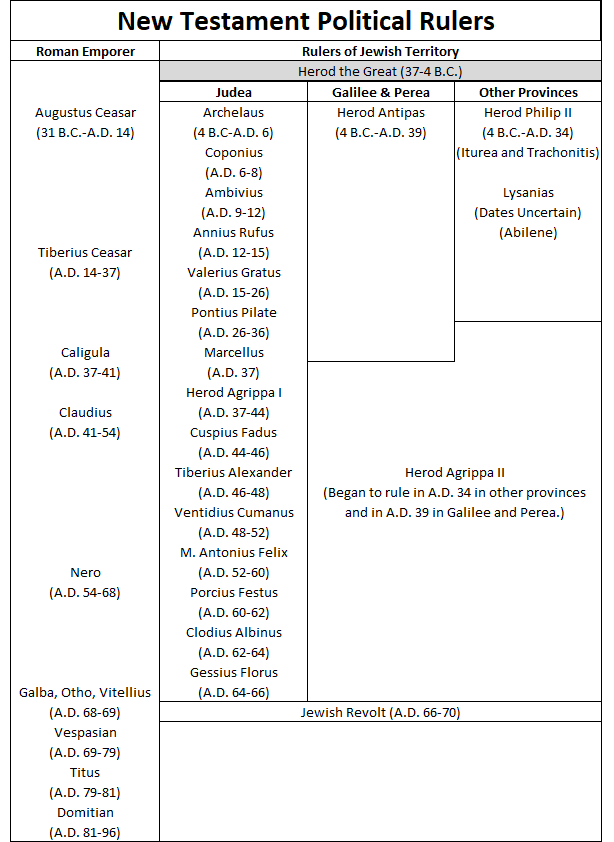
Finally, I directed my attention to the verse in Luke. Although the account in Luke is brief, it seems to represent an alternative history that excludes the entire exodus to Egypt. In Luke, verse 39 immediately follows the family’s visit to the temple to present Jesus as a baby, whereupon Luke says they returned to Nazareth after completing all the necessary offerings and rituals. But in reading some commentary about the apparent discrepancy, I realized it was folly to interpret Luke’s statement as “immediately” following the visit to the temple. “Perhaps the most perplexing differences between parallels occur when one gospel write as condensed the account of an event which took place in two or more stages into one concise paragraph which seems to describe the action taking place all at once. Yet this type of literary abridgement was quite common among ancient writers (cf. Lucian, How to Write History 56), and once again it is unfair to judge them by modern standards of precision which no one in antiquity required.” [BLOM:135] In addition to the practices of ancient historians, we also must take into account the purpose set forth by the respective writers. “Luke takes another opportunity to mention the fidelity of Jesus’ parents to the Jewish law as he continues the narrative (v. 39). He omits mention of the flight to Egypt. It is important to Matthew, providing another example of fulfilled prophecy (Matt 2:13-15); but this is not so significant at this point in Luke. What is significant is that Jesus’ parents were faithful to the Jewish law and that the child grew normally, the object of God’s grace (v. 40; cf. v. 52). [EBCNT]” (http://christianthinktank.com/infancyoff.html). In the end, both gospel stories put Jesus in Nazareth during His formative years.
See the next post here https://onthepath.online/2019/02/28/young-jesus-visits-the-teachers/
Scripture Reference
1Mt 1:20 But when he had considered this, behold, an angel of the Lord appeared to him in a dream, saying, “Joseph, son of David, do not be afraid to take Mary as your wife; for the Child who has been conceived in her is of the Holy Spirit.
1Mt 2:12 And having been warned by God in a dream not to return to Herod, the magi left for their own country by another way. 13 Now when they had gone, behold, an angel of the Lord appeared to Joseph in a dream and said, “Get up! Take the Child and His mother and flee to Egypt, and remain there until I tell you; for Herod is going to search for the Child to destroy Him.”
2Lk 1:26 Now in the sixth month the angel Gabriel was sent from God to a city in Galilee called Nazareth,
2Lk 2:51 And He went down with them and came to Nazareth, and He continued in subjection to them; and His mother treasured all these things in her heart.
2Lk 4:16 And He came to Nazareth, where He had been brought up; and as was His custom, He entered the synagogue on the Sabbath, and stood up to read.
2Jn 1:45 Philip found Nathanael and said to him, “We have found Him of whom Moses in the Law and also the Prophets wrote—Jesus of Nazareth, the son of Joseph.” 46 Nathanael said to him, “Can any good thing come out of Nazareth?” Philip said to him, “Come and see.”
4Mk 1:24 saying, “What business do we have with each other, Jesus of Nazareth? Have You come to destroy us? I know who You are—the Holy One of God!”
4Jn 18:5 They answered Him, “Jesus the Nazarene.” He said to them, “I am He.” And Judas also, who was betraying Him, was standing with them.
4Jn 18:7 Therefore He again asked them, “Whom do you seek?” And they said, “Jesus the Nazarene.”
4Jn 19:19 Pilate also wrote an inscription and put it on the cross. It was written, “JESUS THE NAZARENE, THE KING OF THE JEWS.”
Is 53:2 For He grew up before Him like a tender shoot, And like a root out of parched ground; He has no stately form or majesty That we should look upon Him, Nor appearance that we should be attracted to Him. 3 He was despised and forsaken of men, A man of sorrows and acquainted with grief; And like one from whom men hide their face He was despised, and we did not esteem Him.
Ps 22:6 But I am a worm and not a man, A reproach of men and despised by the people. 7 All who see me sneer at me; They separate with the lip, they wag the head, saying,
 On The Path
One thought on “The Family Returns to Nazareth”