
The Family Flees to Egypt, Matthew 2:13-15
Matt 2:13 Now when they had gone, behold, an angel of the Lord1 appeared to Joseph in a dream2 and said, “Get up! Take the Child and His mother and flee to Egypt, and remain there until I tell you; for Herod is going to search for the Child to destroy Him.”
14 So [a]Joseph got up and took the Child and His mother while it was still night, and left for Egypt. 15 He [b]remained there until the death of Herod. This was to fulfill what had been spoken by the Lord through the prophet: “Out of Egypt3 I called My Son4.”
Footnotes
a. Matthew 2:14 Lit he
b. Matthew 2:15 Lit was
Commentary
To segue from the last post, I ended the ‘Magi’ story with a comment about the 8th divine revelation or appearance that had happened surrounding the conception and birth of Jesus. In this passage, we see the 9th, another angelic appearance to Joseph, as well as the 6th direct quote from the Old Testament, not including all the paraphrased references outside the context of direct quotes. It’s no wonder that, throughout the life of Jesus, His family, and later the people who heard His teaching, were struck with utter awe and amazement. This was surely the one who had been foretold.
Whenever possible, I like to review the secular history related to the Bible events I’m studying, just to remind myself that these aren’t characters in a story, but historical figures. Whether you believe in God or any of the supernatural occurrences detailed in the Bible is one thing, but the widely accepted fact is that Jesus was a person who lived on this earth. The calculation of our current calendar is off by about 6 years, so the birth of Christ, per the current calendar, took place in about 5-6 B.C., and the death of Herod, which is recorded in detail by Josephus (a Jewish historian), took place in 4 B.C. The abbreviations A.D. and B.C. are solely to distinguish the relevance of time to the life of Jesus, so the fact there is a discrepancy does not detract from the legitimacy of the Bible’s history. If an error occurred when this designation was first assigned, and the entire world is operating by this erroneous calendar, we’re not going to go back and change today’s date. We just continue to learn, validate our findings, and move on.
Another study tool I find particularly helpful is to go back and study the context of the verses referenced in superscript in my Bible. I try to paste all of them at the bottom of each of my posts, to keep everything convenient and simple for you, but, beyond the verse or two I paste, there is often context that is helpful. For instance, Matthew uses a direct quote from Hosea in the above passage, but the New American Standard Bible also references a passage in Numbers. To start with the Hosea reference, Matthew cites the second half of the verse, but the first half tells us that the term ‘son’ was referring to the nation of Israel, alluding to the way God used Moses to free the Israelites from Egyptian captivity. The passage in Numbers is specifically about a king God would raise up from the seed of Jacob, and it is part of a prophecy that was given to Balaam to defy the king of Moab. In verse 24:17, it even says, “I see him, but not now; I behold him, but not near; A star shall come forth from Jacob, A scepter shall rise from Israel…” As I’m reviewing messianic prophecy from the Old Testament, I’m also noticing a phenomenon of angelic appearances to the prophets, of whom Balaam was no exception, despite the fact that he was not originally a prophet of God, but became one through divine intervention. Between the two passages in Hosea and Numbers, we see a picture of Jesus emerge as the eternal champion and representative of Israel, as a metaphor for the entire nation. He will not only be king, but he also lived as a Jew, felt pain as a human, and redeemed God’s people from a different kind of slavery: slavery to sin.
In addition to looking at secular history and Bible context, I also wanted to look at the logistics of the trip itself. How long was the trip to Egypt, and how much did it cost? We don’t know where they stayed in Egypt, but historians believe that some one million Jews lived in Alexandria, during the time Jesus and his family were political refugees (The Word in Life Study Bible, pg. 1620). “Coptic (Egyptian) Christians have identified about 25 places they believe that Mary, Joseph and Jesus stayed during their sojourn in Egypt” (https://www.thebiblejourney.org/biblejourney1/3-jesuss-childhood-journeys-b/the-holy-family-flee-to-egypt/). At the very least, to get from Bethlehem to Egyptian-controlled territory was a minimum journey of 40 miles (65 km) (http://www.biblestudy.org/maps/the-journeys-of-mary-and-joseph.html). With the understanding that they were in a hurry, I’ll assume they moved 2 miles per hour and, excluding rest times, were moving 10 hours per day. That would have made the exodus a 2-day journey. However, based on the terrain and the fact that, per Jewish tradition, Mary would not have weaned Jesus until approximately 3 years old, they may have made much more frequent stops and had a much slower pace than I’m approximating. As far as the cost, I wasn’t able to find much about it, except the note that I previously posted, which is that many historians and theologians believe that Jesus’ family would have used some of the gifts of the Magi to pay for the voyage, as well as setting up a home in Egypt.
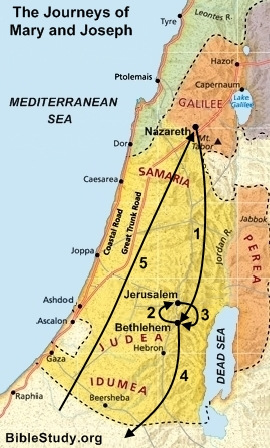
As I continue to study these maps and think about Jesus as an Asian-born refugee, fleeing to Africa, I’m reminded of my skewed sense of color, based on the overwhelmingly white depiction of Bible figures in art and other media. In addition to the dark-complected Jewish people, a number of Africans play significant roles throughout the Bible. Hagar (Gen. 16:1), the pharaohs, The “mixed multitude” of the Exodus (Ex 12:37-38, Num 11:4), Moses’ Ethiopian wife (Num 12:1-2), The Cushite messenger (2 Sam 18:20-33), Labim, Sukkiim, and Ethiopian mercenaries (2 Chr 12:3), The Shulamite (Song 1:5-6; 6:13), Ebed-Melech the Ethiopian (Jer 38:7-16; 39:16-18), Simon of Cyrene (Mark 15:21), The treasurer of Ethiopia (Acts 8:27-39), Simeon/Niger (Acts 13:1), Lucius of Cyrene (Acts 13:1), and Apollos (Acts 18:24-28) (Word in Life Study Bible pg. 1329). I pasted all these passages below, and I encourage you to read them. In particular, it was a striking picture to recall that the man who carried Jesus’ cross was African.
Related to Jesus’ purpose of redeeming the Gentiles (of which I am one), as well as the Jews, the Septuagint was written and used in Egypt, and when Jesus’ family attended the synagogue there, they would likely have heard scripture recited in Greek. The Septuagint is held to have been written in the 2nd century B.C. in Alexandria, and was the first commissioned, collaborative translation of Bible text into another language. Due to the fact the Jews who were living in Egypt had adopted the Greek language, their mother tongue was becoming less familiar to them, and they needed a version of Jewish scripture written in their adopted vernacular (https://www.thebiblejourney.org/biblejourney1/3-jesuss-childhood-journeys-b/the-holy-family-flee-to-egypt/). Handily, this would also have made scripture more accessible to Gentiles, as well as likely being the context of Jesus’ first human exposure to “the law and the prophets”.
That was a lot to look at for just two verses, but for me, the story really comes to life when I can get a clearer picture of the times, places, people, and cultures. It makes me want to go visit – maybe someday I will!
See the next post here https://onthepath.online/2019/02/13/herod-slaughters-babies/
Scriptural References
1Ac 5:19 But during the night an angel of the Lord opened the gates of the prison, and taking them out he said,
1Ac 10:7 When the angel who was speaking to him had left, he summoned two of his servants and a devout soldier of those who were his personal attendants,
1Ac 12:7 And behold, an angel of the Lord suddenly appeared and a light shone in the cell; and he struck Peter’s side and woke him up, saying, “Get up quickly.” And his chains fell off his hands. 8 And the angel said to him, “Gird yourself and put on your sandals.” And he did so. And he said to him, “Wrap your cloak around you and follow me.” 9 And he went out and continued to follow, and he did not know that what was being done by the angel was real, but thought he was seeing a vision. 10 When they had passed the first and second guard, they came to the iron gate that leads into the city, which opened for them by itself; and they went out and went along one street, and immediately the angel departed from him. 11 When Peter came to himself, he said, “Now I know for sure that the Lord has sent forth His angel and rescued me from the hand of Herod and from all that the Jewish people were expecting.”
2Mt 2:12 And having been warned by God in a dream not to return to Herod, the magi left for their own country by another way.
2Mt 2:19 But when Herod died, behold, an angel of the Lord appeared in a dream to Joseph in Egypt, and said,
3Hos 11:1 When Israel was a youth I loved him, And out of Egypt I called My son.
3Nu 24:8 “God brings him out of Egypt, He is for him like the horns of the wild ox. He will devour the nations who are his adversaries, And will crush their bones in pieces, And shatter them with his arrows.
4Ex 4:22 Then you shall say to Pharaoh, ‘Thus says the Lord, “Israel is My son, My firstborn. 23 So I said to you, ‘Let My son go that he may serve Me’; but you have refused to let him go. Behold, I will kill your son, your firstborn.”’”
Gen 16:1 Now Sarai, Abram’s wife had borne him no children, and she had an Egyptian maid whose name was Hagar.
Ex 12:37 Now the sons of Israel journeyed from Rameses to Succoth, about six hundred thousand men on foot, aside from children. 38 A mixed multitude also went up with them, along with flocks and herds, a very large number of livestock.
Num 11:4 The rabble who were among them had greedy desires; and also the sons of Israel wept again and said, “Who will give us meat to eat?
Num 12:1 Then Miriam and Aaron spoke against Moses because of the Cushite woman whom he had married (for he had married a Cushite woman); 2 and they said, “Has the Lord indeed spoken only through Moses? Has He not spoken through us as well?” And the Lord heard it.
2 Sam 18:20 But Joab said to him, “You are not the man to carry news this day, but you shall carry news another day; however, you shall carry no news today because the king’s son is dead.” 21 Then Joab said to the Cushite, “Go, tell the king what you have seen.” So the Cushite bowed to Joab and ran. 22 Now Ahimaaz the son of Zadok said once more to Joab, “But whatever happens, please let me also run after the Cushite.” And Joab said, “Why would you run, my son, since you will have no reward for going?” 23 “But whatever happens,” he said, “I will run.” So he said to him, “Run.” Then Ahimaaz ran by way of the plain and passed up the Cushite. 24 Now David was sitting between the two gates; and the watchman went up to the roof of the gate by the wall, and raised his eyes and looked, and behold, a man running by himself. 25 The watchman called and told the king. And the king said, “If he is by himself there is good news in his mouth.” And he came nearer and nearer. 26 Then the watchman saw another man running; and the watchman called to the gatekeeper and said, “Behold, another man running by himself.” And the king said, “This one also is bringing good news.” 27 The watchman said, “I think the running of the first one is like the running of Ahimaaz the son of Zadok.” And the king said, “This is a good man and comes with good news.” 28 Ahimaaz called and said to the king, “All is well.” And he prostrated himself before the king with his face to the ground. And he said, “Blessed is the Lord your God, who has delivered up the men who lifted their hands against my lord the king.” 29 The king said, “Is it well with the young man Absalom?” And Ahimaaz answered, “When Joab sent the king’s servant, and your servant, I saw a great tumult, but I did not know what it was.” 30 Then the king said, “Turn aside and stand here.” So he turned aside and stood still. 31 Behold, the Cushite arrived, and the Cushite said, “Let my lord the king receive good news, for the Lord has freed you this day from the hand of all those who rose up against you.” 32 Then the king said to the Cushite, “Is it well with the young man Absalom?” And the Cushite answered, “Let the enemies of my lord the king, and all who rise up against you for evil, be as that young man!” 33 The king was deeply moved and went up to the chamber over the gate and wept. And thus he said as he walked, “O my son Absalom, my son, my son Absalom! Would I had died instead of you, O Absalom, my son, my son!”
2 Chr 12:3 with 1,200 chariots and 60,000 horsemen. And the people who came with him from Egypt were without number: the Lubim, the Sukkiim and the Ethiopians.
Song 1:5 I am black but lovely, O daughters of Jerusalem, Like the tents of Kedar, Like the curtains of Solomon. 6 “Do not stare at me because I am swarthy, For the sun has burned me. My mother’s sons were angry with me; They made me caretaker of the vineyards, But I have not taken care of my own vineyard.
Song 6:13 Come back, come back, O Shulammite; Come back, come back, that we may gaze at you!” “Why should you gaze at the Shulammite, As at the dance of the two companies?
Jer 38:7 But Ebed-melech the Ethiopian, a eunuch, while he was in the king’s palace, heard that they had put Jeremiah into the cistern. Now the king was sitting in the Gate of Benjamin; 8 and Ebed-melech went out from the king’s palace and spoke to the king, saying, 9 “My lord the king, these men have acted wickedly in all that they have done to Jeremiah the prophet whom they have cast into the cistern; and he will die right where he is because of the famine, for there is no more bread in the city.” 10 Then the king commanded Ebed-melech the Ethiopian, saying, “Take thirty men from here under your authority and bring up Jeremiah the prophet from the cistern before he dies.” 11 So Ebed-melech took the men under his authority and went into the king’s palace to a place beneath the storeroom and took from there worn-out clothes and worn-out rags and let them down by ropes into the cistern to Jeremiah. 12 Then Ebed-melech the Ethiopian said to Jeremiah, “Now put these worn-out clothes and rags under your armpits under the ropes”; and Jeremiah did so. 13 So they pulled Jeremiah up with the ropes and lifted him out of the cistern, and Jeremiah stayed in the court of the guardhouse. 14 Then King Zedekiah sent and had Jeremiah the prophet brought to him at the third entrance that is in the house of the Lord; and the king said to Jeremiah, “I am going to ask you something; do not hide anything from me.” 15 Then Jeremiah said to Zedekiah, “If I tell you, will you not certainly put me to death? Besides, if I give you advice, you will not listen to me.” 16 But King Zedekiah swore to Jeremiah in secret saying, “As the Lord lives, who made this life for us, surely I will not put you to death nor will I give you over to the hand of these men who are seeking your life.”
Jer 39:16-18 “Go and speak to Ebed-melech the Ethiopian, saying, ‘Thus says the Lord of hosts, the God of Israel, “Behold, I am about to bring My words on this city for disaster and not for prosperity; and they will take place before you on that day. 17 But I will deliver you on that day,” declares the Lord, “and you will not be given into the hand of the men whom you dread. 18 For I will certainly rescue you, and you will not fall by the sword; but you will have your own life as booty, because you have trusted in Me,” declares the Lord.’”
Mark 15:21 They pressed into service a passer-by coming from the country, Simon of Cyrene (the father of Alexander and Rufus), to bear His cross.
Acts 8:27-39 So he got up and went; and there was an Ethiopian eunuch, a court official of Candace, queen of the Ethiopians, who was in charge of all her treasure; and he had come to Jerusalem to worship, 28 and he was returning and sitting in his chariot, and was reading the prophet Isaiah. 29 Then the Spirit said to Philip, “Go up and join this chariot.” 30 Philip ran up and heard him reading Isaiah the prophet, and said, “Do you understand what you are reading?” 31 And he said, “Well, how could I, unless someone guides me?” And he invited Philip to come up and sit with him. 32 Now the passage of Scripture which he was reading was this: “He was led as a sheep to slaughter; And as a lamb before its shearer is silent, So He does not open His mouth. 33 “In humiliation His judgment was taken away; Who will relate His generation? For His life is removed from the earth.” 34 The eunuch answered Philip and said, “Please tell me, of whom does the prophet say this? Of himself or of someone else?” 35 Then Philip opened his mouth, and beginning from this Scripture he preached Jesus to him. 36 As they went along the road they came to some water; and the eunuch said, “Look! Water! What prevents me from being baptized?” 37 [And Philip said, “If you believe with all your heart, you may.” And he answered and said, “I believe that Jesus Christ is the Son of God.”] 38 And he ordered the chariot to stop; and they both went down into the water, Philip as well as the eunuch, and he baptized him. 39 When they came up out of the water, the Spirit of the Lord snatched Philip away; and the eunuch no longer saw him, but went on his way rejoicing.
Acts 13:1 Now there were at Antioch, in the church that was there, prophets and teachers: Barnabas, and Simeon who was called Niger, and Lucius of Cyrene, and Manaen who had been brought up with Herod the tetrarch, and Saul.
Acts 18:24-28 Now a Jew named Apollos, an Alexandrian by birth, an eloquent man, came to Ephesus; and he was mighty in the Scriptures. 25 This man had been instructed in the way of the Lord; and being fervent in spirit, he was speaking and teaching accurately the things concerning Jesus, being acquainted only with the baptism of John; 26 and he began to speak out boldly in the synagogue. But when Priscilla and Aquila heard him, they took him aside and explained to him the way of God more accurately. 27 And when he wanted to go across to Achaia, the brethren encouraged him and wrote to the disciples to welcome him; and when he had arrived, he greatly helped those who had believed through grace, 28 for he powerfully refuted the Jews in public, demonstrating by the Scriptures that Jesus was the Christ.
 On The Path
3 thoughts on “The Family Flees to Egypt”